 United States Time Spans Contemporary Music Festival – Various: DiMenna Center for Classical Music, New York, 8 & 10.8.2026. (DS)
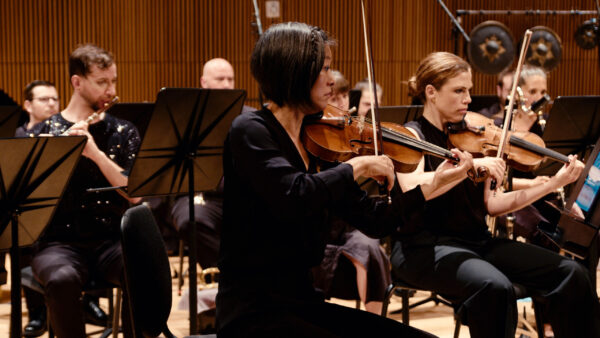
8.8.2026: Talea Ensemble / James Baker (conductor)
Rihm – Jagden und Formen (2008)
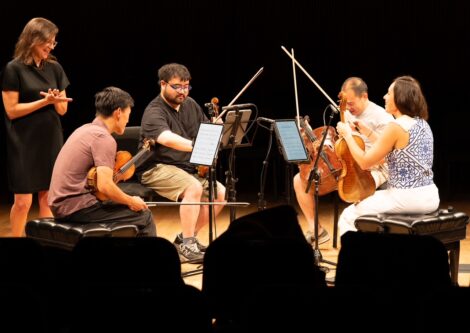
10.8: Parker Quartet
Kurtág – ‘Officium breve’; ‘Aus der Ferne III’; ‘12 Microludes’; ‘Aus der Ferne V’; ‘Six moments musicaux’
Farrin – SEA-DRIFT (world premiere)
This Time Spans Festival this year began with a single clap. The Talea Ensemble produced a sharp whack to open Wolfgang Rihm’s Jagden und Formen – a work of formidable complexity filled with layers of memory, much in line with the texturized paintings of Anselm Kiefer whose work Rihm admired. Like a jolt bringing one out of a dream, the clap separated the space of reality and ushered in the realm of musical language.
In many ways, this is the purpose of the festival: to give listeners two weeks to enter a space dedicated to the expression of humanity via superbly crafted works by living and recently deceased composers. Rihm passed away in July 2024 just before he would have begun his composer-in-residence role at the Berlin Philharmonic. The loss to composition was great.
Rihm has said ‘Music is always profoundly human; there can be no music without people’. For me, this statement includes the people who bring the music to audiences. The opportunity to hear a work like Rihm’s live is visceral, multi-dimensional and elevating. Executive and Artistic Director Thomas Fichter of The Earle Brown Music Foundation Charitable Trust (which presents Time Spans) skillfully curates prominent composers from both sides of the Atlantic into a dialogue that manages to outdo itself each year. It is unmatched and strangely under the radar in the international contemporary music festival scene – except for the dedicated listeners who make sold-out performances.
Rihm’s work runs about an hour (most Time Spans concerts clock in at 60-75 minutes). Fichter’s curatorial decision is purposeful: premieres or seminal works should not be heavily bookended to avoid cluttering the ear which needs time to process and understand. Jagden und Formen (‘Hunts and Forms’) stood alone on the program. Written in several iterations in the first decade of the 21st century, it is often considered outdated in its modernist atonal vernacular, but I found it timeless in its most foundational purpose – to musically present the unfolding of process in the search of a goal. In the way Moby Dick is not just about a whale, this is not about atonality but rather how each musical moment builds from one moment to the next. Listeners discover along with the composer: a feat that solidifies the artistic importance of the work.
Talea Ensemble played with enviable accuracy despite the demands. They brought out the arc of development, moving it seamlessly from atonal fractures to romantic sweeps. Rihm does not write solos so much as pull up appearances of one or two instruments. Violist Hannah Levinson, in particular, met Rihm’s demands with command and the dialogues between her and Michelle Farah on English horn were dispatched with elegant gravitas. The structure was tightly built by Talea’s conductor, James Baker: a master facilitator who establishes continuity with an unassuming grace and allows the players to flex the strength of their collective expertise.
In an ideal world one would be fortunate enough to attend every night of the festival, and I aspire to that. This year, I caught the third performance with the Parker Quartet who premiered a new work, SEA-DRIFT by Suzanne Farrin. Time Spans, which began in 2000, has also played a crucial role in commissioning works. Farrin briefly addressed the audience and spoke about the great influence György Kurtág had on her compositions and the evening doubled as an homage to his 100th birthday. Farrin spoke to his ‘expressiveness of detail’, explaining that he helped her understand ‘subtle change can relay dramatic psychological shifts’. Even without an exclamatory clap!
Before the Farrin, the Parker Quartet played a set of works by Kurtág that ran together in an otherworldly experience (the group stood to bow at the end). The stage’s set-up with the audience surrounding the quartet on all four sides beckoned viewers to feel immersed in the music. At any given moment, one could look across to see an audience member (perhaps with eyes closed) sporting a blissful smile while another might lean forward, eyes wide in fear of missing anything with a blink. Because Kurtág separates sound pixels in these miniaturist works, they summon an attention that leaves even tiny details magnified. The Parker Quartet played with both sensitivity and fearlessness, exceptionally suited to this aesthetic. A light moment landed like a feather in a silent room, and a fleeting, raucous melody became euphoric only to quickly shift to a saintly introspective murmur. As Farrin so pointedly had described, subtlety can be dramatic.
Another reason an ideal listening environment is so important: new realizations emerge. I began to perceive Kurtág’s shaping of spatial elements. Rather than diminuendo and crescendo being just dynamics, they were expressions of distance – objects moving close up or far off. The players’ skill molded the sparseness of Kurtág’s works into a stunning landscape of sonic placements, like a garden through which one wanders.
Farrin’s SEA-DRIFT is an ecosystem of microscopic instrumental diversions around a structured center. Kurtág’s influence was evident. She drew on the use of tiny sounds and included spatially aware sonic decisions while producing complex material suited to stretching the possibilities of string playing without falling into a trap of the avant-garde extreme. SEA-DRIFT, Farrin told us, is influenced by the ‘experience of nature’. Maybe that is what gave it such universal appeal. Nature is here for all of us even if we come away with our own unique experiences.
One movement in particular was awesome. It was reminiscent of the ‘Flight of the Bumblebee’, but in Farrin’s work the buzzing ostinato was not a cartoonish humanization, like in Rimsky-Korsakov’s piece. Instead, each string part (often played in slightly different patterns) blended together in a dense fabric of buzzing sounds, sometimes to the point of deliberate annoyance, like a swarm of gnats in one’s path on a humid day. At other moments, the buzz shifted into a beauteous swoon over which a player would seemingly move into another sonic room, leaving the buzz to play lyrical material in the distance.
SEA-DRIFT is a thoughtful work of singular depth. As it came to an end, it relied on the precise but loving touch of the Parker musicians to fulfill its demands: a stark but yearning cello trill, passages closing in on breathy brevity, silent moments growing ever longer. Eventually, the music disintegrated into the distance. The ecosystem disappeared, perhaps still heard elsewhere but lost to us. Farrin gives us that extraordinary question to end upon, or to remind us that nature, too, can disappear.
Time Spans Festival will have performed two world premieres by the end of the event, along with several US and NY premieres. The Talea Ensemble returns on 22 August (the closing night) with two US premieres from the Triptych cycle by Rebecca Saunders: Scar (Triptych II) and Skull (Triptych III). If it is not sold out, rush to get a ticket. The clapping will surely fill the space.
Daniele Sahr
Featured Image: Members of the Talea Ensemble perform at The DiMenna Center © H. Paul Moon