
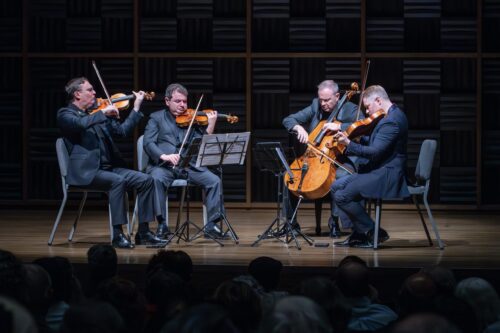
 United States Shostakovich Cycle [2]: Jerusalem Quartet (Alexander Pavlovsky, Sergei Bresler [violins], Ori Kam [viola], Kyril Zlotnikov [cello]). Gartner Auditorium, Cleveland Museum of Art, Cleveland, 30.4.2025. (MSJ)
Shostakovich – String Quartets No.13 in B-flat minor, Op.138; No.14 in F-sharp major, Op.142; No.15 in E-flat minor, Op.142
The Cleveland Chamber Music Society sure knows how to throw a party. To celebrate the organization’s seventy-fifth season, they arranged a visit by the Jerusalem Quartet that featured a performance of the entire cycle of Dmitri Shostakovich’s fifteen string quartets. While these intense works aren’t party pieces, the artistically significant occasion was marked with a festive series of events that included film showings and masterclasses, a strikingly designed, 45-page program booklet, insightful preconcert talks and even – in this final concert of the series – goodie bags for attendees with a promotion for CCMS’s 2025/26 season and miniature bars of dark chocolate.
As intense as the Shostakovich quartets are generally, the final three are particularly so: the composer began to come face-to-face with his own mortality as his health started failing late in life. Listening to Nos.13, 14 and 15 in one concert was an intimidating prospect but, as it turned out, it was a spectacular opportunity to hear the works in the context of the long arc of the composer’s life, reflected in these intimate pieces. One could not ask for better guides than the Jerusalem Quartet. Celebrating their thirtieth season, the ensemble operates with unity, power and precision, but also with a personal warmth that goes far beyond mere technical considerations.
Shostakovich’s Quartet No.13 is a single-movement work in an arc structure. Preconcert speaker James Wilding pointed out that the quartet seems to take its starting point from the music Shostakovich wrote for a film version of Shakespeare’s King Lear, with the needling staccato section which follows being likened to Lear’s goading sidekick, Iago. I would add that the staccato figuration seems to echo the bitter ‘khokhochu’ laughter in the ‘Madame, Postmotrite’ movement in Shostakovich’s Symphony No.14, which he finished around the same time as this quartet. Wilding further nailed the uncanny, shadowy world of the quartet by describing the central, faster episode as ‘skeletons at a nightclub’, which captures the essence of Shostakovich’s smoky, spectral jazz. The players grasped all of this with an intensity that made it unfold in one breath, from grim chorales to tapping and knocking on their instruments, to the creepy taste of distorted pop music in the jazz section and back again.
In the context of these three quartets, the Fourteenth is comparatively lighter, beginning with an almost Haydnesque ease, though the fact that it builds to considerable intensity could be seen visually in the players having to pull and discard broken bow hairs along the way. These moments of vigor were contrasted with what Shostakovich called his ‘Italian bit’, a lyrical passage in the slow movement where a melody is taken up in sweet sixths by the cello and violin though with a typical twist: the cello is so high in its range and the first violin so low that the cello actually takes the high note and the violin the low. The Jerusalem Quartet players showed that they are just as adept at sweet lyricism as at the darker heft of these works.
The Fifteenth Quartet – six movements, all of them slow – unfolded here in a single, mesmerizing breath. The thirty-five minutes of its run seemed to pass quickly yet in another way, on another level, it felt timeless, eternal, particularly as presented here with dimmed lights in the hall and on the stage. Everything in Gartner Auditorium became so shadowy and insubstantial that the music felt like the only real thing in the room. The Jerusalem Quartet found a kaleidoscope of muted colors in Shostakovich’s writing, including pushing their instruments to the brink in the terrifying crescendos that open the second movement. After the grim strength of the fifth-movement funeral march, the finale catapulted into visionary territory, the life-flashing-before-one’s-eyes review of the earlier movements interspersed with hallucinogenic thirty-second note interludes. The passages sounded like a sonic picture of the final breakdown of electrical activity in the brain before death. This was harrowing, demanding music, but the performance brought it home and made it personal. It was met, after several long seconds of silence, by a shouting, cheering and, for many of us, weeping standing ovation.
This series, and CCMS’s seventy-fifth anniversary in general, were important artistic milestones in Cleveland, a city that has had a long-running relationship with Shostakovich, ever since Cleveland Orchestra music director Artur Rodziński championed his works here in the 1930s. May this relationship, and CCMS’s other ventures, continue long into the future.
Mark Sebastian Jordan
Featured Image: The Jerusalem Quartet played Shostakovich’s String Quartet No.15 under dim light to close the cycle © Ronald Werman/CCMS