
 United Kingdom Various: Sean Shibe (guitar). Turner Sims Concert Hall, Southampton, 3.5.2025. (CK)
Anon – Scottish Lute Manuscripts
Adès – Forgotten Dances
Frank Martin – Quatre pièces brèves
Bach – Cello Suite No.1 in G, BWV 1007
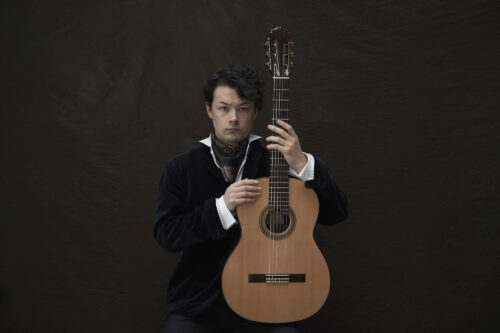
The young guitarist Sean Shibe – Scottish, of partially Japanese ancestry – was apparently invited to the Turner Sims a few years ago: then an emerging talent, he returned now as a player with an international reputation, equally active at the cutting edge of contemporary music and in devising fresh, and often collaborative, ways of presenting the music of the past.
I should begin with a slightly awkward disclaimer: this review will be less detailed and less specific than usual. At the mid-point of each half of the programme Shibe talked to us about the music he was playing; he was a relaxed and courteous communicator, but a soft-spoken one, and (since I currently have only one functioning ear) I missed a good deal of what he said. His manner – gently amusing, never dry – suggested to me that he was speaking as he would to a hall full of music students rather than a concert audience.
One ear or two, this was the quietest concert I have ever experienced. Shibe is an extraordinary musician. His playing is so fine, so exquisite that there is something inscrutable about it: as if his music-making is a personal matter, even a private one, which we are permitted to overhear. We could sense him, at the beginning of each piece, withdrawing from us into a consciousness in which only he, the guitar and the music existed, and in which these three were indivisible. As an intensely focused silence settled on the hall, I found myself thinking of Yeats’s great poem Lapis Lazuli, where Yeats brings the ancient carved figures of Chinese musicians to life in a creative act of his own: Accomplished fingers begin to play…
Accomplished fingers began to play and – had I been unable to see as well as hear perfectly – I would have sworn that Shibe was playing a lute. There were half-a-dozen pieces, two of them with a distinctive tang of Scottish folk music: it transpired that they were transcribed (no doubt by Shibe himself) from Scottish lute manuscripts, from a time when – I think I heard him say – the border between classical and folk music was more porous than it is today. Such was the purity of Shibe’s playing that it was as if we were hearing – unmediated – music from a distant time and place, as if his playing sidestepped interpretation and took us back to the initial act of creation. (Pretentious, moi? Just trying to give a flavour of the quality of the experience.)
Shibe ended the first half with a performance of Thomas Adès’s Forgotten Dances – a neat contextual segue from the long-forgotten lute music, though light years away from it in style and content (or perhaps not: there may have been some of his beloved Couperin in there). Commissioned for Shibe, it is apparently Adès’s first foray into writing music for a solo instrument other than the piano: it would take a few further hearings to do it any kind of justice, though to me its six ‘dances’ seemed to hint at a world of violence and nightmare just around the corner.
After the interval, more ‘forgotten’ music: an attractive suite for guitar – Quatre pièces brèves – written by the Swiss composer Frank Martin for Andrés Segovia. Segovia never played it, and it languished in obscurity until Julian Bream took it up. Best known for his Petite Symphonie Concertante, Martin is well worth exploring, there is a bracing Harpsichord Concerto and a fine, late Requiem (both of them preserved on CD by the Swiss label Jecklin). Finally, an arrangement for guitar of Bach’s First Cello Suite: fascinating – and beautiful – to hear its notes plucked rather than bowed, though ‘plucked’ is too violent and unsubtle a word for the quiet resonances Shibe coaxed from his instrument. In the Allemande it was as if he was releasing the notes to dance in air, like butterflies.
It was good to remember that the last time I heard this piece (played on the cello by Rainer Crosett) was alfresco, at sunrise by the river Test, in the opening concert of last year’s Romsey Chamber Music Festival: this year’s Festival begins in Romsey Abbey on the last day of May.
The Bach was not quite the final performance: either side of it Shibe slipped in arrangements of short piano pieces by Harrison Birtwistle, showing the famously dour, granitic Lancastrian in an unusually intimate and domestic light. Oockooing Bird was written when he was a teenager; the other – my internet research suggests that it was Berceuse de Jeanne – was a lullaby, a cradle song, played – so my sharper-eared companions informed me – at the tempo of the infant’s breathing. It was novel to hear Birtwistle’s music described as ‘touching’: but so it was.
My companions were mildly disappointed that Shibe left his electric guitar behind for this recital: clearly there is much more to his music-making than met the ear (singular, in my case) on this occasion.
Chris Kettle