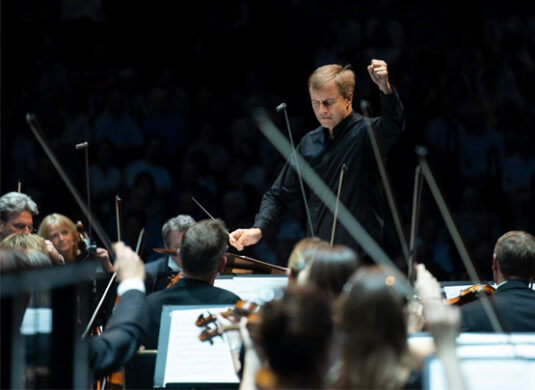
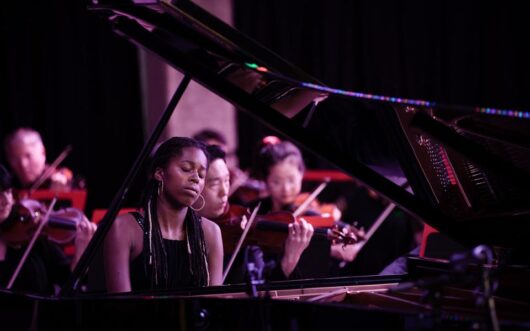
 United Kingdom Howell, Price, Tchaikovsky: Jeneba Kanneh-Mason (piano), Royal Philharmonic Orchestra / Vasily Petrenko (conductor). Royal Festival Hall, London, 25.6.2025. (CK)
Dorothy Howell – Lamia
Florence Price – Piano Concerto in One Movement
Tchaikovsky – Symphony No.4 in F minor
This concert at the Royal Festival Hall, given by the Royal Philharmonic Orchestra under their Chief Conductor and Music Director Vasily Petrenko, culminated in as thrilling a performance of Tchaikovsky’s Fourth Symphony as you could hope to hear: a fitting end to their London season. The RPO, individually and collectively, played (as they so often do) as if they were extensions of Petrenko’s arm.
The epic first movement was remarkable not only for the oceanic surge of the main material – played with fire and tremendous precision – but, equally, for the sense of wide and desolate spaces conjured in its quieter stretches by the woodwind principals and by the violins, fining down their tone until they sounded almost wraithlike.
In the second movement the lonely oboe tune was warmed into life by the cellos and later the violas; the major-key counter-theme mounted to a shining climax before subsiding to the return of the oboe tune on violins, the solo woodwinds bubbling up and down behind it like tropical fish. It is a movement full of subtle shifts of mood, none of them conclusive: it runs out of steam, mid-phrase, on the bassoon. As Tchaikovsky wrote, ‘One mourns the past and has neither the courage nor the will to begin a new life’.
New life nevertheless appears, most unexpectedly, in the busy insect-activity of the pizzicato Scherzo, sounding slightly surreal in’ needle-sharp precision of the RPO strings, and unmistakably comedic: an interlude, or has the symphony taken a new and surprising turn? At the centre of this brief movement it is the turn of the woodwinds to party (gate-crashed by a splendidly shrill and assertive piccolo); then a tight little sotto voce march for the brass before the pizzicatos return. It is a charming movement, beguilingly played, and it somehow prepares us for the whirlwind arrival of the Finale: Allegro con fuoco: which was dispatched with terrific brio by a seething platform-width of strings, with winds, brass and percussion on crackling form, all the way back to the famously hyperactive cymbals. Whoops, cheers and a standing ovation.
Such was the excitement of this performance that it blew away any lingering memory of the music that had preceded it. Yet the first half of the concert was a heartening, if qualified, success. Why heartening? Now that the doctrinaire High Priests of Darmstadt and Donaueschingen (and the Glock era at the BBC Proms) are fading into history, it is good that orchestras are finding room in their concert programmes for music that was ignored back then, including music by women composers – who have been ignored, period.
That said, Dorothy Howell’s Lamia is a piece that has had its day: Sir Henry Wood, no less, championed it between the Wars, but it has nothing interesting or memorable to say to us today. It aims at a post-Romantic lushness somewhere between Debussy and the Respighi of Fontane di Roma, but nothing really sticks, apart from a drooping three-note phrase: not enough.
Florence Price’s Piano Concerto in One Movement is a different matter. Price was doubly disadvantaged (‘I am a woman’, she wrote to Koussevitsky, ‘and I have some Negro blood in my veins’): but thanks to the marvellous Chineke! the last couple of years have brought me opportunities to hear her Third and Fourth Symphonies. I was looking forward to hearing the concerto.
In contrast to the full orchestral dress that Howell uses in Lamia, Price’s means are modest: single woodwind with a second clarinet; horns, trumpets and trombones in pairs. The music’s attractiveness stems in part from her Deep South heritage (she settled in Chicago, but she was from Little Rock) and in part from the works of her favourite European composer, Dvořák, with its healthy outdoor air so often tinged with nostalgia.
Pianist Jeneba Kanneh-Mason’s lively personality put us in the mood before she had played a note. The opening trumpet motif is pure Dvořák, and the piano cadenza that follows – Price reversing the usual first-movement practice – is thoroughly European, but as the music proceeds it seems to work a charming alchemy: Southern feeling and Dvořákian lilt sound inseparable, one and the same. Or so it seemed to me. In the central Adagio the piano muses freely, accompanied at first by the oboe, in music of great simplicity and beauty.
In both the Third and Fourth Symphonies, Price entitled the third (scherzo) movement Juba: a playful and energetic dance brought from West Africa to the American slave plantations. Danced at brief times of holiday, it expresses an infectious feeling of liberation. The concluding Allegretto of the Piano Concerto is also modelled on the Juba; the piano part carefree and ragtime-like, the orchestra swinging along, the percussion pointing the rhythms. Irresistible. Kanneh-Mason’s spirited performance was applauded with great enthusiasm, and she favoured us with an encore: the Precipitato from Prokofiev’s Piano Sonata No.7, played here with thunderous energy rather than the hard-edged ferocity of Pollini’s famous recording.
Chris Kettle
Featured Image: Vasily Petrenko conducts the Royal Philharmonic Orchestra