 United Kingdom Romsey Chamber Music Festival 2025 [3] – Various: Romsey URC Church, 6.6.2025. (CK)
Ravel – Oiseaux Tristes (Ziteng Fan [piano])
Hildegard von Bingen – O Virtus Sapientiae (Lydia Hillerudh [cello], Coby Mendez [guitar])
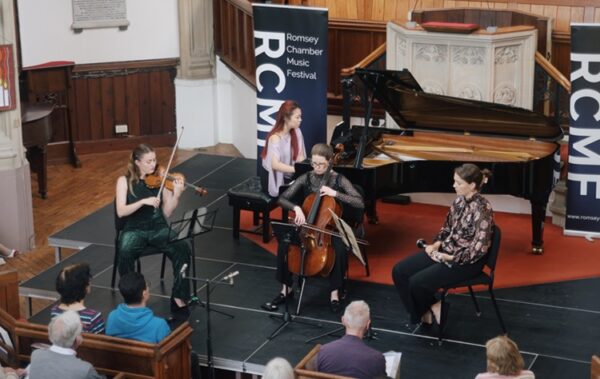
Messiaen – Quatuor pour la Fin du Temps (Junyan Chen [piano], Emma Roijackers [violin], Lydia Hillerudh [cello], Gerbrich Meijer [clarinet])
I could write a whole piece on Laura Rickard’s original, inventive and adventurous programme planning for RCMF 2025 (or any other year), but let this afternoon concert stand as an example. Ziteng Fan’s performance of Oiseaux Tristes – a spray of notes, a blossoming of birdcalls – from Ravel’s Miroirs led without a break into Hildegard of Bingen’s O Virtus Sapientiae – a Christian hymn given wings, made sensuous – played by Lydia Hillerudh (cello) and Coby Mendez (guitar) from the gallery. Eight centuries of quiet musical ecstasy spanning the length of the church. How better to prepare for Messiaen?
The circumstances of the composition and performance of Messiaen’s Quatuor pour la Fin du Temps in a concentration camp are well enough known – so much so that it is difficult now to separate fact from myth. Clarinettist Gerbrich Meijer, introducing the performance, spoke of ‘a constant battle for hope in a dark place’. What followed was extraordinary.
The first movement, Liturgie de cristal, instantly ushered us into Messiaen’s world: birdsong on the clarinet against calm piano chords and quiet harmonics on violin and cello. And between the declamatory sounds that open and close the Vocalise, the calm chant of the strings against tiny gamelan sounds on the piano. And then, probably the best-known of the eight movements, for clarinet (silent in the preceding movement) alone: Abîme des Oiseaux, the abyss of the birds.
In Gerbrich Meijer’s performance the different elements of this seven-minute solo – the long, slow crescendos, the periods of silence, the brief outbursts of freedom and joy – were held in perfect balance, so that the whole seemed weightless, timeless. Her breath control was phenomenal: and in those single-note crescendos it was impossible to pinpoint the moment when silence gave way to sound – something parallelled only, in my experience, by the flautist Emmanuel Pahud. It was, as I have said, extraordinary.
After the brief Scherzo interlude – the piano silent this time, the other instruments chugging cheerfully in characteristic Messiaen fashion – there was another long, slow, contemplative solo from Lydia’s cello, accompanied by soft, barely moving chords from Junyan Chen’s piano. Sweet-toned, at times within a whisker of sounding saccharine: music that only Messiaen could have written. And then the Dance of Fury: angular, rhythmically complex, the instruments in unison to suggest the trumpets of the Apocalypse. The music requires a phenomenal level of concentration and precision, the four instruments in absolute synchrony: it is dumbfounding to watch and to listen to. The huge, climactic augmentation of the theme was terrifying in the way the Statue Theme in Turangalîla is, summoning ‘the oppressive, terrible brutality of ancient Mexican monuments’.
Cluster of Rainbows returns us to a calm cantilena on cello and piano, which gives way to complexity and even violence as the ‘mighty angel’ appears. The music traverses dizzyingly varied terrain: the strings provide an imitation of an Ondes Martenot; and just when we think we have reached our destination, bathed in a glow of radiance, there is a further dislocating shock. Perhaps Messiaen’s visions – in a performance as intense as this – are too vivid for us (and perhaps Bernard Herrmann found the inspiration for his Psycho music here).
Radiance and calm are restored in the last movement, a long, slow meditation for the violin, supported by soft piano chords that chime like bells. Emma Roijackers played it beautifully, rising and falling in intensity, her line always controlled, her poise never disturbed, taking us gently upwards until her sound passed out of hearing.
It was a wonderful performance from start to finish. I found myself remembering St Paul’s words, that we see through a glass, darkly: in Messiaen’s music – in a performance as fine as this – it is as though the glass shatters. We may not glimpse the Beyond, but we are dazzled by the shards.
Dowland – In Darkness Let Me Dwell (Lydia Hillerudh, Ellen Baumring-Gledhill, Margaryta Dorosh, Rainer Crosett [cellos])
Bruch – Aria (Lydia Hillerudh, Ellen Baumring-Gledhill, Margaryta Dorosh, Rainer Crosett [cellos])
Schubert/Liszt – Litanei (Ziteng Fan [piano])
Vasks – Lonely Angel (Laura Rickard [violin], Lydia Hillerudh [cello], Ziteng Fan [piano])
George Crumb – Black Angels (Emma Roijackers, Alice Ivy-Pemberton [violins], Martin Moriarty [viola], Rainer Crosett [cello])
In the evening concert – entitled Angels – we were again prepared imaginatively for the main event: first by a quartet of cellos (Lydia Hillerudh, Ellen Baumring-Gledhill, Margaryta Dorosh and Rainer Crosett). This was one of the Festival’s side-by-side projects, bringing students from Hampshire and the London conservatories to join the resident artists. They played an arrangement of Dowland’s In Darkness Let Me Dwell, without vibrato, sounding like a viol consort. As Laura’s note told us, ‘The anonymous text speaks of self-imposed exile and despair, its imagery mirrored in the music’s stark harmonies and expressive dissonances’. They followed this with an arrangement of Max Bruch’s frankly Romantic Aria from his Four Pieces for Cello and Piano; then Ziteng Fan played Liszt’s arrangement of Schubert’s simple musical prayer for the souls of the departed, Litanei auf das Fest Aller Seelen.
The first half’s closing item was also the most substantial, and the one in starkest contrast with what was to come. Pēteris Vasks wrote Lonely Angel, for violin, cello and piano, in response to a vision of an angel stooping over the war-torn Earth to bring healing with a touch of his wings: the music touchingly enacts this, Laura’s high-lying melody descending to entwine briefly with Lydia’s low-lying cello over static piano figuration before separating and returning to her original station. As simple, and perhaps as hypnotic, as Tavener’s The Protecting Veil.
George Crumb’s Black Angels for amplified string quartet, written in protest against the war in Vietnam, derives some of its disturbing power from the absence of any middle ground between the often-brutal violence of its foreground activity and the barely audible sounds that seem to emanate from an immeasurable distance: a contrast that was finely achieved in this performance. The opening is certainly violent: like a swarm of monstrous bees, the amplified strings imitate the sound of attack helicopters (along with the music’s Departure/Absence/Return structure this gives the piece a distant and unlikely kinship with Coppola’s 1979 film Apocalypse Now). Crumb instructs at one point that the volume should be ‘on the threshold of pain’.
As in other of Crumb’s works there is a strong element of ritual, of theatre embedded in this music: you have to see it as well as hear it. It is tempting to catalogue the devices that the players are required to use to produce sound (including two large tam-tams and their own voices), but it is probably better to focus on key moments. With the stunning performance of Schubert’s Death and the Maiden earlier in the Festival still very much in our minds and ears, there was a real frisson in hearing Crumb’s version (more kudos for Laura and her concert planning): the instruments held like viols, the hands reversed so that the music was played upside down. The sound was unearthly, as if war – napalm and mechanised killing – had obliterated all but a faint echo of Western culture and the civilised values that it is supposed to represent.
The monstrous bees/helicopters return; so does quiet music, the violins making no more sound than the wind through grass. And then, the most striking and indelible image of the whole performance: three players use bows to draw glacial chords from tuned wineglasses, heedless of the cello’s increasingly anguished music. I cannot think of a more telling depiction of a universe indifferent to human suffering; it is a starker sound-image than the untroubled strings in Ives’s The Unanswered Question. Crumb’s Black Angels are the negation of Vasks’s Lonely Angel: there is no healing touch, only unimaginable distance.
Quiet cello harmonics against tiny insect activity on the other strings; a tam-tam is bowed; wineglasses are tapped with metal rods. End.
Chris Kettle