
 United Kingdom Shostakovich Cycle: Jerusalem Quartet (Alexander Pavlosky, Sergei Bresler [violins], Ori Kam [viola], Kyril Zlotnikov [cello]). Wigmore Hall, London, 2-4.6.2025. (AK)
Shostakovich – String Quartets: Nos. 7-9 (2 June), Nos. 10-12 (3 June), Nos. 13-15 (4 June)
Founded in 1993 with their subsequent debut in 1996, thirty years later the four founding members of the Jerusalem Quartet are a remarkably united group with astonishing skills.
Shostakovich has been central to the quartet’s repertoire right from the beginning, reflected in multiple performances and critically acclaimed recordings of the composer’s fifteen string quartets. To celebrate their thirty years together, at the beginning of 2025 the Israeli but mostly Soviet-born quartet embarked on performing several cycles of all fifteen string quartets of the Soviet-born Shostakovich. In addition to their regular touring, in 2025 and early 2026 they are presenting full cycles in London, Zurich, Amsterdam, Cologne, Portland (OR), Cleveland (OH), Saint Paul (MN), and São Paulo (Brazil).
The London cycle was delivered at the Wigmore Hall in February (Quartet Nos. 1-6) and in June (Quartet Nos. 7-15). I attended the last two concerts that is the performances of Quartet Nos.10-15.
For both evenings the Wigmore produced free and extensive programme notes, digitally as well as with hard-copy sheets at the door. Each quartet on the programme was analysed in detail and at length (by Daniel Elphick). Nobody should have been in the dark about what we were listening too. However, as far as I could see, nobody was reading programme notes during the performances. I was new to all the pieces – previously I only heard the famous Eighth Quartet – but the Jerusalem Quartet’s delivery was as transparent as compelling.
Most programme notes are primarily unashamed marketing for performers. Wigmore Hall’s programme notes for these concerts went the other way: they provided exemplary detailed analysis for the pieces but not a single word about the performers.
The background of the four musicians in these concerts matters. Three of the four Jerusalem Quartet members come from the former Soviet Union. The leader of the quartet, Alexander Pavlovsky was born in Kiev, Ukraine and immigrated with his family to Israel in 1991. Second violinist Sergei Bresler was also born in Ukraine in 1978; he too immigrated to Israel in 1991. Born in Minsk, Belarus to a family of professional musicians, cellist Kyril Zlotnikov began his music studies at the Belarusian State Music Academy with Prof. Vladimir Perlin. He continued his studies in Israel first with Prof. Uzi Wiesel and Hillel Zori but completed his musical education under the direction of Prof. Michael (Mikhail) Khomitzer in Jerusalem’s Rubin Academy of Music and Dance.
Born in Ukraine but trained at the Moscow Conservatoire, Khomitzer (1935-2002) was well supported by the Moscow regime and deservedly so. I recall his magnificent performance of Shostakovich’s Cello Concerto No.1 at the 1963 Pablo Casals cello competition in Budapest where he was a prize winner (as he also was in the 1962 Moscow Tchaikovsky Competition). Jerusalem Quartet cellist Zlotnikov did well by completing his formal studies with Khomitzer.
I admit to often thinking that one does not have to be Hungarian to perform Bartók well but it helps. During the Jerusalem Quartet’s Shostakovich performances, I could not help thinking that one did not have to come from the Soviet Union to understand Shostakovich but it helped.
Performing at the Wigmore Hall also helps. Already entering the door from the street, friendly ushers greet you, joined by other welcoming ushers further on, creating a perfect ambiance for chamber music. The Hall itself and its stage are of perfect size for a quartet or other small ensembles. It is to be hoped that Wigmore Hall will continue its chamber projects for a long time to come.
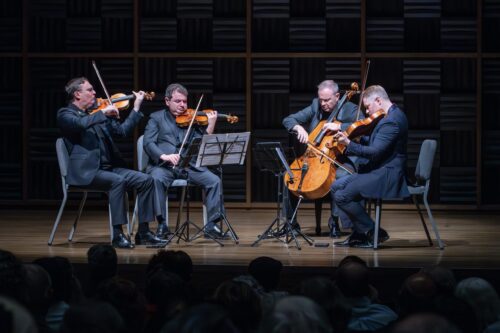
The stage presence of the Jerusalem Quartet is as exemplary as their musical delivery. Dressed alike in simple but elegant black, they sit close to each other – closer than many other quartets – hence visually as well as musically they speak as one. In spite of the vast range of emotions contained in the six Shostakovich quartets which I heard during these performances, excessive body movement was off the chart: if you just looked but did not hear, you would have had no idea of the astonishing beauty as well as the gripping power projected.
Shostakovich heaped on lyrical emotion, passionate drive as well as technical challenges in his scores. All four players of the Jerusalem Quartet are masters of their instruments whether in cantilena or virtuoso passages. They all had extensive solo passages, they all showed their skills on any parts of their instruments (however high on the fingerboard) and they all supported each other with immense dedication and discipline.
The performances were greatly enjoyed and appreciated by the audience. For once I do not feel the need to look at Shostakovich’s scores – I often look after I attend performances – as I am confident that I heard what Shostakovich notated as well as intended between the notes. On the other hand, I am certain that, on this occasion, I heard the ultimate interpretation of Shostakovich quartets and I do not want to hear these pieces performed by any other group.
Agnes Kory