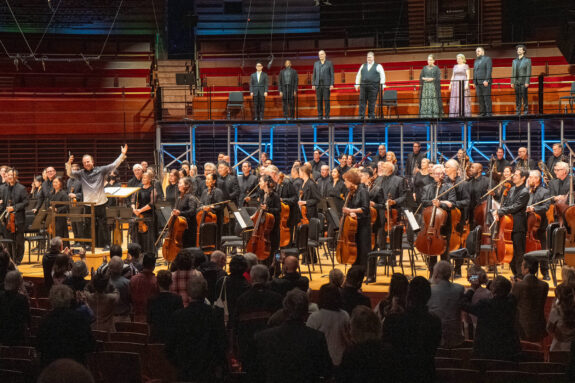
 United States Wagner, Tristan and Isolde (concert performance): Soloists, Tenors and Basses of Philadelphia Symphonic Choir, Philadelphia Orchestra / Yannick Nézet-Séguin (conductor). Marian Anderson Hall, Philadelphia, 1.6.2025. (ES-S)
Cast:
Tristan – Stuart Skelton
Isolde – Nina Stemme
Brangäne – Karen Cargill
King Marke – Tareq Nazmi
Kurwenal – Brian Mulligan
Melot – Freddie Ballentine
Shepherd / Young Sailor – Jonghyun Park
Steersman – Nathan Schludecker
‘I am still looking for a work of equally dangerous fascination, of an equally shivery and sweet infinity, as Tristan. And I look in all the arts, in vain’.
So wrote Nietzsche in Ecce Homo, a reflection penned years after his break with the composer. The remark captures something essential about this Wagner opera: its unnerving beauty, its capacity to seduce and disarm, and its singular place in the emotional imagination of Western music. From the first suspended harmony of the Prelude to the final transfiguring swell of the Liebestod, this music offers not resolution but deferral – its chromatic tensions always searching, never settling.
The Philadelphia Orchestra’s concert performance of this monumental work, conducted by Yannick Nézet-Séguin, did not attempt to mitigate its dangers or soften its infinite yearning. Performed in its entirety for the first time by the Orchestra since 1934 – when the great Fritz Reiner conducted what was billed as the first uncut American performance – Tristan returned to the city in a concert staging with extraordinary immediacy. Stripped of staging but not of drama, the afternoon unfolded as an unbroken tide of harmonic ambiguity, orchestral color and psychological intensity that reaffirmed why Wagner’s meditation on love and death remains without parallel.
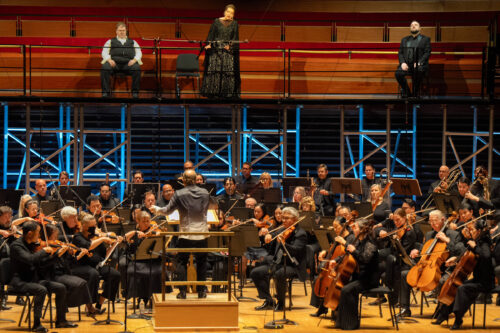
The drama unfolded as much from the stage itself as from a raised structure installed behind the orchestra – its bare, elevated surface faintly evoking the deck of a ship, as if recalling the vessel on which the first act unfolds. Descending onto the platform from backstage, the singers waited for their cues, paced back and forth with minimal gestures and encountered one another in a restrained but evocative staging conceived by Dylan Evans. Perhaps surprisingly, one of those conceptually ambitious productions that aim to overlay Wagner’s mythic structure with new interpretive ‘meaning’ was not missed at all. With physical action reduced to essentials, the Philadelphia Orchestra assumed the role of an emotional narrator.
Under Nézet-Séguin’s fluid, long-breathed direction, the ensemble revealed Tristan’s febrile architecture with remarkable transparency and control. The pacing was supple throughout, always responsive to psychological nuance – never indulgent, never rushed. The famous Prelude, often treated as a suspended breath, unfolded here with patient tension, each phrase tendered rather than declared. In the extended Act II love duet, the balance between stillness and volatility was finely judged, with textures that shimmered and smoldered without collapsing into inertia.
The orchestra’s expressive power was never more haunting than in the bleak desolation of Act III. From the opening bars, Wagner’s vision of inner disintegration – with the past dissolving into hallucination – found a piercing voice in the plaintive English horn solos played by Elizabeth Starr Masoudnia from the upstage platform used by the singers. Her tone – earthy, unvarnished and utterly human – seemed to emerge from silence like a memory breaking the surface of consciousness. Around her, Nézet-Séguin and the orchestra summoned a sonic terrain at once luminous and desolate, marked by half-formed harmonies and rhythmic decay.
By contrast, the Liebestod offered not catharsis but glowing suspension. The famous final chord – the long-delayed resolution of the ‘Tristan’ motif heard hours earlier – was voiced not as triumph or closure but as a kind of exhalation, tender and weightless.
Nowhere did the orchestra overpower the singers. Instead, it supported them with poised restraint and phrasing that responded sensitively to every vocal turn. In the title role, Nina Stemme offered a portrayal shaped by experience and intelligence. Announced as her final complete Tristan, this performance was anything but a farewell in decline. Stemme sang with stamina, control and dramatic insight, suggesting not fatigue but a kind of apotheosis – an artist closing a chapter on her own terms and in full possession of her powers. Her voice, though no longer in its freshest bloom, retained its core radiance and expressive flexibility, with a top that could still cut cleanly through the densest orchestral textures. What impressed most was not sheer vocal power but the emotional chiaroscuro she brought to each phrase, the way her tone could darken almost imperceptibly in moments of grief or disbelief, then soften into tenderness without losing shape. In Act I, as Isolde recalled tending to the wounded Tristan, Stemme’s lines were mirrored by Choong-Jin Chang’s solo viola, whose timbre captured the tenderness and ambivalence embedded in her memory. Isolde’s Act II entrance had the force of an invocation – quietly controlled but charged with suppressed urgency. By the Liebestod, she seemed to recede into the music rather than rise above it, her final phrases unfolding with a calm inevitability that made resolution feel both tragic and transcendent. This was not a performance that imposed itself on the role but one that revealed it from within.
In the role of Tristan – a quintessential heldentenor part – Stuart Skelton did not rely on sheer sonic force or clarion brilliance. Instead, he shaped the role with warmth of timbre and an unusually refined sense of phrasing, bringing a quieter intensity to the character’s unraveling. His top was present and secure, but what lingered most was the way he tapered lines, shaped dynamic shifts and allowed vulnerability to emerge without vocal strain. The long association between Skelton and Stemme – they have portrayed the couple on multiple occasions, including the 2016 Metropolitan Opera production – resulted in a duet of uncommon dramatic cohesion. Their Act II exchange unfolded with natural fluency, each singer attuned to the other’s breath and phrasing. In the long soliloquy of Act III, Skelton’s soft-edged diction and gradual decrescendo into near-whisper suggested a man suspended between consciousness and death, still clinging to a remembered voice. His performance, like Stemme’s, conveyed not just endurance but interpretive maturity – a fitting counterpart to an Isolde on the verge of farewell.
Karen Cargill was a compelling Brangäne, her mezzo-soprano rich and steady with a natural warmth that projected effortlessly from her position in the upper balcony during Act II. Singing from above heightened the scene’s tension while allowing her voice to float across the hall with a haunting clarity. She shaped her lines with care, imbuing Brangäne’s warnings with both urgency and restrained compassion. Tareq Nazmi brought a dark, resonant bass to King Marke, and his long monologue in Act II unfolded with nobility of line and quiet gravity. If his portrayal didn’t fully explore the emotional fracture beneath the character’s dignity, it nonetheless offered a poised, measured response to the chaos around him – rather less personal anguish than solemn reckoning.
Brian Mulligan brought a grounded presence to Kurwenal, though his baritone didn’t always rise above the orchestral texture – particularly in the outer acts, where greater vocal projection was needed. Among the supporting cast, Freddie Ballentine made a strong impression as the scheming Melot, singing with bright, incisive tone. Jonghyun Park delivered the Young Sailor’s lines and later the Shepherd’s plaintive Act III calls with lyrical poise, while Nathan Schludecker as the Steersman offered a sturdy contribution.
For all its minimal means, this Tristan left a lasting impression – not through spectacle, but through conviction, precision and emotional depth. Yannick Nézet-Séguin will lead a new staged production at the Metropolitan Opera next season. If this performance is any indication, it will be outstanding, at least musically.
Edward Sava-Segal
Featured Image: Yannick Nézet-Séguin conducting a concert performance of Tristan and Isolde in Philadelphia © Jessica Griffin