
 Germany Bayreuth Festival 2025 [1] – Wagner, Die Meistersinger von Nϋrnberg: Soloists, Bayreuth Festival Chorus and Orchestra / Daniele Gatti (conductor). Broadcast live (directed by Michael Beyer) from the Bayreuth Festspielhaus and available on STAGE+, 25.7.2025. (JPr)

Wagner’s Die Meistersinger von Nϋrnberg, his only ‘comedy’, is a favourite for many and was the first of the composer’s works I saw in an opera house fifty – yes fifty! – years ago. Of all his operas it is the most accessible and potentially least disturbing, perhaps because Wagner ignored all the rules he had proposed for opera in his theoretical prose writings in the 1850s. It has a historically well-defined plot, rather than mythological or legendary one, and is Wagner’s only mature opera which is based on an entirely original story he devised himself. So, Meistersinger deliberately uses many of the operatic conventions which Wagner had previously railed against, including a ballet, rhymed verse, choruses, arias; the work even has five different characters singing together at one point (the celebrated Meistersinger Quintet). The whole is an extended metaphor about the meaning of Art, reflecting on the response to the foreign or unfamiliar in music and asking whether everyone can be sufficiently open-minded to value the modern. It is essentially an autobiographical treatise where Wagner propounds his view that there is a greater chance of being understood by the masses than by essentially conservative professionals (critics?).
Meistersinger has been referred to over the years as ‘the longest single smile in the German language’. I might be accused of being naïve, but I have no doubt it is Wagner’s idea of a comedy and certainly that is the opinion of Matthias Davids, director of the new production at Bayreuth. Davids – who now appears to have been a bold choice as his background is mostly staging musicals for Landestheater Linz – is quoted as saying ‘What you find in Meistersinger are certain human shortcomings that create comedy.’ So put simply it is a comedy of manners and possibly all the better for being presented like that from which its themes of Art, tradition and human love can arise spontaneously.
Since 2007 at Bayreuth I have seen the politicisation/Nazification of Meistersinger in two different productions. The first from Katharina Wagner had Hans Sachs go from the barefoot non-conformism of the stuffy educational establishment to which he belonged, to become, if not the Fϋhrer himself, then perhaps his chief propagandist Goebbels as Sachs spat out ‘Habt Acht’ and warned against foreigners who might dilute what is German. At this point he was iconically spotlit and flanked by two huge Third Reich statues.
The director Barrie Kosky then turned Meistersinger into a Nuremberg Trials tribunal and staged a program on St John’s Eve. And when Nuremberg’s citizens were violently drunk at night, he had a stage-sized Jewish caricature balloon inflated. Yes, we all know how Wagner’s words and music were (ab)used for propaganda purposes in World War II – and it is important to reflect on this from time to time – but what is wrong with having some fun again for once?
Seen in close-up on a screen there was much to enjoy in Davids’s entertaining production from its astonishing opening with Andrew D Edwards’s vertiginous set of steps (with a warning sign at the bottom) down from the high-up St Catherine’s Church to the garish folk festival at the end with the inflated upside-down cow (a reaction to Kosky perhaps?) and a sunburst set straight from a TV entertainment show, perhaps Germany’s Let’s Dance or something similar.
Susanne Hubrich’s often-colourful costumes are not time-specific, for instance Walther is in a blue jacket and slacks and Eva in a pink, flowery dress; the guild of master singers wear fur-trimmed robes and funny headwear – and their gathering is more of a social than anything else as they all seem to bring something to eat – and in Act III there is much lederhosen and dirndls. After Walther and Eva’s wooing involves them throwing (music) paper darts at each other – with a quartet of musicians on the stage – we see the interior of the church which mirrors the lighting and wooden seats of the Festspielhaus itself. The sight gags start here with one of the masters needing cushions for the notoriously hard seats and another sneaking out for a cigarette. Beckmesser spies on Walther from on high and unfurls a banner of ‘neins’ rather than brandishing a completed slate covered with chalked errors.
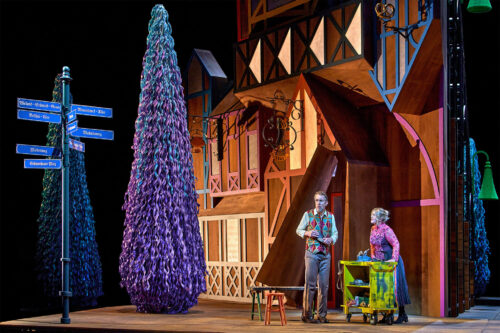
For me, the Nuremberg we see in Act II looks like the deconstructed exterior of the Festspielhaus. On the stage is an old phone box that is now a library and advertises the Festwiese of Act III. Beckmesser woos Eva looking like an old rocker with a heart-shaped guitar. The set splits, artificial trees sway, and the riot is definitely riotous. Stand-ins for David and Beckmesser do much of the fighting until both stand-ins and singers face off together briefly in a large boxing ring.
The final act opens in Hans Sachs’s workroom where he is repairing a stool used to earlier beat Beckmesser and that features a central pile of wooden lasts which will later collapse for the wounded town clerk as – totally expectedly – does the stool when he sits on it. During the emotional heights of Sachs’s ‘Wahn! Wahn!’ he looks at a small photo of his wife and one of his children which would be impossible for anyone in the Festspielhaus to see. The final scene is full of banners, dancing and the antics of the guilds; the girls from Fürth are like a beauty contest and there are lookalikes for former chancellor Angela Merkel and TV personality Thomas Gottschalk who have visited the Bayreuth Festival for many years. Eva is brought on like a Chelsea Flower Show display and Beckmesser sings atop a straw bale. The humiliated and peeved Beckmesser disconnects the bouncy castle-like cow though Sachs stops it from totally deflating. Walther refuses to join the guild and rejects the regalia Sachs offers, Eva returns the chain to her father, Pogner, before she leaves with Walther. Beckmesser has been embarrassed but not particularly ostracised, so no reconciliation is needed.
Georg Zeppenfeld is quoted as saying Davids didn’t want him to make his Sachs too serious. This doesn’t seem to have got through to the grizzled bass whose philosophical, avuncular, yet short-tempered Sachs was, well, mostly the same as his King Henry, Gurnemanz and Daland, and possibly, simply Zeppenfeld himself! Generally, there was little to fault in the singing from all the soloists and enthusiastic chorus and notably the masters were well-characterised throughout and perhaps this was clearer too on the screen than in the opera house. Jordan Shanahan was a forthright Fritz Kothner; Jongmin Park was the stern, stoic Pogner; Tobias Kehrer was the cavernous-voiced Night Watchman with his large horn and expanded role; the warm-toned Christa Mayer was Eva’s conspiratorial companion Magdalene, less youthful than we usually see the character these days; and, as the focus of her attention, David was sung pleasantly by Matthias Stier with just a little difficulty the higher his voice was stretched. Michael Nagy was an excellent Beckmesser, singing without exaggeration yet without making his character sound or appear anything other than vainglorious or exasperated by turns.
The two major role debuts were Christina Nilsson as confident, headstrong, determined and spiritedly sung Eva whilst Michael Spryres’s Walther was sung with remarkable radiance, lyricism, nuance, stamina and impeccable phrasing; it was as if he was determined to convey the meaning of every word he sang through his outstanding voice.
Daniele Gatti returned to conduct at Bayreuth after more than a decade and as heard through loudspeakers his account seemed a little at odds with the joyous production. This was possibly because there was so much going on to look at that the orchestra sounded merely accompanists to the stage pictures. Orchestral colour and balance came to the fore in the more introspective moments such as Sachs’s Flieder and Wahn monologues and Walther’s ‘Morgenlich leuchtend’; elsewhere the crowd scenes were occasionally rushed catching those on the stage a little by surprise, though issues like this will, I have no doubt, settle down as the performances continue.
Jim Pritchard
Featured Image: Die Meistersinger von Nϋrnberg Act III © Enrico Nawarth/Bayreuther Festspiele
Creatives:
Director – Matthias Davids
Stage – Andrew D Edwards
Costumes – Susanne Hubrich
Lighting – Fabrice Kebour
Choreography – Simon Eichenberger
Chorus master – Thomas Eitler-de Lint
Dramaturgy – Christoph Wagner-Trenkwitz
Cast:
Hans Sachs – Georg Zeppenfeld
Veit Pogner – Jongmin Park
Walther von Stolzing – Michael Spyres
David – Matthias Stier
Walther von Stolzing – Michael Spyres
David – Matthias Stier
Eva – Christina Nilsson
Magdalene – Christa Mayer
Kunz Vogelgesang – Martin Koch
Konrad Nachtigal – Werner Van Mechelen
Sixtus Beckmesser – Michael Nagy
Fritz Kothner – Jordan Shanahan
Balthasar Zorn – Daniel Jenz
Ulrich Eisslinger – Matthew Newlin
Augustin Moser – Gideon Poppe
Hermann Ortel – Alexander Grassauer
Hans Schwarz – Tijl Faveyts
Hans Foltz – Patrick Zielke
A Night Watchman – Tobias Kehrer