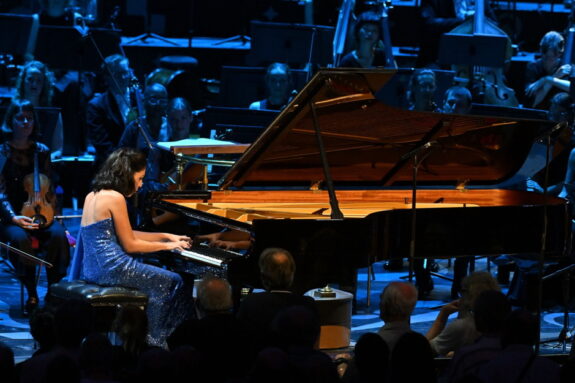
 United Kingdom BBC Proms 2025 [12] – Dukas, Rachmaninov, Bartók: Beatrice Rana (piano), BBC Singers (chorus master: Neil Ferris), BBC Symphony Orchestra / Josep Pons (conductor). Royal Albert Hall, London, 8.8.2025. (LJ)

Paul Dukas – La Péri (Poème dansé)
Rachmaninov – Rhapsody on a Theme of Paganini, Op.43
Bartók – The Miraculous Mandarin, Op.19
Upon the request of Serge Diaghilev, French composer Paul Dukas composed the ballet La Péri between 1909 and 1911. It was dedicated to the Russian Prima ballerina Natacha Trouhanova with Vaslav Nijinsky in the role of Iskender (the Persian name for Alexander the Great). The work is about Iskender’s search for immortality, during which he meets a Persian Peri who holds a flower of immortality in her hands. Dukas’s composition combines two themes: Iskender’s romantic theme and the orientalist dance of the Peri.
In Le Peri conductor Josep Pons brought out its romantic theme, indulging Dukas’s fulsome score by taking an ever so slightly slower pace (the performance lasted 19 minutes rather than the average of 18 minutes). This gentler pace was welcome in the section where violas take the melody, supported by cellos and double basses playing pizzicato. After a slightly unconvincing opening (perhaps due to the omission of the Fanfare), the BBC Symphony Orchestra did not disappoint. La Péri is notable for the prominence of harpists (Elizabeth Bass and Daniel de Fry) who added a fairy-tale quality to the performance.
The stage was promptly rearranged to accommodate the Royal Albert Hall’s Model D Steinway (replete with audience ‘Heave, ho!’). Beatrice Rana then entered the stage wearing a dazzling blue dress and quickly demonstrated that even the most well-known pieces can bring elements of surprise. Whilst playing a piece as familiar as Rachmaninov’s Rhapsody on a Theme of Paganini (Op.43) must be quite daunting (one thinks of all the virtuosos who have performed the piece, recently Stephen Hough at the BBC Proms in 2001, 2013, and 2016). Rana seemed unperturbed and her performance was assured and fresh.
Written in 1934, Rachmaninov’s Rhapsody is characteristic of the composer’s ability to write long, beautifully phrased melodies that require a pianist to convey a range of emotion and play at vastly different tempi in various parts of the piece. Indeed, it was Rana’s range of tempi and dynamics from her quicksilver arpeggios in Variation 4 to the moving Variation 12 (marked Tempo di minuetto) that stood out. The piece can be divided into three sections that correspond with the conventional movements of a concerto: the first is predominantly fast (Variations 1-10), the second is slow (Variations 11-18), and the last is fully vivacious (Variations 19-24). Rana’s performance of the ‘Crème de Menthe Variation’ – labelled such because Rachmaninov himself kept a glass of the liquor at the ready to calm his nerves before performing the technically fiendish final variation – was impressive. Rana combined boldness with sensitivity, wowing the audience as she leapt across the piano with speed. But it was Variation 18 that most of the audience came to hear. Marked Andante cantabile, Rana brought out the singing quality of the Variation. There was sensitivity, but also a strong sense of direction that highlighted the uniqueness of this Variation without losing a sense of the composition’s arc.

Performing the Variations as a unified whole requires attention to the shape of the composition and an ability to generate momentum when playing. This is where Rana excelled. Perhaps this could be due to her time spent studying composition with Marco Della Sciucca at the Nino Rota Conservatory of Music in Monopoli. (Or perhaps the BBC Symphony Orchestra also deserve some credit for the supportive and deliberately uncompetitive role they took.) Evidencing her understanding of the narrative quality of Rachmaninov’s work, Rana told Chloe Cutts in an interview published in the programme notes for the concert: ‘It’s like a puzzle where everyone has a piece, and you don’t get the full picture until all the pieces are put together.’ She added that the work has a ‘compact architecture’ that combines grandiosity with delicacy. Musicologist Geoffrey Norris also commented on this architectural quality, stating that Rachmaninov’s ‘skill as an architect is rarely exemplified more clearly than in his organization of these 24 variations, finely conceived into an entirely logical and close-knit structure’ (Rachmaninoff, Schirmer Books, 1976, p.121). Rana’s performance was certainly thematically coherent and powerful. Her interpretation focused on the Dies Irae theme that appears most prominently in Variations 7, 10, and 24. Yet, in these Variations there is humour too, something that Rana could incorporate a little more in future performances.
Rana showed off her lighter side when she delighted the audience with a charming and virtuosic encore: Mikhail Pletnev’s 1978 transcription of Tchaikovsky’s March from The Nutcracker Suite, originally composed in the fin de siècle. The piece, composed by another great Russian composer, complemented Rachmaninov’s Rhapsody with echoes of dynamic staccatos, impressive runs, and instantly recognisable melodies. After a performance like this, Rana may become a Proms favourite.
After the interval, the BBC Symphony Orchestra returned to the stage with the BBC Singers to perform Bartók’s The Miraculous Mandarin (Op.19). Bartók worked on The Miraculous Mandarin in 1918/19 from notes he made in August 1917. Its eventual orchestration took place in 1923/24. It was not warmly received in the composer’s home of Hungary, with the Hungarian National Opera refusing to perform it. Subsequently, in August 1950, the work was censored by the Communist Party’s division of Agitation and Propaganda due to its non-traditional style and sexual themes that were deemed inappropriate for uplifting the masses and banned from Hungarian Radio. Hence, it may not come as a surprise to learn that the piece has only enjoyed relatively recent performances at the Proms with Pierre Boulex conducting its first complete performance in 1984. Its appearance in this year’s Proms is certainly, therefore, welcome!
In this work, passion supplants humanity, morality, and feeling. Its story was written by Menyhért Lengyel and takes place in an unnamed city over the course of one night. During this eventful night, three robbers capture a prostitute and use her as bait to entice three unsuspecting men. The first two men are of no use to the robbers as they are penniless, but the third, a wealthy Chinese man (the Mandarin), is enticed by the prostitute and beaten by the robbers. To their surprise, the Mandarin does not die despite being suffocated, stabbed, and hung. It is only when the prostitute gives herself to him that he finally collapses.
The music is broadly Expressionist, and elements of atonality can be heard in the combination of abrupt rhythms and bold dissonances. In the performance, clarinet (Richard Hosford and Jonathan Parkin) and bass clarinet (Thomas Lessels) solos as well as the low brass excerpts (Helen Vollam and Dan Jenkins on trombone, Joseph Arnold on bass trombone, and Sam Elliott on tuba) were played with boldness and clarity during the three so-called ‘enticement’ scenes which intensify with each iteration. The BBC Singers sounded siren-like as they sung a wordless passage in a minor third interval, representing the Mandarin’s suffering and imminent death. Overall, Pons demonstrated control and structure in his conducting as he moved between the 6/8 and 5/4 rhythms and drew the audience’s attention to Bartók’s themes and recurring characters by accenting what are often referred to as the piece’s ‘tone patches’.
Whilst The Miraculous Mandarin may not ever reach the crowd-pleaser status that Rachmaninov’s Rhapsody instantly achieved, its performance gave the BBC Symphony Orchestra an opportunity to demonstrate their skill, range, and attention to detail.
Lucy Jeffery
Nice explanation Lucy Jeffery. Makes me think about what I am listening to with greater depth.