 United Kingdom Edinburgh International Festival 2025 [6]: (SRT)
15.8.2025: Songs by Schumann and Brahms: Florian Boesch (baritone), Malcolm Martineau (piano), Queen’s Hall.
15.8.2025: Huang Ruo, Book of Mountains and Seas: Artists of Ars Nova Copenhagen / Miles Lallemant (conductor). Royal Lyceum Theatre.
Director and Production – Basil Twist
Lighting – Ayumu ‘Poe’ Saegusa
Creative – Beth Morrison
In 2022 Florian Boesch and Malcolm Martineau gave the most memorable Edinburgh International Festival song recital I have been to when they did Winterreise (review here). Thinking about it is still gives me the shivers when I remember the depth of Boesch’s identification with the text and the way Martineau seemed to crowbar open the piano line, exposing the psychological depths and emotional trauma lying therein.
So I guess you could say I came to this recital with high expectations, and it is hardly their fault if the results weren’t quite on 2022’s stratospheric level: that is more down to the composers than to them. Robert Schumann and Brahms are central to the German lieder tradition, but even Dichterliebe cannot live up to the level that Schubert set in his cycles.
No matter: this was excellent for all the same reasons that the 2022 concert was: a singer who understands and breathes every phrase, and a pianist for whom the piano line is an extension of the music’s and text’s psychology. Take, for example, Schumann’s Die beiden Grenadiere, where Boesch relished the story’s unfolding narrative while Martineau enjoyed the Marseillaise references in the piano; or Boesch’s stunned whisper when the disembodied hand appeared at the feast in Belsatzar. They carried off the three Harfenlieder in a way that captured their sorrow without making them sound melodramatic, and they maintained the folksy idiom of Schumann’s three Arme Peter songs while maintaining the evocation of loss, devastatingly expressed in Boesch’s hushed half-voice. The Brahms sequence felt less substantial and more episodic, but it kept up the folksong tone, with overtones of a hymn in Sonntag, but also defiance in Kein haus, kein heimat.
After the interval, before singing Dichterliebe, Boesch spoke from the stage about the pre-eminence of the piano in the cycle, explaining that the thing that really helped him to crack the piece was the realisation that the piano, not the singer, is the main protagonist. He is being modest, no doubt, and he went a bit far by audibly thanking Martineau at the end; unwise not least because it broke the spell that hung over the silence in the final piano postlude. He has a point, though. I hadn’t really noticed before just how many times in the cycle Schumann gives the piano the final word in a song, and with some pretty serious stretches of music, not just some throwaway phrases. Hearing that made Dichterliebe sound less like the poet’s neurotic reaction to loss and more like a thoughtful reflection on human relationships and, indeed, mankind’s capacity for love. The gently wandering piano line of Am leuchtenden Sommermorgen, for example, felt like an abstract piece of meditation over which Boesch’s singing was reduced to a virtual whisper, and in Hör ich das Liedchen klingen the piano seemed to tinkle vainly into the void after Boesch had stopped singing.
Here as elsewhere, however, Boesch’s singing was judged to perfection. The opening songs were pitched tentatively, not impetuously, and a noticeable thread of darkness crept into the voice from Ich grolle nicht onwards. Aus alten Märchen, on the other hand, felt like a final gasp of defiance, and while the final song held resentment and bitterness, it wasn’t altogether hopeless. This was a poet, alongside his piano therapist, who lamented the loss of love, but knew there was a future and held out hope for the next phase.
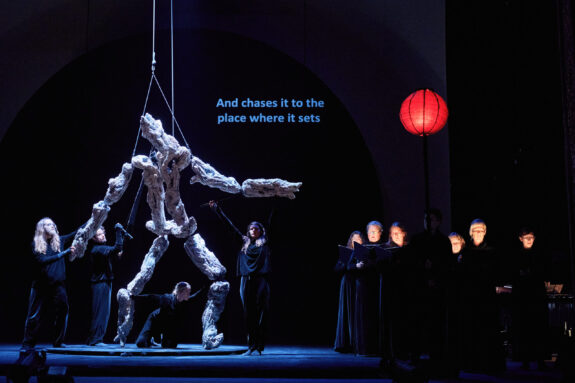
There was more drama in one of those songs than there was in the whole of Book of Mountains and Seas, the second of the festival’s two staged operas, though calling it an opera is stretching it a bit. Premiering in 2021, it is more of a staged ritualised mythology, setting four Chinese creation myths using two percussionists, the twelve singers of Ars Nova Copenhagen and six puppeteers, directed by Basil Twist and all marshalled under the banner of Beth Morrison Productions.
Huang Ruo wrote the music and text and would have benefited from a ruthless editor because everything moves so slowly that the 80-minute show feels like it is double the length it should be. The puppetry builds up to the last of the four tales, the story of the giant Kua Fu, who rises impressively over the stage as he chases the sun (see featured image); but there is a lot of very static (and, bluntly, unimpressive) gesturing to get through before that.
Ruo’s music moves through microtones and repetition (so much repetition!) and drains the energy out of what are the bones of very short stories. Hats off to the singers, who keep things going with maximum focus through what must be a jolly difficult score to perform, and to the percussionists, Michael Murphy and John Ostrowski, who create some engaging soundscapes with their range of instruments. A few moments aside, however, this was overlong and unengaging. The applause at the end was what could generously be called ‘polite’.
Simon Thompson
The Edinburgh International Festival runs at venues across the city until Sunday 24th August. Click here for further details.
Featured Image: Book of Mountains and Seas © Andrew Perry
Music performed by Florian Boesch & Malcolm Martineau:
R. Schumann – Die beiden Grenadiere, Op.49 No.1; Belsazar, Op.57; Der Arme Peter, Op.53 Nos. 1-3; Mein Wagen rollet langsam, Op.142 No.47; Gesänge des Harfners, Op.98a (Nos. 4, 6 & 8); Dichterliebe, Op.48
Brahms – Sonntag, Op.47 No.3; Blindekuh, Op.58 No.1; Sehnsucht, Op.14 No.8; Dein blaues Auge, Op.59 No.8; Kein Haus, kein Heimat, Op.94 No.5; Die Trauernde, Op.7 No.5; Schwermut, Op.58 No.5; Es steht ein Lind in jenem Tal, WoO 33