 United Kingdom Edinburgh International Festival 2025 [11]: 23.8.2025. (SRT)

Bach, Leonidas Kavakos (violin), ApollΩn Ensemble, Queen’s Hall.
J.S. Bach – Violin Concerto in A minor, BWV 1041; Violin Concerto in E major, BWV 1042; Violin Concerto in G minor, BWV 1056r; Violin Concerto in D minor, BWV 1052r
Figures in Extinction: Nederlands Dans Theater, Complicité, Edinburgh Festival Theatre.
Creatives included:
Creators – Crystal Pite and Simon McBurney
Lighting design – Tom Visser
Scenic design – Jay Gower Taylor
Costume design – Nancy Bryant, Simon McBurney (in collaboration with Yolanda Klompstra)
Set design – Michael Levine
Video design – Arjen Klerkx
Projection design – Will Duke
The Edinburgh International Festival always likes to bring out a touch of star power to end their Queen’s Hall series, and this year that fell to Greek violinist Leonidas Kavakos and his ApollΩn Ensemble playing Bach’s violin concertos, two original concertos plus two reconstructed from elsewhere.
ApollΩn Ensemble’s USP is playing one-to-a-part which meant that, including Kavakos, there were only ever seven musicians on the stage. In that sense Kavakos playing the solo part was only the first among equals. There was no doubt that he was the star, however: not only does Bach give him the best, most elaborate lines, but he created plenty of tasteful ornamentations and threw in a touch of vibrato on the longer notes to colour his part.
That shows that this very much wasn’t a Historically Informed Practice band, and that was most obvious in the speeds. There was appealing bounce in the outer movements of each concerto, though interestingly not as much transparency as you would have expected: you lose some of the lines of action when everyone is equal and there is less contrast between soloist and orchestra.
The slow movements, however, were anachronistically slow. Klemperer in his pomp would scarcely have taken them slower, leading to a suspicion that Kavakos was wallowing in their beauty a bit too much. The long lines of the arias seemed to be stretched out beyond what they could reasonably take, and several of them threatened to grind to a halt, a fate suffered quite literally in the Adagio of the E major concerto.
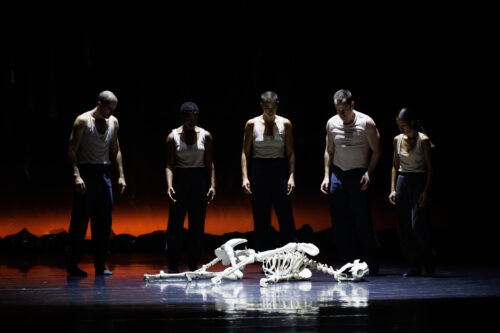
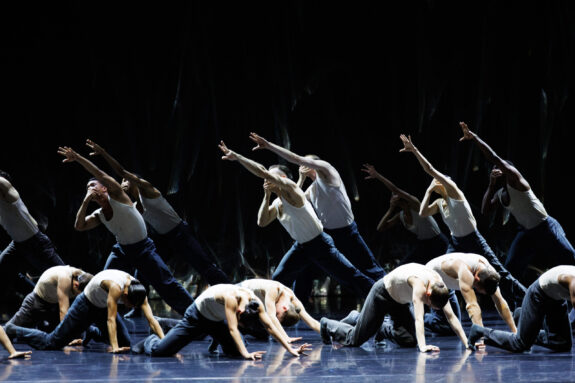
Much more drama, together with a dollop of existential trauma, was on display up the road at the Festival Theatre in Figures in Extinction, Nederlands Dans Theater’s much anticipated return to the International Festival. There is a strong argument to be made that this is the finest, most exciting contemporary dance company in Europe, and when they teamed up with choreographer Crystal Pite and actor/writer/director/polymath Simon McBurney, the prospect was mouth-watering.
In the event, some parts of their collaboration worked more powerfully than others. Figures in Extinction is a three-part meditation on humanity’s role and purpose in an age of mass destruction. The first part is a simple list of animals, lakes, glaciers that have gone extinct, and the dancers’ main task is effectively to impersonate those things.
Putting it that simply makes it sound like they are playing a children’s game, but this was anything but: instead, it was incredibly powerful to watch, like seeing a world of beauty disintegrate and vanish before your eyes as the dancers embodied animals, birds or even natural phenomena. The sheer accuracy of the movement was remarkable, a testament to the power of choreographer Crystal Pite: every flick of the neck, every jerk of an elbow was incredibly precisely calibrated so that the dancer really did seem to inhabit the body of, say, an ibex, a macaw, a caribou. We saw herds of beasts, out of which one individual stood alone; and they even became a school of fish, choked off one by one. All the while we both saw and heard a simple list of living things that have gone extinct or are critically endangered. The effect was strangely and unexpectedly heartbreaking.
At the heart of all this is Simon McBurney and his Complicité theatre company. It is McBurney’s voice (and that of his daughter) that we heard talking us through the list, and every vocal cadence is perfectly judged to eke out the poignancy of the loss. The second and third parts, which dealt more directly with humans, were less focused and less gripping. 2.0 (the second part) dealt with humanity’s isolation from one another and our need for connection, through fairly predictable tropes like a crowd isolated from one another as they check their phones, finally coming together through an intimate duet as one dancer reaches out to another in their need. The third part (3.0) was a meditation on death, and featured McBurney reciting some dubious hoo-hah about the relationship between the dead and the living (did he write that stuff himself?!) followed by some dark humour in a hospital ward and a meditation on the circle of life.
It is for the animals that I will remember this, though, and for their powerful meditation on what we are losing even now and seem powerless to prevent. Pite’s choreography was remarkable because so little of it used music, apart from traces of Bach, Shostakovich or Fauré): instead the dancers mostly moved to speech, language and breath but did so with remarkable precision and utmost dedication. Remarkable.
Simon Thompson
Featured Image: Crystal Pite and Simon McBurney’s Figures in Extinction for NDT © Andrew Perry