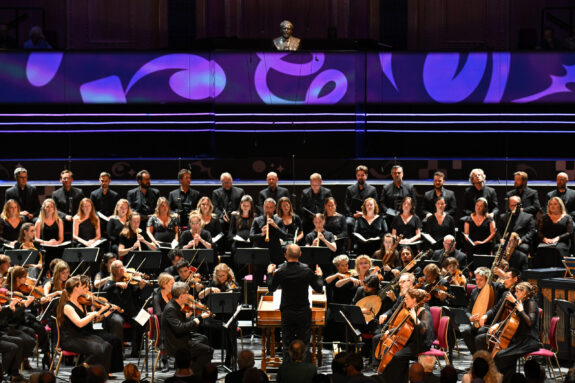
 United Kingdom BBC Proms 2025 [25] – Handel: Hillary Cronin (soprano), Stuart Jackson (tenor), Hillary Cronin (soprano), Irish Baroque Chorus, Irish Baroque Orchestra / Peter Whelan (conductor). Royal Albert Hall, London, 30.8.2025. (AV-E)

Handel – Alexander’s Feast (1742 Dublin Version)
Composed in 1736, George Frideric Handel’s Alexander’s Feast, subtitled The Power of Music, after a setting to a 1697 Cecilian Ode by John Dryden, was performed in Dublin in 1742 on Handel’s visit to Ireland, when he premiered his Messiah on Fishamble Street.
Under Peter Whelan’s dramatically ecstatic direction, Alexander’s Feast came across as overtly operatic rather than a hybrid work of ‘musical theatre’ (uncannily akin to Berlioz’s The Damnation of Faust as constituting a hybrid work that cannot be easily classified).
Whelan conducted the score from the keyboard with an with an unusually vivaciously flamboyant expressivity hardly heard in Handel since Charles Munch conducted the composer with the Boston Symphony Orchestra. Whilst Whelan may not be into ‘big band’ Handel as such, this was, unashamedly, ‘Big Baroque’ Handel designed by Whelan with the Royal Albert Hall in mind with 30 strings, three bassoons, four oboes, four horns and a chorus of 40. Yet the orchestral sound was unbalanced because the violins and violas well out-numbered the cellos and double basses, with the latter being barely audible even from a seat near the front of the stage; and so the cellos and basses were probably inaudible at the back of the hall.
Whelan would have been wise to add four extra cellos and four extra bases in order to balance the string section sound out. After all, cellos and basses are absolutely essential for expressing ‘depth’ in the darker moods of the music.
Hillary Cronin (soprano), Stuart Jackson (tenor), and Hugh Cutting (countertenor) were perfectly integrated with their contrasting tonal colours and expressive moods and all had one thing in common: they actually gave the words expressive meaning. Stuart Jackson in Happy, happy, happy pair! None but the brave deserves the fair had such clarity and fluency that one was not really aware that it was sung such was direct delivery free from ostentatious mannerisms. The following Chorus, A present deity! had a serene shimmering evanescent eloquence to it. Hillary Cronin sung With ravished ears the monarch hears with such a powerful projection filling the entire hall with a golden gleaming.
This was followed by the vivacious valveless horns which were played with an exhilarating virtuosity accompanying the tenor and chorus in Drinking is the soldier’s pleasure. I have never heard valveless horns played with such suave style and an assured and total control before.
Listening to Hugh Cutting brought in tears to my eyes in Softly Sweet, in Lydian measures, Soon he soothed his soul to pleasures: I have never heard such beautiful male alto voice sounding like liquid gold glow so.
The most well-known ‘number’, War, he sung, is toil and trouble, Honour but an empty bubble, was given an impassioned urgency by Stuart Jackson where again, the words meant what they said. Too often today, opera singers seem so detached for the words that they sing having more concern with the sound for sound’s sake.
The insertion of the composer’s Concerto a due cori in F major was well integrated and did not sound just ‘stuck on’ to pad it out and it was conducted with a fleeting light elf elegance.
Jackson sounded strikingly valorous in in Revenge, revenge! Timotheus cries, and it continued with the starkly contrasting melancholic mood of Cutting in Behold the ghastly band, Each a torch in his hand!
Unfortunately in, And rouse him, like a rattling peal of thunder, the brass and timpani were far too timorous and lacked the appropriate attack and brio required. The concluding Chorus of Let’s imitate her notes above, using texts from Newburgh Hamilton, had an uplifting potent poignancy that left us all spellbound. The unexpected encore was the Hallelujah Chorus from Handel’s Messiah which was delivered with dynamism initiating a rapturous applause.
The BBC Proms audience were totally attentive and utterly transfixed throughout such was the hypnotically mesmerising ‘power of the music’ performed to such perfection. This was the first time that Irish Baroque Chorus, Irish Baroque Orchestra and Peter Whelan have appeared at the Proms: I, and I am sure many others present, wish them a speedy return.
Alexander Verney-Elliott
Featured Image: Peter Whelan conducting Alexander’s Feast at the BBC Proms 2025 © Chris Christodoulou/BBC