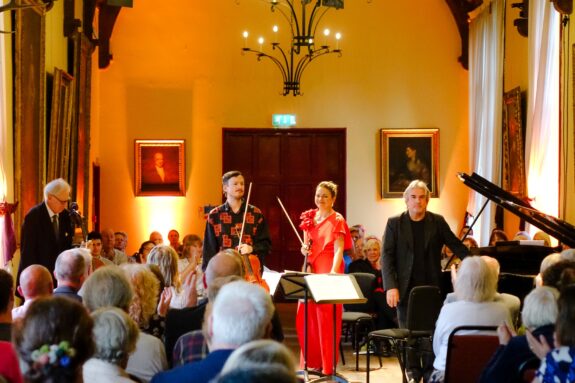
 United Kingdom Clandeboye Festival 2025 [1] – Brahms, Franck: Barry Douglas (piano), Tatiana Samouil, Michael D’Arcy (violins), Ed Creedon (viola), Arto Noras (cello). Clandeboye Estate, County Down, Northern Ireland, 20.8.2025. (RB)

Brahms – Piano Quartet No.3 in C minor, Op.60; Piano Quintet in F minor, Op.34
Franck – Violin Sonata
This year’s Clandeboye Festival opened on 16th August. It features a series of chamber music and solo recitals in the historic Clandeboye Estate in County Down. The theme of this year’s festival is, ‘Aspects of Summer’ and the specific focus is on how to celebrate the growth and blossoming of musical talent across the island of Ireland. The festival is known for bringing together local and international musicians and for providing training, mentoring and performance opportunities for exceptional young talent. This concert featured two masterworks by Brahms and Franck’s perennially popular Violin Sonata.
The concert opened with the last of Brahms’s piano quartets which the composer completed in 1875. Brahms told friends that it could be considered as a musical interpretation of Goethe’s Werther, a novel in which the husband shoots himself due to his anguish over his feelings for the wife of a husband whom he admires. Brahms was in a similar situation to the protagonist given his feelings for Clara Schumann and his admiration for her husband, Robert.
Barry Douglas was joined by Tatiana Samouil, Ed Creedon and Arto Noras for this performance. The weary, sighing figures in the strings which opened the work signalled the bleak journey ahead. The four performers brought an extraordinary emotional intensity to the opening movement and succeeded in capturing the dark turbulent mood and sense of despair which permeate the work. Douglas injected rhythmic drive and dynamism into the galloping Scherzo and there was tight coordination with his string partners. The Andante slow movement is a gorgeous song without words. Noras opened with a luscious, extended melody before the baton was passed to Samouil and Creedon. The movement had a wonderful sense of flow as phrases were passed seamlessly between the players. The Finale opened in restless fashion with Samouil playing an extended violin solo against Douglas’s energetic accompaniment. I was struck by how modern some of the material sounded particularly in the piano part. Dark shadows and restless anxiety flowed through the movement before the ensemble drove the work to its biting conclusion.
Franck wrote his Violin Sonata in 1886 as a wedding present for the Belgian virtuoso violinist, Eugène Ysaÿe. The work has a cyclic structure where themes from earlier movements reappear in a transformed form in ensuing movements. It is one of the most famous violin sonatas ever written and a landmark of the chamber music repertoire. Barry Douglas was joined by Tatiana Samouil for this performance.
Both performers brought warmth and intimacy to the opening movement with its gently rocking theme. Samouil created a wonderful sense of flow with her seamless legato lines. There was excellent balance and rapport between the two performers. The second movement is noted for its technically demanding piano part and Douglas rose to the challenge magnificently by producing an incendiary virtuoso display. Samouil proved a perfect partner, bringing passion and dynamism to the surging violin line. The coda was a virtuoso tour de force by both performers. Samouil captured the improvisatory spirit of the third movement and there was a wonderfully expressive quality to her performance. As the movement progressed, Douglas provided exemplary support with his richly coloured rippling accompaniment. The final canon was taken at a brisk pace and there was excellent interplay between the performers. Samouil and Douglas succeeded in capturing the joyous celebratory quality of the movement. There were minor balance issues at the end of the movement although they did not detract from what was a superb performance of the sonata.
The final work on the programme was Brahms’s Piano Quintet which is often called ‘the crown of his chamber music’. The composition began life as a string quintet, after which Brahms transcribed it into a work for two pianos before giving it its final form.
All five players brough power and dynamism to the opening movement which emerged with symphonic depth and gravitas. They did an excellent job navigating their way through the shifting contrasts and tempo transitions in the score. One or two of the entries could perhaps have been a little tighter. The slow movement was heartfelt and tender: Douglas imbued the opening theme with a luminous poetic sheen while the string players allowed Brahms’s harmonies to bloom in a poetic and rapturous way. The string players captured brilliantly the unsettled, slightly sinister quality in the opening section of the Scherzo. As the movement progressed, all five players brought an adrenaline rush to the music with its rhythmic energy and breathless syncopations, while Douglas brought unbridled power to the climax points. The ensemble captured perfectly the dark sombre mood in the extraordinary introduction to the Finale with its rising semitone figures. As the movement progressed, the music once again caught fire, and one was increasingly caught up in the urgency, drama and dark turbulence of the work. This was a barnstorming performance from all five players at the top of their game.
Robert Beattie
Featured Image: [l-r] Arto Noras (cello), Michael D’Arcy (violin), Tatiana Samouil (violin) and Barry Douglas (piano) © Camerata Ireland