
 Germany Musikfest Bremen 2025 [1] – Mozart, Die Zauberflöte (The Magic Flute): Soloists, Chorwerk Ruhr, Deutsche Kammerphilharmonie Bremen / Tarmo Peltokoski (conductor). Die Glocke, Bremen, 27.8.2025. (DM-D)
Production:
Director – Romain Gilbert
Lighting design – Hervé Gary
Chorus director – Michael Alber
Cast:
Sarastro – Manuel Winckhler
Queen of the Night – Kathryn Lewek
Pamina – Elsa Dreisig
Tamino – Mauro Peter
Papageno – Äneas Humm
Papagena – Miriam Kutrowatz
Monostatos – Andreas Conrad
Speaker – Marcell Bakonyi
First Lady – Silja Aalto
Second Lady – Iris van Wijnen
Third Lady – Marie Seidler
Second Priest – Maximilian Fieth
First Man in Armour – Martin Loger
Second Man in Armour – Marcell Bakonyi
The Three Boys – Soloists of St. Florianer Sängerknaben
As soon as the lights on the podium came on and those in the auditorium were dimmed, the musicians of the Deutsche Kammerphilharmonie Bremen came on the stage and sat down briskly and efficiently on the edges of their seats, ever so ready to go. They had already tuned their instruments backstage. Their conductor, Tarmo Peltokoski, came on only a second after the last of the musicians, took his bow not on the podium but from behind the conductor’s stand, and conductor and musicians began making music together the second he had climbed onto the podium. Their music-making was inspired by complete attention to each other and complete trust. Peltokoski first worked with the Deutsche Kammerphilharmonie Bremen in June 2021; the rapport between orchestra and conductor was such that he was appointed as first principal guest conductor in February 2022.
Such attention and trust were also characteristic of the relationship between orchestra and conductor on the one hand, and the singers on the other hand. Peltokoski was aware of and attentive to the singer’s individual needs and moulded the music accordingly. For example, he supported Manuel Winckhler, the early-career bass singing Sarastro, in the exposed very low passages in both of his arias. He reduced the volume, so that Winckhler was able to focus on and apply his technique in his completely successful effort to make those low register notes as beautiful and sonorous as the rest of the role without that obvious need to focus on technique. In other productions, such reduction of volume may come across exclusively as the conductor’s support for the singer. Peltokoski, however, was able to mould the music in such a way that the reduction of volume became first and foremost, almost exclusively, an expression of overall artistic interpretation.
The two arias of the Queen of the Night provide a further example. In many productions, the two arias come across as very similar, although the libretto suggests completely different contexts as the Queen addresses Tamino and Pamina, respectively, with entirely different emotions and intentions. One of the reasons those arias can seem similar is the nature of the voice of the soprano cast as the Queen. Often the exposed high notes go along with delicate sounds, sometimes wafer-thin, in the best sense of the words. The conductor must hold the orchestra in check quite considerably in such cases to allow the voices to shine. Kathryn Lewek represents a rare exception. In the Queen’s first aria, Lewek’s voice allowed her to come across as the charming mother when addressing Tamino, with the coloratura as a means of enticing him into saving Pamina. Her voice, most importantly, also allowed her to reach the highest exposed notes of the part beautifully, with ease, at full throttle. Thus, in her revenge aria, the effect of Peltokoski’s unleashed orchestra, with Lewek’s unbridled voice, was indeed one of witnessing hellish rage at absolute boiling point. In both cases, the intention of using the voice achieved its aim: it was the voice as much as the words that brought Tamino to commit to saving Pamina, and it was the voice that rendered Pamina willing to kill Sarastro. Pamina experienced her mother’s vengeful voice as physically painful; she tried hard, and for a long time, to resist the impact of that voice, writhing in agony, with many silent screams reminiscent of the famous Munch painting, but by the end of the aria she had been broken, in a trance induced by that voice, ready to commit murder.
The other singers were equally excellent. Mauro Peter was a strong and ardent Tamino. He has already sung Max in Der Freischütz, and he may well have a future in the heavier German repertoire. Elsa Dreisig was a radiant Pamina, her well-controlled soprano rising to exciting silvery bloom where required. Miriam Kutrowatz was engaging in her short scene as Papagena. Äneas Humm was not only very funny as Papageno: he sang with a fully focused, burnished voice. Andreas Conrad was the Mime in the 2015 Ring in Bayreuth directed by Frank Castorf. As Monostatos he used his balanced character tenor voice to great effect. Silja Aalto, Iris van Wijnen and Marie Seidler were excellent as the Three Ladies, vocally well nuanced and individual. Maximilian Firth was more than reliable as the Second Priest. Martin Loger and Marcell Bakonyi complemented each other well as the Two Men in Armour, while Bakonyi was very convincing as the Speaker.
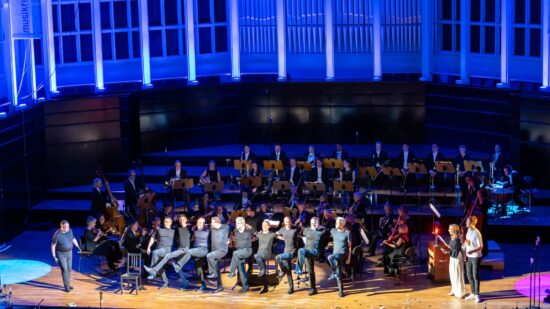
The impact of music and singing was enhanced by the semi-staged production, directed by Romain Gilbert and with lighting design by Hervé Gary. The characters entered and exited from the left or right of the stage, or at the raised level of the concert hall’s organ and had a small strip of playing area in front of the orchestra. The best adjective to use to describe the production is witty. There were numerous moments that were funny and caused laughter in the audience because they were unexpected. For example, the snake chasing Tamino was in fact a practical joke by the Three Boys, who dressed up as the snake. The snake was ‘killed’ by the Three Ladies pulling one boy each by the ear and dragging them off the stage. Papageno did not play the Glockenspiel himself: Suwon Kim sat at the carillon and whenever the libretto asked for Papageno to play the carillon, he motioned to the instrument on the stage, a red light lit up on top of it and Kim played. Enchanted by Papageno’s Glockenspiel, the nine thugs working for Monostatos embarked on a chorus line number. Äneas Humm as Papageno uttered some words in his native Swiss German accent to the effect that there should be no problem with him talking like that while under the order of silence because nobody around can understand a word spoken in that accent anyway.
The Bremen audience acknowledged their appreciation of the evening with an immediate standing ovation.
Daniel Meyer-Dinkgräfe
Featured Image: Musikfest Bremen’s Die Zauberflöte final curtain call © Patric Leo
The same cast has just reprised the production on Sept 7, as part of the Enescu Festival in Bucharest. A wonderful afternoon, with Papageno interpolating references to Romanian food and wine. With great economy of means the magic of the opera was conveyed, above all in the quality of the voices. Not mentioned above was the chorus, very powerful. The audience was given a full libretto in Romanian, but with all the ad libbing it was more fun listening. Standing ovation, in the intimate venue of the Sala Radio.