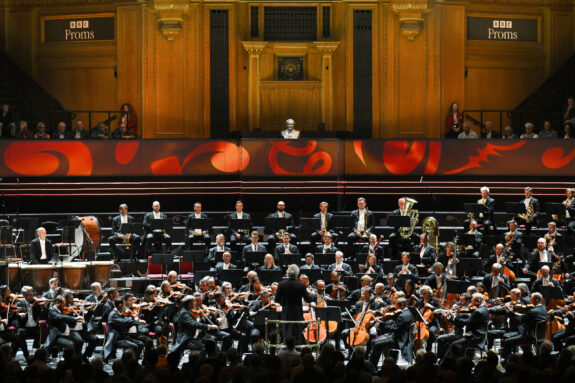
 United Kingdom BBC Proms 2025 [29] – Mozart, Tchaikovsky: Vienna Philharmonic / Franz Welser-Möst (conductor), Royal Albert Hall, London 9.9.2025. (JR)

Mozart – Symphony No.38 ‘Prague’, K.504
Tchaikovsky – Symphony No.6 ‘Pathétique’, Op.74
The tube strike made it exceptionally hard for many to attend this ‘early start’ Vienna Philharmonic concert but, judging from the very few empty seats and the queue for returns, few were actually daunted – although some had to be admitted after the first movement of the Mozart. The difficulties in reaching the Royal Albert Hall were quickly forgotten as soon as we heard the first strains of this glorious orchestra, surely one of the world’s finest ensembles.
Some consider Mozart’s 38th Symphony as fine enough to rank with his generally accepted final three symphonic masterpieces (Nos. 39, 40 and 41), citing its intellectual force, triumphant mixture of grandeur and lyricism, introduction of counterpoint and its emotional complexity. Welser-Möst played it fairly straight, and although the work was graceful, elegant, it lacked much joy. The opening Adagio was a mite turgid, and the huge Albert Hall did the work no favours acoustically (the orchestra were in Lucerne on the 6th with the same programme where the KKL, the fine concert hall overlooking Lake Lucerne, is acoustically nigh perfect). The work seemed lost in space. Yes, the strings were a glory, woodwind mellow, it was all very smooth, like a limousine stuck in second gear. I yearned for a Norrington or a Mackerras to bring the music to life. Only in the last movement did I find some balm, the violins scampered gleefully, the flutes and oboes chirped, the bassoons babbled, but Welser-Möst found it hard to smile and any jovial energy was hard-earned.
I do not think of the Vienna Philharmonic and Tchaikovsky in the same breath, they are hardly natural bedfellows. And so it turned out. In a programme interview, Welser-Möst said that, when he was young, he considered Tchaikovsky as ‘sugary and nice’. Then he heard Mravinsky’s Leningrad Philharmonic performance of the ‘Pathétique’ which he described as ‘simply frightening’; he then goes on to say he will simply conduct what the score tells him, eschewing self-indulgence and extremes of rubato. The result was the performance was plain to a fault; there was no nastiness, no spiky edges, no dissonance, and in the last movement very little emotion. Welser-Möst is the opposite of flamboyant, he moves little on the podium, there is only the odd hand gesture and no sweat on the brow: one could call it restrained, but some could call it boring. Admittedly, this orchestra cannot fail to sound wonderful, especially the lush strings (violins and violas in particular) and I must highlight the captivating principal clarinet. The strings turned the page before the big bang in the first movement with extreme and notable caution, aiding the grand coup de théâtre. The brass were not as secure as they could have been, here I yearned for the sound of a Russian orchestra in this music and the violent conducting of, say, Semyon Bychkov or Vasily Petrenko. The quieter sections of the score came off best in this conductor’s hands. Welser-Möst did well to forestall premature applause at the end of the third movement Allegro motto vivace, launching almost immediately into the final movement before the musical incognoscenti knew what had hit them.
Welser-Möst did build up the mighty crescendo in the final movement with skill and then wound down to the depths for the symphony’s gloomy ending: here Welser-Möst held an arm aloft to let the despair sink in before allowing applause. No yelps or whoops from the audience, no encore, and only the very faintest of smiles from Welser-Möst. I came away with the silky sound of the Viennese strings echoing in my head but agonising about how many buses I would need to get home.
John Rhodes
Featured Image: Franz Welser-Möst conducts the Vienna Philharmonic at the BBC Proms 2025 © BBC/Chris Christodoulou