 United Kingdom Britten, The Turn of the Screw: Soloists, Jessica Meakin, Julian Cann (violins), Kim Becker (viola), Daniel Crompton (cello), Richard English (double bass), Richard Allen (harp), Hannah Gillingham (flute/alto flute/piccolo), Mana Shibata (oboe/cor anglais), William Hammond (clarinet/bass clarinet), Ursula Leveaux (bassoon), Chris Howlings (French horn), Alex Norton (piano/celesta), Stephen Burke (percussion) / Joe Davies (conductor). Victoria Hall, Grange-over-Sands, 30.8.2025. (CK)
How does a reviewer do justice to the difference between a performance that is excellent in every respect and one that he knows he will remember for the rest of his life? I pose the question because these performances (there were two) fell emphatically into the second category. It is an opera that I have heard in a large opera house, where despite the presence of illustrious singers it simply didn’t work; of course it is not simply a matter of scale, but a performance in a venue such as the delightful Victoria Hall in Grange-over-Sands begins with a distinct advantage. Delightful, but well suited to an opera that deals in darkness and claustrophobia.
For the Cumbria Opera Festival’s opening performances of The Marriage of Figaro (review here) in Penrith an orchestra of four strings and four woodwind plus harpsichord continuo sufficed (thanks to Joe Davies’s miraculous arrangement of Mozart’s score). Here, the full complement of thirteen players specified by Britten was present: and one of the great pleasures – if that is the right word for so hair-raising a score – of the evening was to be able to appreciate (and, at times, to be overwhelmed by) the extraordinary brilliance of Britten’s writing for his chosen instruments, the almost preternatural range of colours he elicits from them: from, for example, the four woodwind players, handling eight instruments between them. Extraordinary, too, to experience in close-up the resourcefulness and dramatic acuity of Britten’s writing for percussion, entrusted to a single player, at times combining with harp and piano/celesta in a sinister gamelan.
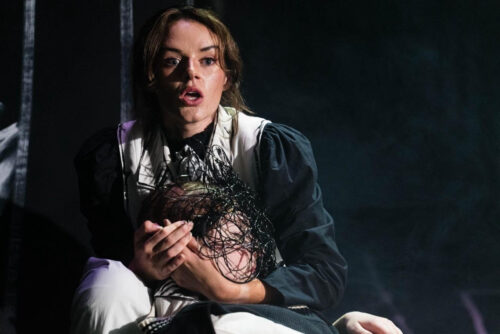
It has long been a critical commonplace to view the story as the product of the Governess’s overheated imagination: her hallucinations eventually frighten Miles to death. As far as I know, director Jonny Danciger broke new ground in this production: taking his cue from Catherine Storr’s 1958 novel Marianne Dreams, he refracts the opera through the memory and imagination of the traumatised surviving child, Flora.
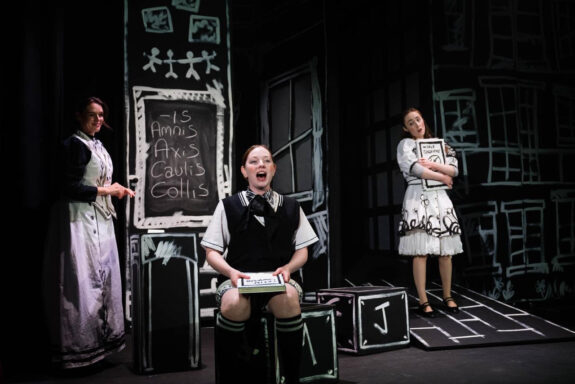
The first thing we think of when we see the stark and disorienting set is early German Expressionist cinema: the house’s façade is split in two by a central tunnel, a passage into darkness, its floor steeply raked, defying the laws of perspective, from which Quint and Miss Jessel emanate into the children’s lives. But it isn’t long before we realise that the house – in fact, everything we see – is as it has been drawn by Flora, down to such details as the clothing worn by Quint and Mrs Grose.
The Prologue (Rhydian Jenkins) is a white-coated psychiatrist: Flora is on a chair in his consulting room as the opera opens, obsessively drawing pictures, some of which we see projected on a screen, as on a flip chart. Later in the opera we see that she is covering the walls of the children’s bedroom with drawings: and at the end the last thing we see is Flora – everything else in darkness – in a red glow (a colour associated with Quint), still drawing, still pinning pictures to the wall. Is she reacting to frightening and disturbing events, or – as in Storr’s novel – is she drawing her dreams which then become reality?
The production bristled with telling detail: when, for example, the children sing Lavender’s blue, at the line You shall be Queen Miles dubbed Flora lightly on each shoulder with a (presumably) toy sword – it looked pretty real – and then mimed cutting her throat. Flora’s doll becomes her totem, pulled between Miss Jessel and the Governess; in Act II the children enact its burial with blasphemous mock-seriousness.
Kirsty McLean – who recently made her Covent Garden debut in Jenůfa – was a marvellous Governess, evoking in her singing her anxiety and bright hopes at the beginning, her confusion of feeling and her desire to impress the unseen guardian, her vulnerability and her determination to do the right thing, her attempts at courage; she was aided and abetted by Mae Heydorn’s forthright Mrs Grose – strong of voice and presence, no timid underling. Lottie Day and Rebecca MacGregor-Black were splendid as Miles and Flora, especially Lottie: in her acting as well as her singing she suggested everything about the corrupted and conflicted Miles, engaging our sympathy and perhaps our horror too.
Rhydian Jenkins’s Peter Quint was an immensely powerful and troubling figure, in both his physical presence and his alluring voice: I shall not forget the salacious ecstasy of his elaborate melismas on Miles’s name from the back of the tunnel – a crack in the world of ordinary appearances – or the glamour which penetrates and perverts the boy (‘I am all things strange and bold’). Georgia Mae Ellis as Miss Jessel has less to do, but she sang the part beautifully and never allowed us to forget that she too is a victim.
There is much that can be said about Britten’s tightly organised structuring of the opera, shadowing the tightening of the drama, the turning of the screw; and about the ways in which the music suggests insidious corruption without ever bringing it into the open. In this performance, all these things were apparent: Joe Davies and his players did not permit us to miss them.
A very remarkable evening. Almost forty years ago the original production of Birtwistle’s opera The Mask of Orpheus had a handful of performances at English National Opera and then disappeared into opera folklore, leaving indelible memories in the minds of those of us who experienced it. Perhaps something similar will be true of this production. I wish fervently that many others might have the chance to see it: but its reputation is secure in the minds of those of us who did.
Chris Kettle
Featured Image: Kirsty McLean (The Governess), Lottie Day (Miles) and Rebecca MacGregor-Black (Flora)
Production:
Director – Jonny Danciger
Assistant Director – Lucy Britton
Set designer – Emma Turner
Costume designer – Megan Bowyer
Lighting technician – PJ Summers
Assistant Conductors – Beatrice Farncombe, Friyan Bajan
Cast:
The Governess – Kirsty McLean
Prologue/Peter Quint – Rhydian Jenkins
Miss Jessel – Georgia Mae Ellis
Mrs Grose – Mae Heydorn
Flora – Rebecca MacGregor-Black
Miles – Lottie Day
It is very nice that you credit the small orchestra with their names. They will have studied their craft for years, generally starting as young children yet often they are rarely mentioned. Imagine a production without them. In these times of A1 highly-trained young musicians they need all the help they can get. They rarely get a crumb of credit and the deserve it. Each and every single one of them!