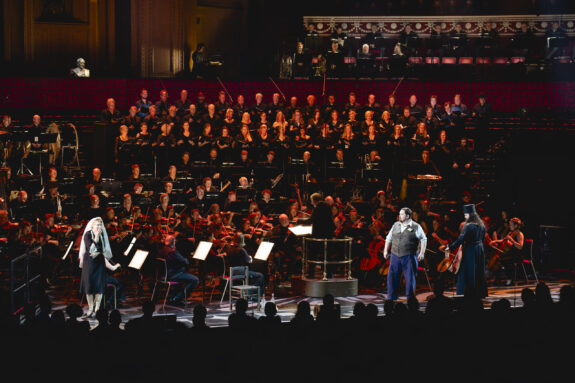
 United Kingdom BBC Proms 2025 [26] – Shostakovich, The Lady Macbeth of the Mtsensk District: Soloists, BBC Singers, Chorus of English National Opera (chorus master: Matthew Quinn), Brass Section of the Orchestra of English National Opera, BBC Philharmonic Orchestra /John Storgårds (conductor), Ruth Knight (stage director). Royal Albert Hall, London. 1.9.2025. (CSa)

For probably the first time in the 130-year history of the BBC Proms, the organisers thought it wise to issue parental guidance about the content of the programme. Deemed unsuitable for those under the age of 15, parents were warned that Ruth Knight’s harrowing semi-staged production of The Lady Macbeth of the Mtsensk District would feature ‘mild depictions of violence and sexual assault’ and that the libretto, translated into earthy English by David Pountney contained ‘strong language’. Premiered in 1934 Shostakovich’s dramatically powerful and musically radical work contains scenes of murder, lust and brutality, which as this outstanding performance demonstrated, still have the capacity to shock a modern-day audience.
Shostakovich based his work on a mid-nineteenth century novella of the same name by Nikolai Leskov. It tells the story of Katerina, the desperately bored wife of a wealthy merchant, Zinovy, and trapped in a stifling provincial and loveless marriage. She is seduced by and falls in love with the cynical opportunist Sergey, a handsome worker on her husband’s estate. Their passionate affair – sometimes lovemaking and sometimes rape – takes place while Zinovy is away on a business trip. Once Katerina’s infidelity is discovered by her tyrannical and domineering father-in-law Boris, things quickly turn violent and lead her to murder not only her husband and her father-in-law, but also to Sergey’s new love interest, Sonyetka .
While Leskov’s Katerina is a one-dimensional Shakespearean villainess, red in tooth and claw and archetypically evil, she is reshaped by Shostakovich into a more complex and sympathetic character. His ‘Katya’ is unquestionably wicked, but she is also a victim crushed by the cruelty of others. It is her desperate desire for love that ultimately leads her to destruction. After acknowledging her guilt, she commits suicide by drowning.
Leskov gave the young composer the storyline for his opera, but Nikolai Gogol, one of the most original and influential figures in pre-revolutionary Russian literature, gave him the tone. Gogol’s grotesque caricatures of small-town official corruption, greed and brutality, rampant in Stalin’s Russia, provided Shostakovich with the perfect dramatic backdrop for surreal comedy and monstrous parody. Little wonder then that when Stalin attended a performance at the Bolshoi on 26th January 1936, he walked out after the third act. ‘Muddle instead of Music’ thundered Pravda two days later, denouncing the work as ‘coarse, primitive and vulgar’.
The power of Shostakovich’s tragediya -satira as he described it, lies in the collision between Katerina’s essential humanity – a combination of spiritual pain and existential despair – and the conduct of the ridiculous, cruel and venal characters who surround her.
The unrelenting atmosphere of this compelling Proms performance was simply but ingeniously suggested by constantly shifting abstract images projected onto a semi-circle of digital screens behind the performers. Themes of violence passion and turmoil were intensified by raw shafts of light ranging from brilliant white to carnal red. Props were minimal but effective: a solitary iron bed, a small table, a wooden witness box, and a translucent, crimson-lit plastic cube in which the silhouetted figures of Katerina and Sergei copulated.
American soprano Amanda Majeski brought an icy nobility to the abused Katerina. The range and purity of her silver-edged voice reached the furthest recesses of the cavernous Royal Albert Hall. One could not repress strong feelings of sympathy for her ‘Katya’ as she urged her lover Sergey (a convincing Nicky Spence) to strangle her hapless husband (tenor John Findon), or when she served up a bowel of mushrooms generously seasoned with rat poison to his bullying father (menacingly portrayed by stentorian bass Brindley Sherratt). There were equally impressive performances in the smaller roles. Mezzo-soprano Naimh O’Sullivan, as the stocking stealing Sonyetka charmed and appalled in equal measure. Baritone Thomas Mole as the tottering drunken priest invoked the Holy Spirit with the assistance of a bottle of vodka, while the great Willard White in the critical role of the Old Convict, reminded us of the larger world of human suffering. His poignant lament will linger in the memory.
The excellence of these individual performances was fortified by the combined forces of the BBC Philharmonic Orchestra and Chorus and brass of the Orchestra of English National Opera. – some 149 musicians and singers in all – under the baton of the indefatigable John Storgårds.
It is striking that a piece once condemned from the highest echelons of power, could now draw a full house at the Proms. Stalin might have recoiled from its unvarnished depiction of life under his regime, but eighty years after its denunciation, the audience, captivated and unsettled by its continuing relevance, were unwilling to look away.
Chris Sallon
Featured Image: The Lady Macbeth of the Mtsensk District at the BBC Proms 2025 [front l-r] Amanda Majeski (Katerina), John Storgårds (conductor), John Findon (Zinovy) and Thomas Mole (Priest) © BBC/Andy Paradise
Cast:
Katerina – Amanda Majeski
Boris / Ghost of Boris – Brindley Sherratt
Zinovy – John Findon
Mill Hand / Priest – Thomas Mole
Sergey – Nicky Spence
Aksinya / Convict – Ava Dodd
Shabby Peasant – Ronald Samm
Steward – Alaric Green
Police Sergeant – Chuma Sijeqa
Teacher – William Morgan
Old Convict – Sir Willard White
Sonyetka – Niamh O’Sullivan