 United Kingdom Puccini, Tosca: Soloists, Chorus and Orchestra of the Vienna State Opera / Pier Giorgio Morandi (conductor). Directed for the screen by Anna Gettel and broadcast from the Vienna State Opera on 27.9.2025. (JPr)
This year Puccini’s ‘shabby little shocker’ (musicologist Joseph Kerman) was 125 years old and for almost half that time – 67 years to be precise – it has been performed at Vienna State Opera in the late Margarethe Wallmann’s ultra-traditional – at least for 2025 – staging which premiered on 3rd April 1958, with Renata Tebaldi as Tosca and conducted by Herbert von Karajan. ‘If it ain’t broke, don’t fix it’!’ typifies the Vienna State Opera I have known and loved for almost 50 years. Although for the previous performance in this short early season run the stage machinery did break down and Act II had to be played out in front of a closed curtain!
Thankfully by this, the 665th outing of this production all was well. As I have written before, Nicola Benois’s solidly three-dimensional sets, sumptuous costumes and Wallmann’s direction (such as it now is) will strongly remind you are of the famous 1976 filmed Tosca with Catherine Malfitano, Plácido Domingo, and Ruggero Raimondi that was performed in the actual Roman settings – the church of Sant’Andrea della Valle, Palazzo Farnese, Castel Sant’Angelo – described in by Luigi Illica and Giuseppe Giacosa’s libretto and at the appropriate times of a June 1800 day.
Vienna State Opera’s Tosca is as Puccini intended and why not? For Act I there was a realistic chapel for Cavaradossi to paint in with its small Madonna statue and plenty of room to showcase the procession of the bishop, priests, altar boys, choristers, and worshippers for the well-populated ‘Te Deum’. Act II shows us Scarpia’s well-furnished chambers including a table, chaise longue, desk, the requisite two candlesticks and a crucifix, as well as a concealed torture chamber. And for the final act we are on castle ramparts under a suitably starry sky with a large Archangel Michael (I guess?) statue as on the actual Castel Sant’Angelo. My only criticism of how I saw it online now was that it all looked rather dark apart from the principals in their spotlights.
It is not the first – not will it be the last – time I will write that a memorable Tosca needs three singing-actors who can create believable characters and draw you into the very – very – familiar story through their vocal strength and dramatic artistry to make you feel you are watching the opera for the first time. That it certainly gets here from a Russian soprano, Chilean-American tenor and French baritone making the venerable Tosca production look fresh – due in part, I suspect, to revival director Natalie Ortner-Menconi – even if some of the sets and costumes are fraying at the edges.
Elena Stikhina acts and sings superbly as Tosca, evincing all the emotions you would expect from her diva character; piety, allure, passion, jealousy, despair, defiance, anger and finally, gullibility over the unlikeliest of happy endings she envisages for herself and Cavaradossi. Having grappled with Scarpia on the chaise longue – and sung while kneeling on the floor – Stikhina’s ‘Vissi d’arte’ genuinely was a prima donna’s cri du coeur from the depth of her soul and deeply moving consequently. Stikhina’s expressive soprano voice has a solid mezzo-ish foundation and is evenly and seemingly effortlessly produced across its range. It came as no surprise given her anguish in this second act that Stikhina’s Tosca was capable of killing someone and Scarpia was despatched more convincingly than we will sometimes see.
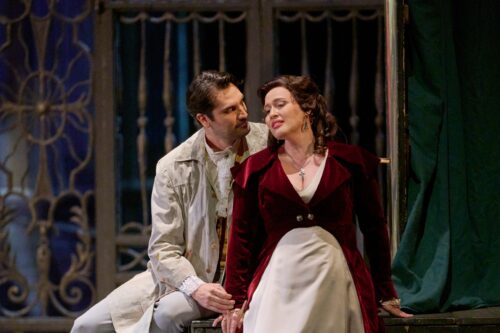
On the contrary, Jonathan Tetelman – making a house role debut – was a rather more effortful Cavaradossi but he was a convincing actor both as Tosca’s lover (the chemistry with Stikhina was palpable) and fervent revolutionary. ‘Recondita armonia’ was somewhat forthright; aided by a compliant conductor the defiant Act II ‘Victoria! Victoria!’ high note went on and on; and his final act ‘E lucevan le stelle’ was heartful and beautifully phrased but began softly and interiorised as if it was Pagliacci’s ‘Vesti la giubba’. His Cavaradossi appeared equally guileless and seemed to believe Tosca’s fake execution nonsense. This final scene is much better when Cavaradossi realises he will be killed but doesn’t want to reveal that to Tosca.
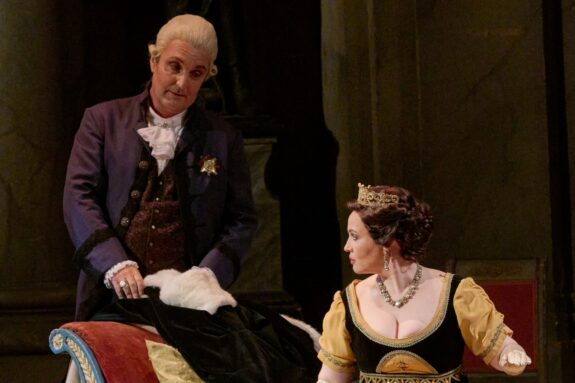
Singing his role for the first time in Vienna, Ludovic Tézier in tricorn hat, powdered wig and embroidered frock coat looked as you would expect Scarpia should look. Despite an air of civility, he was a ruthless, sex-crazed brute. Consummate acting and a magnetic stage presence was allied to Tézier’s virile singing. The Act I ‘Te Deum’ had a visceral edge and the threat Scarpia posed to Tosca was chilling when he fondled her fur-trimmed robe as she reclined on the chaise longue and he nuzzled her shoulder before the softest, yet most menacing, ‘Ebbene?’ (‘Well?’).
There were solid and strongly sung performances elsewhere in the ensemble including Wolfgang Bankl as a fairly serious – though still greedy – Sacristan; Jusung Gabriel Park’s ardent Angelotti; Devin Eatmon’s acquiescent and rather youthful Spoletta; and Dan Paul Dumitrescu’s stolid, jobsworth Gaoler.
From the first three thunderous chords, Italian Pier Giorgio Morandi conducted Puccini’s sumptuous score with passion, force and narrative drive. He supported his singers attentively throughout this memorable Tosca and rarely drowned out their voices, at least as heard through loudspeakers. From the musicians of the Vienna State Opera Orchestra there was the familiar sheen from the strings, mellow woodwind and resonance from its glowing brass.
I hope to see and hear soon whether The Royal Opera’s new Tosca can match this excellent performance of an almost seven decades old production.
Jim Pritchard
Featured Image: Ludovic Tézier (Baron Scarpia) and Elena Stikhina (Floria Tosca) © Wiener Staatsoper/Michael Pöhn
Production:
Director – Margarethe Wallmann
Revival director – Natalie Ortner-Menconi
Sets and Costumes – Nicola Benois
Chorus master – Martin Schebesta
Cast:
Floria Tosca – Elena Stikhina
Mario Cavaradossi – Jonathan Tetelman
Baron Scarpia – Ludovic Tézier
Cesare Angelotti – Jusung Gabriel Park
Sacristan – Wolfgang Bankl
Spoletta – Devin Eatmon
Gaoler – Dan Paul Dumitrescu
Sciarrone – Hans Peter Kammerer
A Shepherd – Nare Kazanjian