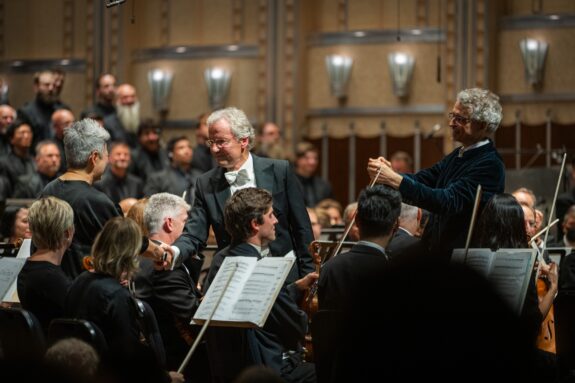
 United States Various: Cleveland Orchestra Chorus (chorus director: Lisa Wong), Cleveland Orchestra / Franz Welser-Möst (conductor). Mandel Concert Hall at Severance Music Center, Cleveland, 26.9.2025. (MSJ)
Bernd Richard Deutsch – Urworte
R. Strauss – ‘Salome’s Dance’ from Salome, Op.54
Ravel – Boléro
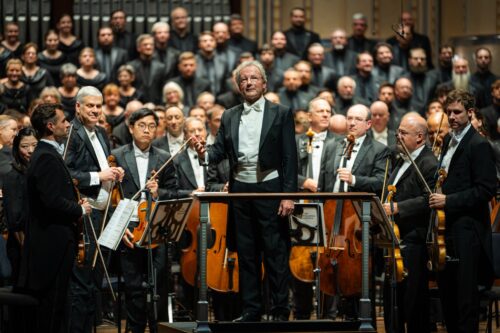
After missing a chunk of the season last year due to health battles, Franz Welser-Möst was back in peak form for the opening of his twenty-fourth and penultimate season with the Cleveland Orchestra. In many ways, it summed up the best features of his time in Cleveland: innovative repertory that offers exciting new challenges, fresh thought on classics and, above all, the exalted playing of the Cleveland Orchestra.
The first part of that triple constellation ended up being a lot larger than even Welser-Möst expected. In an onstage, pre-concert, season-preview interview with orchestra president André Gremillet, Welser-Möst said that when he co-commissioned a new work from composer Bernd Richard Deutsch for chorus and orchestra, he assumed Deutsch would deliver a twenty-to-twenty-five-minute piece. Instead, Urworte (Primal Words) runs close to an hour and feels conceptually even larger.
For his text, Deutsch selected a late cycle of poems by Johann Wolfgang von Goethe which offers philosophical meditations on four ancient Greek archetypes: ‘Demon’, ‘Accidental’, ‘Love’ and ‘Necessity’, to which Goethe added ‘Hope’. I would choose ‘Daemon’ in place of the more conventional but misleading word ‘Demon’, which was used in the Kirk Wetters translation (Northwestern University Press, 2025) utilized in the program for this concert. The latter word has accumulated a great deal of religious and pseudo-religious baggage, whereas the arcane ‘Daemon’ has been used to refer to the original Greek meaning of the word: a primal formative force of one’s personality, neither necessarily good nor evil. Deutsch used it as a cosmic departure point, beginning the piece with one of the most striking shapeless voids in music. From this a contrabassoon and then a contrabass clarinet crawled with a phrase that uncoiled like a strand of DNA.
And as musical DNA, that strand generated the entire piece, too vast to absorb in one hearing. As heard previously in Deutsch’s Okeanos and Intensity, written when Deutsch was a Daniel R. Lewis Composing Fellow with the orchestra from 2017 to 2020, the composer’s musical imagination is fertile and wide-ranging, from angular gestures and percussive fusillades to tonally anchored planes of sound. The choral contribution, handled spectacularly by Lisa Wong’s Cleveland Orchestra Chorus, likewise ranged from lyrical arcs to jagged twists and even included unpitched chanting.
The powerful forces sparkled in the scherzo-like second movement. Exploring the philosophical idea of chance, the movement brought back memories of the playful passage from Deutsch’s organ concerto, Okeanos, which actually provoked a ripple of delighted laughter from the audience during that work’s premiere in 2018. The present work was on a vaster scale: each movement of Urworte, though clearly a part of the whole, could also work as self-contained concert pieces like the parts of Smetana’s Má vlast or the Sibelius Lemminkaïnen Legends. The third movement, ‘Love’, was ardently lyrical, including a substantial solo for the orchestra’s new concertmaster, Joel Link, who displayed a lovely, tawny tone. The fourth movement, ‘Necessity’, despite being the most abstract of the four Greek concepts was perhaps the most musically focused of these discursive rhapsodies. ‘Hope’ rounded the piece off with radiance, followed by a return to the opening primordial soup, with the contrabassoon finally plunging back into the depths and disappearing mid-phrase, a closing wink. Deutsch was on hand for this US premiere and received the audience’s warm ovation.
Despite the massiveness of the new work, which Welser-Möst handled with assurance, the conductor appeared more fully energized in the second half than he has in years, pitching into Salome’s veil dance with vigor. Richard Strauss has always been one of Welser-Möst’s strong suits, but it is interesting to hear how much subtler his approach has become over the years. In his youth, the conductor tended to be unyielding with pulse, but he has become more flexible, giving the music a quality of living shape. This dance progressed with countless touches of understated but definite rubato, giving the orchestral juggernaut a human face, not an easy trick in this music. The Cleveland strings sounded full and warm, bringing the sensual element of the dance to the forefront. Frank Rosenwein’s oboe solo featured both that sinuous touch and the exotic intensity of the composer’s concept of Middle Eastern music.
I was fully prepared to dislike Welser-Möst’s take on Ravel’s Boléro. I am a fan of taking Ravel at his word, which was that this piece should be seventeen minutes long. His own recording of the work was just shy of sixteen minutes, and when one of his friends remarked that it was slower than average, Ravel is reported to have remarked that if he thought they could have played it, he would have gone more slowly. The orchestra’s Musical Arts Association has twice put out live concert recordings of Welser-Möst’s rendition of Boléro, one from the beginning of his tenure in 2003 and another from midway through in 2012. I just about despise the first one, clocking in at just over fourteen minutes, which falls squarely in the irritating ‘wham-bam-thank-you-ma’am’ tradition of fast versions started by Toscanini (to Ravel’s fury!).
Over a decade after, Welser-Möst had grown as a conductor, broadening a little and offering more flexibility. In this concert some ten years later, we heard a Boléro broader yet still a little quicker than Ravel’s ideal. But what mattered is that within the framework of a now moderately paced performance, the conductor offers seemingly infinite nuance. He made sure that everyone from top to bottom was treating the bolero rhythm as a human dance rhythm, subtly uneven and swaying, as opposed to a literal, mechanical reading. And he encouraged the soloists to go even further with that process of leaning into the beat, a feature that does harken back to Ravel’s own recording. Principal flutist Joshua Smith led it off with a wonderfully supple handling of the melodic line, full of golden tone even at the hushed opening. Others followed, some more flexible than others, which gave it the kind of personal engagement that many performances lack. There were a few minor blips along the way but nothing of significance in the grand picture that built up.
Many Boléro performances lose that sense of personality once the entire band gets cranking, but that wasn’t the case here. Welser-Möst didn’t merely beat time, he conducted this highly familiar work like it was another premiere, leaning toward the violins to make sure that they snapped the phrases as much as any of the soloists had. In a characteristic display of the conductor’s refusal to substitute mere volume for real intensity, the performance didn’t reach full roar until the final bar. It doesn’t matter now familiar Boléro might be, I would gladly hear it in any concert when performed with this level of mastery. What an auspicious way to kick off the season.
It is also worth noting the four-page salute in the concert program to the Cleveland Orchestra’s music director laureate, Christoph von Dohnányi, who passed away recently at the age of 95. Dohnányi led one of the orchestra’s golden ages, from 1984 to 2002, with patrician distinction. After their first peak under George Szell, the orchestra remained skilled during the Boulez stewardship (1970 to 1972) and during the tenure of the alternately brilliant and willful Lorin Maazel (1972 to 1982). Dohnányi restored and enhanced the orchestra to full luster, a magical blend never quite caught in any of the ensemble’s commercial recordings. After a sometimes-rough start, Dohnányi’s successor, Franz Welser-Möst, has grown tremendously as a conductor, bringing the orchestra to its third peak in its 107-year existence. It remains one of the world’s musical gems.
Mark Sebastian Jordan
Featured Image: Chorus director Lisa Wong, conductor Franz Welser-Möst and composer Bernd Richard Deutsch take a bow © Extraordinaire Photos/TCO