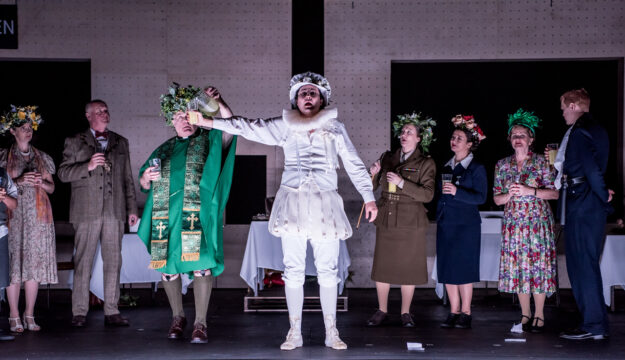
 United Kingdom Britten, Albert Herring: Soloists, Orchestra of English National Opera / Daniel Cohen (conductor). London Coliseum, 13.10.2025. (CC)
A rare opportunity to see and hear Britten’s 1947 opera (his Op.39), Albert Herring for this first shared English National Opera production between the London Coliseum and Manchester’s Lowry. After two performances at St Martin’s Lane there are two in Manchester (October 21 and 22).
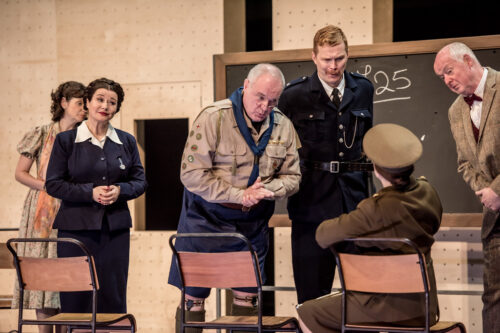
The director himself, Antony McDonald, describes this as a ‘pared-down’ production, and so it is: two panels suffice for all locations, and there is an added ‘stage manager’ who changes the time and at one point gives prompt cards for applause; a nice meta/theatrical sleight that reminds us that what we are seeing is fiction. Perhaps we should not get too close to Albert’s tale.
McDonald’s stated intent is that he intends to ‘investigate … the hypocrisy of the very judgmental characters in the story. At certain moments, we might see these characters through Albert’s eyes a little more.’ He also points out that via this simplicity of means, the exploration of ‘the recurring concern of Britten for the repressed individual pitted against a judgmental and blinkered society’ is possible.
Amazingly, this is ENO’s first staging of Albert Herring. Glyndebourne premiered it in 1947 and there have been several productions since including 2002 (with Alfie Boe as Albert – Allan Clayton took it in the 2008 revival – and Felicity Lott as Miss Billows and Susan Gritton as Miss Wordsworth); that same year, the Royal College of Music presented it staged by Thomas Allen. London colleges have embraced Britten’s score more than the big houses: both the Royal Academy and Guildhall in 2010, with the RCM following suit in 2015. Britten’s score has fared pretty well internationally, though. Interesting to see if it travels well; certainly, it stands in huge contrast to the works around it: it is preceded by The Rape of Lucretia (Op.37) and succeeded by Billy Budd (Op.50, four years later in 1951). So is this Albert Herring a slender Grecian maid?
No, it is a comedy: albeit a somewhat discomfiting one in McDonald’s post-war staging (most obviously when the vicar chases the schoolboy off brandishing a pack of sweets; or possibly where Sid kisses both his beloved/intended prey Nancy and Albert. In filling in some gaps to the community characters, McDonald puts shadows over the work, and not inappropriate ones. Britten’s score, for chamber ensemble, is deft but by no means always light. An adult’s soufflé, perhaps? And it does resonate with the idea of pagan associations with May: the May Queen (or King, in his case, as there are no female virgins to be found!) and the surrounding festivities. The dark stage background seems to imply there is an undercurrent here: Herring is an outsider, yes, but maybe that is a good thing. An innocent in a society corrupt at multiple levels. Matthew Richardson’s virtuoso lighting supports this concept perfectly, providing contrasts and emphases galore.
Before we get to the singing, it is the conductor who deserves praise: Daniel Cohen, currently Generalmusikdirektor at Darmstadt. This is his ENO debut and for me he is welcome back at any time. I was lucky enough to have a seat from which I could see him at work: his knowledge of the score was complete, as was his engagement with both music and players. He fully embraced McDonald’s conception, finding reciprocal darkness in Britten’s score, but also high beauty (the first act ensemble headed by the vicar, ‘Virtue, says Holy Writ’) a prime example. Mr Gedge the vicar, kicks this off (Eddie Wade here, in fine voice); and how lovely the ensemble sounded at ‘Herring’ (‘Albert … what’s his name? … Herring’). Cohen also reveled in Britten’s quotations and semi-quotes, with horn player Timothy Ellis particularly impressive in the Siegfried-through-a-looking glass moments. Cohen also highlighted Britten’s imaginative scoring, most notably the remarkable Interlude in Act I. Claire Wickes (flute/piccolo. alto flute), Rosie Stanforth (oboe/cor anglais) and Barnaby Robson (clarinet/bass clarinet) and Charlotte Cox (bassoon) were the standout wind soloists, and all credit to the control demonstrated by the strings. It did feel that Britten’s soundworld was there in all of its colour (including the darker shades); a more variegated experience, one could argue, than McDonald’s staging.
The cast was a fine one, led by Caspar Singh’s superbly awkward Albert. He was funny when drunk (but we should remember that there was malice aforethought in the spiking of his drink, definitely a no-no these days). His nemesis, Sid, was taken with great swagger (and vocal presence) by Dan D’Souza, all toxic masculinity; but of course, musically they were a fine team, nicely contrasted as Britten intended. Emma Bell made for an imposing Lady Billows (her name could justifiably have been ‘Lady Bellows’: this was a strident, forthcoming assumption of the role); Carolyn Dobbin was a strong housekeeper, Florence Pike, in the earlier scenes particularly. Andri Björn Róbertsson hammed up the role of Superintendent Budd superbly; Anne Elizabeth Cooper, a current ENO Harewood Artist, was an absolutely brilliant Nancy. There was also a spivvy mayor selling black market silk stockings from Mark Le Brocq who sang and acted impressively once again.
Leah-Marian Jones is certainly a familiar name certainly to Welsh National Opera aficionados (and of course, she was part of their Prokofiev War and Peace they bought to Covent Garden in 2019, review here). Her Mrs Herring was the perfect depiction, entirely her own, strong and a contrasting pillar to Lady Billows. With Aoife Miskelly a creditable Miss Wordsworth and the kids’ roles brilliantly taken, this was really what ENO does best: a true company effort.
But what of the actual score itself? There seems to be a case (to my ears) for tightening up, although Britten only truly meanders on rare occasions.
Handel Partenope is eagerly awaited: just as ENO has a grand tradition of Britten staging, so it is known for its progressive stagings of Handel. Jake Heggie’s Dead Man Walking sits in between Albert Herring and Partenope.
Colin Clarke
Featured Image: English National Opera’s Albert Herring © Genevieve Girling
Production:
Director / Designer – Antony McDonald
Lighting – Matthew Richardson
Associate Costume designer – Ilona Karas
Cast:
Albert Herring – Caspar Singh
Sid – Dan D’Souza
Nancy – Anna Elizabeth Cooper
Lady Billows – Emma Bell
Florence Pike – Carolyn Dobbin
Mrs Wordsworth – Aoife Miskelly
Mr Gedge – Eddie Wade
Mr Upfold – Mark Le Brocq
Superintendent Budd – Andri Björn Robertsson
Mrs Herring – Leah-Marian Jones
Emma – Abigail Sinclair
Cis – Natasha Oldbury
Harry – Henry Karp
Stage Manager – Ashton Hall