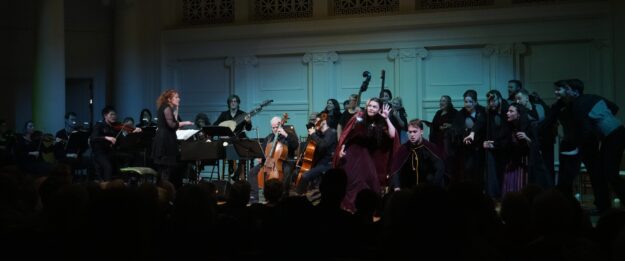
 United States Purcell, Dido & Aeneas: Soloists, Apollo’s Singers, Apollo’s Fire / Jeannette Sorrell (music director and conductor). Greystone Hall, Akron, 3.10.2025. (MSJ)

Some pieces fare well on recordings, but there are many that don’t really come to life until you experience them in person. Purcell’s Dido and Aeneas is definitely one of the latter, particularly in this clever semi-staging by Jeannette Sorrell, music director of Apollo’s Fire. Instead of making any nod toward naturalistic stagecraft, Sorrell has her cast and chorus lean into the artificiality of the conceit, setting the opera as if it is being performed at Josias Priest’s Boarding School for Girls in Chelsea, London in 1689, which is also the earliest documented presentation of the opera.
The four ‘girls’ who double in the smaller roles and the chorus opened the show with a witty spoken prologue written by Sorrell that explains the conceit, introduces the characters and hints where the plot will go. By adding this spoken prologue, borrowing some instrumental music from Purcell’s King Arthur and adding an entr’acte of traditional sea shanties for the sailors, Sorrell was able to flesh out the piece to evening size, running Acts I and II as the first part of the show and an expanded Act III after an intermission. The action took place downstage and, when not singing, the chorus members sat in chairs onstage, donning costume pieces to become witches or sailors as needed. Sorrell assured her audience that 1689 wasn’t as formal as 2025, and encouraged people to applaud, cheer or hiss villains when moved – and they did.
Aryssa Leigh Burrs was regal in presence and vocally rich as Dido, her lustrous sound giving the queen’s closing aria, ‘When I am Laid in Earth’, an intense glow, justifying it as the culmination point the opera has been building toward from the very beginning. While her love interest, Aeneas, does not have nearly as much stage time as Dido, Edward Vogel made sure that the part registered with supple grandeur in his handsome voice. Vogel returned elsewhere as a singing sailor, giving us a delightful chance to savor his voice in a more swaggering style.
Alternating between the support role of Belinda, Dido’s lady-in-waiting, and various smaller parts as well as chorus, Andréa Walker was everywhere but deserves the highest possible praise for so completely throwing herself into the parts – each felt like a separate entity. Try as I might, I could never catch her merely acting. She became each part and brought vocal warmth and grace to Belinda, yet she could absolutely snarl as one of the witches. Walker is a force to be reckoned with.
The witches were a wicked delight, snapping, snarling and twisting in their every moment, Walker and Kristine Caswelch whirling around the Sorceress, Cody Bowers. Casting a countertenor in the role was highly effective, Bowers’s supercharged voice and sexy, subversive stage manner providing its own justification better than librettist Nahum Tate’s rather random bad guys. Their writhing stage activity, suitably hissed by the audience after we got over our initial dazzlement, was choreographed by Sorrell along with all other stage blocking. Julie Andrijewski choreographed the numerous dances throughout the opera, giving what can come across as a more conceptual opera a genuine stage life. Caswelch also served effectively as the spirit who delivers the news of the curse to Aeneas and his sailors, setting the downward spiral in motion.
Speaking of those sailors, the interpolated set of three sea shanties to open the third act was a brilliant idea, and the show had luxury casting for these parts. The first and third songs, ‘Wellerman’ and ‘Leave Her Johnny, Leave Her’, featured baritone Sam Kreidenweis, who not only has an attractive voice and mastery of the style, he knows how to tell a story without ever detracting from the music, a true unity of creative skills. In the central song, ‘Downed & Drowned’, the stunning Michael Galvin took his bottomless bass voice about five fathoms deep to tell the tale of the sailors who never made it back to port, aided by tenor Michael St. Peter on the longing refrain.
Throughout the opera, Sorrell worked as closely with the instrumental players as the singers, drawing everyone present into the energetic whirlwind of Purcell’s masterpiece, to triumphant effect. The chorus ‘No Stars Again Shall Hurt You’ from Purcell’s music for The Tempest was offered as an encore. This semi-staged concept of Dido was so fast-moving and full of life, it is hard to imagine a fully-staged version of the work better capturing its spirit. Seeing it in Greystone Hall in Akron – a former Masonic temple – intensified the sense of communing with a more ornate past. The audience’s response was rapturous. The production proceeded to Chicago for performances over the weekend before returning to northeast Ohio for the remainder of the run.
Mark Sebastian Jordan
Featured Image: The Witches Kristine Casswelch (left), Andréa Walker (right) and the Sorceress Cody Walker (center) © Freddy Fletcher/AF
Production:
Director – Jeannette Sorrel
Dance choreography – Julie Andrijeski.
Cast:
Dido – Aryssa Leigh Burrs
Belinda – Andréa Walker
Second Woman – Elora Kares
Aeneas – Edward Vogel
Sorceress – Cody Bowers
Witches – Andréa Walker, Kristine Caswelch
Spirit – Kristine Caswelch
Sailor – Edward Vogel
How proud I am of my son-in-law Sam. He has such an awesome voice, a wonderful spirit and is a great actor!