 United Kingdom Britten, The Rape of Lucretia: Soloists, English Touring Opera / Gerry Cornelius (conductor), Hackney Empire, London, 4.10.2025. (AK)
Britten’s The Rape of Lucretia is no easy entertainment; both the subject matter and the libretto itself pose considerable challenges. Nevertheless, as far as I could tell, the Hackney Empire theatre (with its approximately 1300 seating capacity) was packed. Happily so, as English Touring Opera presented a top-quality performance, holding focused attention from its audience throughout. Owing to the sad story there was not much joy on the stage, but the visual beauty of the Empire theatre balanced the sorrow before and after the performance.
The libretto – written for Britten in 1945 by the English writer, poet and playwright Ronald Duncan – was based on an earlier play by French author André Obey (Le Viol de Lucrèce, 1931). The story, however, has been circulating since Roman times but without hard evidence if and how the rape of Lucretia happened.
Ronald Duncan set the story in Rome in 500BC and framed it with a Christian perspective which is somewhat confusing for me as well as at least for one more audience member (who, as she told me, was a committed practicing Christian).
In the opening scene the Female Chorus announces:
‘This Rome still has five hundred years to wait
Before Christ’s birth and death from which Time fled…’
During the opera’s plot Lucretia, the wife of the Roman general Collatinus, is assaulted at home by the prince Tarquinius while her husband is away. The following day, Lucretia – traumatised and destroyed by what has happened to her – commits suicide. There is no reference to Christianity during the plot, but the lengthy Epilogue focuses on Jesus Christ who lived and died for us.
The Rape of Lucretia is a chamber opera, written in 1946 (revised in 1947) for eight singers and thirteen instrumentalists. The premiere and several performances took place in Glyndebourne in July 1946, with a stellar cast (including Peter Pears and Kathleen Ferrier) and excellent conductors (Ernest Ansermet and Reginald Goodall).
Of the eight singers, two – Male Chorus and Female Chorus – are meant to be reading/narrating the story but also, as with Greek Choruses in earlier plays, reacting to it. Both state at the beginning that
‘While we as two observers stand between
This present audience and that scene;
We’ll view these human passions and these years
Through eyes which once have wept with Christ’s own tears.”
The two choruses, therefore, are not just outsider storytellers; they are emotionally involved. Tenor William Morgan as the Male Chorus delivered a virtuoso performance vocally as well dramatically and soprano Jenny Stafford as Female Chorus matched her counterpart in all dimensions.
The whole cast was uniformly excellent: they gave their all to poet librettist Duncan’s text and Britten’s music, creating superb theatre and musical experience.
Owing to the singers’ tonal scale, I am slightly unsure about the casting. The role of Lucretia was created for contralto Kathleen Ferrier although clearly a mezzo-soprano can also perform it (which Clare Presland did superbly). I have not heard Ferrier as Lucretia but I recall Jean Rigby’s darker mezzo voice (than that of Presland’s) from English National Opera’s 1987 performances and recording.
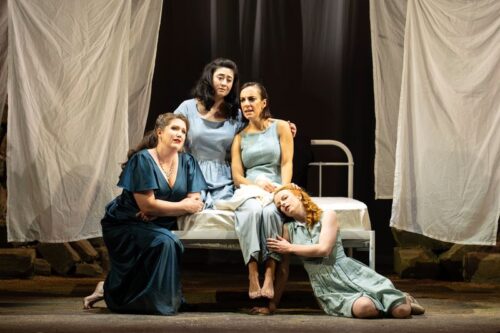
Jane Monari (Bianca) and Rosie Lomas (Lucia) presented a wholly credible support team for Presland’s Lucretia but, again, I would have preferred a heavier mezzo for the role of Bianca to contrast Lomas’s featherlight soprano voice. Admittedly, I may be influenced by my memory of Anne-Marie Owens’s darker-voiced Bianca from 1987. However, for sure, the three ladies in this ETO’s production are of top quality: their trio number in the first act – while supposedly spinning yarns – was particularly moving.
Stage director Robin Norton-Hale presented a production which was wholly truthful both to librettist Duncan’s poetic text and Britten’s music. Her creative colleagues superbly matched her vision: costumes, set design and lighting all united in a gripping theatrical experience.
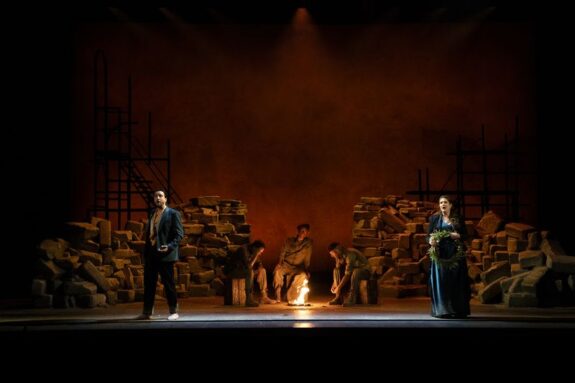
At times I was slightly worried about staging technicalities. In Act I the three male protagonists sit around a camp fire as presumably soldiers often do. The fire looked real to me, so I wondered about safety aspects. Also, at the end of the opera Bianca and Lucia light torches, again with flames which looked real, and walk off with them in a moving procession.
It was a bit scary (for me) to watch opportunist plotter Junius (excellent baritone Edmund Danon) climbing onto the rocky hill, shortly before the Epilogue, to incite the Romans (presumably behind the rocky hill)) to rise against the Etruscans.
Full praise is due to the 13 instrumentalists and conductor Gerry Cornelius. Matching the excellent singers, the orchestra also gave a whole range of dynamic: while listening to them one forgot that this was not a large orchestra but thirteen virtuoso soloists blended into a coherent ensemble.
Neither the text nor Britten’s music is light entertainment. Thankfully, in ETO’s production they combine into a top quality, deeply moving theatrical and musical experience.
Agnes Kory
For more about English Touring Opera click here.
Featured Image: William Morgan (l, Male Chorus), Jenny Stafford (r, Female Chorus) © Richard Hubert Smith
Production:
Director – Robin Norton-Hale
Designer – Eleanor Bull
Lighting designer – Jamie Platt
Costume supervisor – Megan Rarity
Movement director – Rebecca Meltzer
Cast:
Male Chorus – William Morgan
Female Chorus – Jenny Stafford
Lucretia – Clare Presland
Lucia – Romie Lomas
Bianca – Jane Monari
Tarquinius – Luca Pisaroni
Junius – Edmund Danon
Collatinus – Trevor Eliot Bowes