
 United States Haydn, G. Smith, Dvořák: Isidore String Quartet (Phoenix Avalon, Adrian Steele [violins], Devin Moore [viola], Joshua McClendon [cello]). Cal Performances, Hertz Hall, University of California Berkeley, 12.10.2025. (HS)
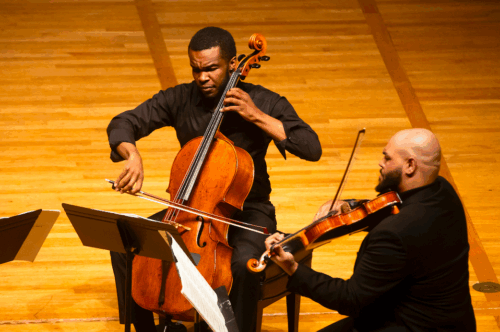
Haydn – String Quartet in B-flat major, Op.76 No.4, ‘Sunrise’
Gabriella Smith – ‘Carrot Revolution’
Dvořák – String Quartet No.13 in G major, Op.106
After a few minutes of Haydn’s ‘Sunrise’ Quartet, it was easy to understand why the Isidore String Quartet has been turning heads in the chamber music world. Formed only in 2019, these young musicians exude everything that can make a string quartet a joyful experience. Their unanimity of intent, technical command and distinctively pure sonority plus an absence of idiosyncrasy produced interpretations that felt natural and unforced.
Not that they cannot get serious, as the quieter moments of Sunday afternoon’s visit (the second in two years) to the University of California Berkeley’s Cal Performances demonstrated. The program began with a Haydn quartet nicknamed ‘Sunrise’ and finished with a Dvořák quartet that brimmed with invention. But the centerpiece was an 11-minute work by Gabriella Smith from 2015 that mashes up the rhythmic vitality of rock music with swaths of Bach and Bartók and a few nods to other contemporary composers.
Smith makes a good fit with this group – her focus in music is to have fun with it. There is a palpable sense of improvisation even through everything is written out. The ensemble dug in with gusto on the rhythmic aspects of ‘Carrot Revolution’ (a title based on a Cézanne misquote, of all things). The piece began with violist Devin Moore and second violin Adrian Steele scratching away with percussive sounds I associate with tango master Astor Piazzolla, while Joshua McClendon alternated pizzicato phrases with drumming on his cello as if it were a conga drum.
That sort of in-your-face sonics settled down to something more lyrical as Smith’s format of a fantasia evolved. A musical pattern would settle into a groove before morphing almost imperceptibly into a different episode. At one point the music seemed to reference the chugging rhythms of Steve Reich’s Different Trains. At another, the pace softened into what felt like a medieval chorale. The musicians handled it all with both grace and specificity. Most of all, they communicated their enjoyment to the audience.
The same sort of enthusiasm infused the performances of standard works by Haydn and Dvořák, though the specific pieces also emphasized those composers’ penchant for playfulness.
Haydn’s String Quartet in B-flat major, Op.76 No.4, begins with a rising tune emerging from contemplative chords that contrast with a lively Allegro that follows. The music switched back and forth throughout the first movement (which made a nice preview for the olio of Smith’s piece) and highlighted the individual musicians’ styles – McClendon’s lithe cello texture, Moore’s lyric contributions on viola and a contrast between Phoenix Avalon’s metallic, edgy first violin sound and Steele’s less assertive, supple tone
Even better was the Adagio where the slow-moving harmonies created a richness that revolved slowly to reveal different colors like a kaleidoscope. The Menuetto danced brightly, and the Finale made for a happy culmination.
Dvořák’s String Quartet in G major, which predated the composer’s time in the United States, offered a wealth of jovial tunes and rhythms that kept things spinning playfully. The piece fit nicely as the capstone of a program that traded mainly in sunniness. The musicians savored the way each return of a musical figure comported itself a bit differently than it had only a minute ago, but without making it too obvious. The result was a first movement that could not help but feel fresh.
With its overlapping melodies, the slow movement was a model of grace, and in the folk-dance third movement the quartet deftly moved between a tune in two to another in three. Their breathless tempo when the Finale segued into Allegro con fuoco brought things to a lively climax.
The encore, Moore’s arrangement of the early Brahms chorale Geistliches Lied, made for a serene moment to top things off.
Harvey Steiman
Featured Image: Isidore String Quartet in recital at Cal Performances in Berkeley © Brittany Hosea