
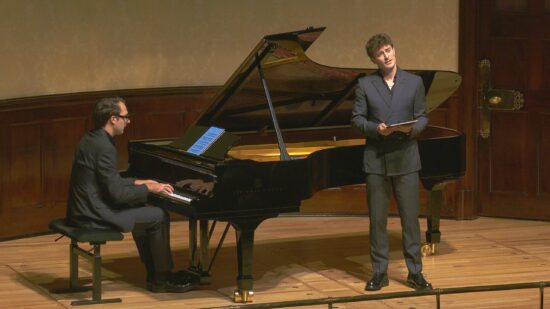
 United Kingdom JS Bach, Vivaldi, Purcell, Fago, Dębicz, Handel, Rodrigo, Moniuszko: Jakub Józef Orliński (countertenor), Aleksander Dębicz (piano). Wigmore Hall, London. 10.10.2025. (CSa)
JS Bach – Widerstehe doch der Sünde, BWV54; Vergnügte Ruh, beleibte Seelenlust, BW170
Vivaldi – Eja mater, fons amoris from Stabat mater in F minor, RV621 (arr: Dębicz)
Purcell – Strike the viol, touch the lute from Come, ye sons of art, away, Z323; (From King Arthur) Fairest Isle (arr. Dębicz)
Nicola Fago – Alla gente a Dio diletta from Il Faraone sommerso (arr. Dębicz)
Aleksander Dębicz – Quarantine song; Dream 9; Thoughts
Handel – (From Giulio Cesare in Egitto) Empio, dirò, tu se!
Joaquín Rodrigo – Adela (arr. Dębicz)
Stanisław Moniuszko – Przaśniczka (arr. Dębicz)
Baroque music fused with jazz is unusual fare for more staid Wigmore Hall regulars and there is no doubting that cross culture concerts are not everyone’s cup of tea. This may account for some conspicuously empty seats after the first half of this sold-out recital by Polish operatic countertenor, skateboarder, and breakdancer Jakub Józef Orliński and his compatriot, the composer and pianist Aleksander Dębicz. For those who like to take their tea with a dash of something more spicey, the duo offered some refreshingly new and frequently liberating insights into the vocal treasures of seventeenth- and eighteenth-century musical literature.
Orliński, now 34 years old, possesses a rich and mesmerizing voice coupled with the cinematic good looks. He is a man who could probably sing a Purcell aria while starring as the romantic lead in his own biopic. Meanwhile, Debiçz, his accompanist, collaborator and the arranger of many of the pieces on the programme, plays it cool, enveloping the defined classical contours of the music with a sensuous, syncopated elegance. Orliński predicted that as soon as he and Debiçz met as students in 2010 at the Chopin University of Music in Warsaw, they would make music together. Last year, they released LetsBaRock, a genre-blending album in which Baroque music for voice and instrumental accompaniment is reimagined through a modern lens. The project’s aim is to give old classical ‘masters’ a new guise.
While the idea of combining great classical compositions with jazz piano is hardly novel – one thinks of past artists like Jacques Loussier, Art Tatum or Bill Evans – Orliński and Debiçz breathe new life into old works, adding immensely to their power and universality.
The recital opened with a searingly beautiful and unvarnished account of the Bach cantata Widerstehe doch der Sünde, BWV54, [‘Stand firm against sin’], a warning delivered by Orliński in tones of steely admonition and seductive beauty. After a delicately arranged version of Eja mater, fons amoris [‘O mother fountain of love’] from Vivaldi’s sacred Stabat mater in F minor, it was time to abandon the sacred in pursuit of the profane. An earthy, souped-up rendition of Strike the viol, touch the lute, from Purcell’s Come, ye sons of art, away, written in 1694 as a Birthday Ode for Queen Mary. Orliński punctuated his dynamic performance with pelvic thrusts, come hither nods and suggestive winks. One does not know what Queen Mary would have made of it, but it would have certainly appealed to Purcell’s bawdy sense of humour. Then, in a change of mood, we were treated to a luminous and gently inflected Alla gente a Dio diletta [‘To the people and God beloved’] a song from Nicola Fago’s Il Faraone sommerso. Before returning to Purcell in a smoky, sinuous arrangement of Fairest Isle from his opera King Arthur, the duo inserted Quarantine Song – a languorous song without words, tinged with isolation and yearning composed by Debiçz himself during the pandemic.
The second half began unevenly with another Bach cantata: Vergnügte Ruh, beliebte Seelenlust (‘Delightful rest, beloved pleasure of the soul’) originally scored for alto solo, oboe d’amore, strings and organ. It is intended as a meditation on the peace and joy of a soul that turns away from earthly corruption and finds happiness in divine stillness. Untypically, Orliński’s delivery was unmodulated, coarse, and occasionally off-key, offering little by way of comfort or serenity. His raw, vocal energy was better harnessed in Handel’s declamatory aria Empio, dirò, tu se! (‘Impious Man…Get out of my sight!), where staccato leaps and fiery coloratura runs were brilliantly executed.
The national music of Spain and Poland was well represented and evocatively performed in Adela, a song by Joaquín Rodrigo and Przaśniczka, a gentle folk ballad by Stanisław Moniuszko, but it was in the return to Purcell at the end of the evening in two memorable encores that the concert found its most magical moments: a hypnotically melancholy and superbly controlled Music for a while shall all your cares beguile (from Oedipus) followed by a gloriously jazz-inflected Sound the Trumpet in which Orliński brought an imaginary bugle – Satchmo-style – to his lips. It was in fun-filled moments like this, that we witnessed two supremely gifted artists happily jamming together and clearly having a blast.
Chris Sallon
I have been fascinated with the fusion of what we call classical and other forms of music since my college days as a music major. This review sent me to listen to the LetsBaRock recording. Enhancing the piano accompaniment with rhythm instruments struck me as awkward. Seems piano alone might have been enough.
The long history of jazz artists interpreting classics, including Bach from the Swingle Singers and the Miles Davis/Gil Evans Sketches of Spain. This comes from the other direction, and seems less convincing.