
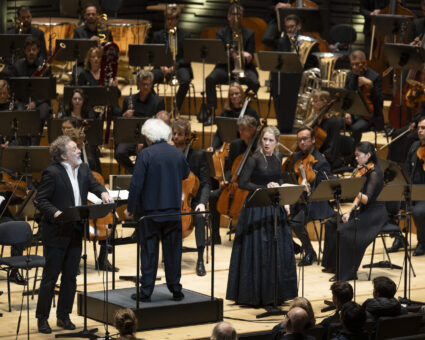
 Germany Berg, Wozzeck (concert performance): Soloists, Chorus of the Bavarian Radio Symphony Orchestra, Children’s Chorus of Bavarian State Opera, Bavarian Radio Symphony Orchestra / Sir Simon Rattle (conductor). Isarphilharmonie, Munich, 5.10.2025. (AL-L)
Cast:
Wozzeck – Christian Gerhaher
Marie – Malin Byström
Drum Major – Eric Cutler
Doctor – Brindley Sherratt
Captain / Madman – Nicky Spence
Andres – Edgaras Montvidas
Margret – Rinat Shaham
First Apprentice – HK Gruber
Second Apprentice – Ludwig Mittelhammer
Munich audiences are familiar with Wozzeck. In 2008, the Nicholas Bachler era at Bavarian State Opera in Munich began with Andreas Kriegenburg’s production of the work, regularly revived to full houses and featuring the very best baritones of our time: Michael Volle, Georg Nigl, Simon Keenlyside, Peter Mattei, and, in 2018, Christian Gerhaher, who also sang the role on this occasion.
As always with concert performances of opera, there is somewhat more attention to the music, at the expense of the dramaturgy. The final scene with the children may seem sentimental and lack the chilling dimension it can have in the theatre.
The orchestra for which Berg wrote is no longer in the pit. Under the baton of their music director Sir Simon Rattle, the musicians of the Bavarian Radio Symphony Orchestra covered the singers a bit at the beginning, particularly in the Sprechgesang exchanges between Marie and Margret. But a balance settled in fairly soon and was ultimately quite satisfactory.
The orchestra’s performance was superb. Under Rattle’s attentive direction, we discover a whole series of details that we had ‘sensed’ and can now ‘see.’ The celesta–harp duo at the end of Marie’s lullaby could have been written by Ravel; the string-section solos during the scene between the Doctor and Wozzeck are very expressive; the quotations from Act II of Der Rosenkavalier in the tavern music of the second act leave no doubt about their origin; the flute passage during Marie’s bible reading is superb; and, of course, the intensity that follows Wozzeck’s drowning — very probably the opera’s climax — shows the connection between Mahler’s music and Berg’s work.
Among the musicians, special mention must be made of the excellence of the horn section led by Carsten Duffin, Radoslaw Szulc on first violin, Magdalena Hoffmann on harp, and Christopher Patrick Corbett on clarinet. The Bavarian Radio Chorus is, as always, impressive, with deep colours — their intervention not unlike the choruses from Wagner’s The Flying Dutchman.
The cast was of the highest level. This is always a sign: the singers’ diction was exemplary. With her clear tone, Malin Byström showed what a true soprano can bring to the role of Marie: there was much expression and emotion at the end of the lullaby. Alongside her, Eric Cutler had the Wagnerian dimension required for the Drum Major’s role. Among the excellent secondary characters, Brindley Sherratt’s Doctor was dreadfully manipulative but had great projection, allowing him to cut through the orchestra effortlessly. In the scene where he confronts the Captain, he sang a glissando toward the low notes that was impressive — and which even Christian Gerhaher acknowledged, standing at his side.
The latter’s performance was, of course, worthy of this great singer. There is real intelligence in his handling of the text, and this baritone, a future Wotan in Salzburg, knows how to find an imposing volume. His Wozzeck was restrained throughout, even somewhat pale at times. The only moment when he was fully in character was during the menacing and insidious ‘Komm’, before Marie’s murder.
This concept is no doubt intelligent and marvellously executed, but is this intellectual and controlled Wozzeck really the crude and hallucinating character that Georg Büchner (the original playwright) and Berg wanted?
With this superb evening begins the 2025–2026 season of the Bavarian Radio Orchestra. The musicians will reunite with Sir Simon Rattle for numerous varied programs, including Bruckner, Henze, Mahler, Janáček, Brahms, and Adámek — and with the most distinguished of guest conductors: Gustavo Dudamel, Nathalie Stutzmann, Daniel Harding, Osmo Vänskä — and soloists such as Alexandre Kantorow, Vilde Frang and Emanuel Ax, among many others too numerous to name. All reasons to visit Munich.
Antoine Lévy-Leboyer