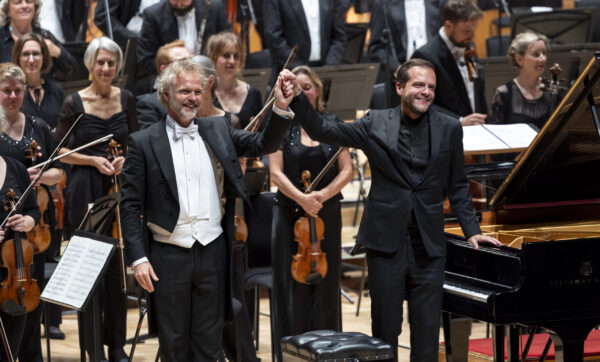
 United Kingdom Knussen, Ravel, Mahler: Francesco Piemontesi (pianist), Royal Scottish National Orchestra / Thomas Søndergård (conductor). Royal Concert Hall, Glasgow, 4.10.2025. (GT)
Knussen – Flourish with Fireworks, Op.22
Ravel – Piano Concerto in G major M.83
Mahler – Symphony No.7 in E minor
In recent seasons, the Royal Scottish National Orchestra have opened their concerts with brief performances of a contemporary orchestral piece, entitled ‘Scotch Snaps’ by a living Scottish composer. On this occasion, the evening began with a piece by the Glasgow-born Oliver Knussen, who passed away in 2018. Knussen was one of the most outstanding all-round musicians that Scotland has produced. He was the most interesting and knowledgeable musician that I have met, and as a conductor, he could draw the most brilliant, colourful playing from the orchestras he worked with, regardless of the repertoire.
Knussen’s knowledge of contemporary music was remarkable, and this scintillating, brief orchestral piece allowed every department of the ensemble to show off its virtuosity in this work written in homage to Stravinsky. Opening on the muted trumpets, the rather austere idea was picked up by the extended woodwind group before switching between loud bursts of shrieks aided by the percussion. It then quietened down to bird calls from the woodwind and plucking from the strings, before the brass and percussion brought a cacophony of noise to the celebratory finale – or was it an anti-climax? Hopefully, one of Knussen’s more expansive compositions, such as his Concerto for Orchestra or the Violin Concerto, would be worthwhile for audiences to judge this composer.
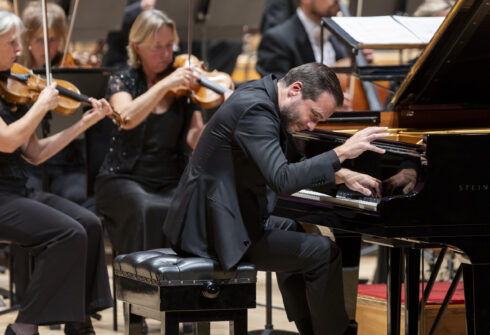
I was fortunate to hear Martha Argerich play the Ravel G major Piano Concerto in the splendid acoustic of the Athenium in Bucharest just a few weeks ago (review here), so I thought this performance would not be so memorable; however, not so, as the Swiss-Italian pianist Francesco Piemontesi proved world-class in this colourful piece. Conductor Thomas Søndergård gave the soloist sensitive accompaniment, allowing him complete expression. Originally composed under the influence of Mozart and Saint-Saëns, the piece adopts the style of Gershwin, the concerto offers the most brilliant opportunities which were sumptuously evinced by Piemontesi, especially in the glittering figurations and glissandos in the opening Allegramente, and the subtle suggestion of a Basque folk song. The cadenza was exhilarating before the coda and the Adagio assai in which the soloist’s weaving of arabesques were subtly articulated against the orchestral playing with charming woodwind revealing Ravel’s homage to Mozart. The briskly performed finale (Presto) was brilliant with the elements of Satie and Stravinsky creating a carnival mood spotlighted by the orchestra with the cheeky slides on the trombones in jazz blues and syncopation rhythms. A special sequence was the collaboration between Piemontesi and Pippa Tunnell on the harp and Henry Clay’s cor anglais. In response to the storm of applause, Piemontesi played an encore of Liszt’s ‘Au lac de Wallenstadt’, from his Years of Pilgrimage.
Mahler’s Seventh is the most labyrinthine of the symphonic cycle, and performances are comparatively rare; this performance was one of the final steps in the Danish conductor’s survey of the Mahler symphonies with the RSNO – in a cycle which will culminate this season. The cause for the Seventh’s lack of popularity is the structure of five quite different movements, with two Nachtmusik movements and, at the centre, a macabrely fiendish Scherzo. The opening Langsam – Allegro risoluto, ma non troppo, is prolonged and increasingly dramatic.
The opening bars by the tenor horn of Chris Flynn were dark and almost menacing and the mood was emphasised by threatening passages by the strings and brass enhancing the character of darkness, until the great theme entered on the massed strings and the brass offered hope (always reminding me of the Star Trek TV theme). By this time, it was clear that Søndergård was ensuring the best from his musicians, often playing as if their lives depended on it; his manner was to adopt a strictly disciplined tempo and not allow any indulging in the symphony’s themes. The standard of playing was magnificent, most notably in the brass and woodwind groups. In the Nachtmusik I movement, there was a beautiful section in which the nocturnal stillness was evoked by the two antiphonal horns calling out to each other, and the nocturnal sound of cowbells reflected the affinity of nature.
There were outstanding solo passages from the viola of Felix Tanner in the Scherzo, in what sounded almost a parody of the Viennese waltz, quite different from the beautiful ländler of other Mahler’s earlier symphonies. And there was magical playing in Nachtmusik II from Maya Iwabuchi on the violin, while the horn of Amadea Dazeley-Gaist was heard again in an enchanting sequence invoking a pleasant Mediterranean serenade from Ross Morris on the guitar and the mandolin of John Robinson accompanied by Tunnell’s harp. The nocturnal passage was swiftly halted – as the composer himself announced in rehearsal to his musicians – ‘And now comes the DAY!’ The Rondo Finale was launched by the thunderous strikes on the timpani by Paul Philbert and was magnificently supported by the ferociously celebrant trombones, horns and trumpets, in a spell which was only broken by the woodwind in the first of the eight variations, during which there emerged parodies of Wagner’s Die Meistersinger and Léhar’s The Merry Widow before bringing us to the final magnificent coda.
This was a terrific ending to this opening concert of the season by Thomas Søndergård and his Royal Scottish National Orchestra, and augers well for the season during which the ensemble embarks on a brief tour to Europe before returning at the end of October.
Gregor Tassie
Featured Image: Conductor Thomas Søndergård, pianist Francesco Piemontesi and members of the RSNO © Martin Shields