 United States Higgins, Grieg, Tchaikovsky: Javier Perianes (piano), San Francisco Symphony / Gustavo Gimeno (conductor). Davies Symphony Hall, San Francisco. 4.10.2025. (HS)

Timothy Higgins – ‘Market Street 1920’
Grieg – Piano Concerto in A minor
Tchaikovsky – Symphony No.5 in E minor
Timothy Higgins left his post as principal trombone at the San Francisco Symphony this year to join the Chicago Symphony, but not before getting a couple of appealing assignments from the SFS. The world premiere of his ‘Market Street 1920’ lit up Davies Symphony Hall on Friday, and next May he returns to play a new trombone concerto (Shift by Jimmy Lopez), both commissioned by the San Francisco Symphony for him.
Who would have thought that the bumptious, swaggering, eight-minute ‘Market Street 1920’ would easily be the highlight of a program that included two certified classics, Grieg’s Piano Concerto and Tchaikovsky’s Symphony No.5. An unwieldy performance from Spanish pianist Javier Perianes made the concerto pedestrian, and guest conductor Gustavo Gimeno overloaded the symphony with speed and muscle.
The Higgins piece started as a COVID-era project to comment on our society’s unwillingness to listen to what others might have to say. A bouncy triplet rhythm in the winds set the tone, only to be countered by an adamant response from the strings in a square two-beat. As the piece unfurled, the different voices increasingly tumbled in different directions, creating fascinating polyrhythms before finally drowning each other out at the raucous finish.
The byplay took captivating turns. There were some near-thefts of Bernstein’s dance music from West Side Story on one side and sturdy march music on the other. It was fast but not blindingly so. Inventive variations on these ideas made me want to hear it again right away.
The title, by the way, emerged in early test-runs with other musicians, one of whom commented that the rhythms and tunes were reminiscent of a short black-and-white film that became a viral meme on the internet. The film followed streetcars rumbling up San Francisco’s Market Street in 1920 as pedestrians jaywalked, and Higgins was inspired by the metaphor of people going against the flow.
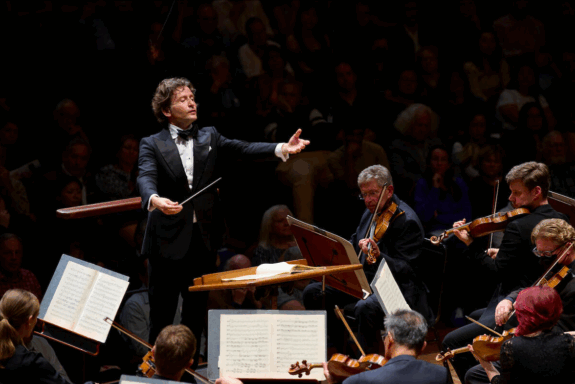
Gimeno is currently the music director of the Toronto Symphony. With his matinee-idol looks and demonstrative conducting style, he conjured up a lively ballet of all these factors in the opener. Unfortunately, the same sort of brash intensity got in the way of subtleties in both the Grieg and Tchaikovsky works.
In the Grieg concerto, Perianes began with a declaration of power over sonority and seldom backed away. The piano’s famous descending flourish clanged rather than creating a rich sound. The rapid passages clattered instead of finding any kind of sinuousness, as if the rumbling railcars of the opening work had taken over the concerto.
Though the orchestra seldom drowned out the soloist, it seemed as if every tutti went for toughness over suppleness: impressive but not very Grieg-like. Even Perianes’s encore, Notturno Op.54 No.4 from Grieg’s Lyric Pieces, clanked at times when smoothness would have been better.
The Tchaikovsky symphony started off well, with gorgeous playing of the soft opening intonings by the clarinets and lovely hesitations in the string chords behind them. But then the sheer volume of the crescendos and climaxes in the first movement felt premature and out of balance.
The sumptuous Andante pointed toward something more restful, bringing some welcome beauty to the proceedings, in particular a horn solo expressively played by Michael Stevens, the acting principal. Every time the music segued into restless byways, though, everything felt too loud again. Tempos for the third movement, Valse, felt faster than the Allegro moderato marked in the score, as did the Andante maestoso that opened the Finale, so the contrasts in tempo and texture didn’t make their point.
The Finale kept reaching pretty much the same volume at each climax, and it felt like some of Shostakovich’s hammering instead of Tchaikovsky’s Romantic sensibilities. Was it impressive? Sure. What was missing were all the colors in Tchaikovsky’s palette.
Harvey Steiman
Featured Image: Gustavo Gimeno conducts the San Francisco Symphony © Stefan Cohen