
 New Zealand Berlioz, Bruckner: Joyce DiDonato (mezzo-soprano), New Zealand Symphony Orchestra / Gemma New (conductor). Michael Fowler Centre, Wellington. 28.11.2025. (PM)
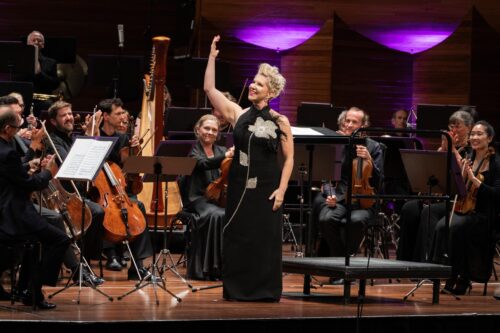
Berlioz – Les Nuits d’été
Bruckner – Symphony No.7 in E major
We would have been forgiven, at the conclusion of this Wellington concert’s first-half-outpouring of glorious vocalism from American mezzo-soprano Joyce DiDonato – making her New Zealand debut – for imagining that the rest of the evening’s music-making would prove at best worthy, but hardly scaling the heights to which we had been taken. And with good reason, as we had just heard one of the most beautiful of all orchestral song-cycles, Hector Berlioz’s Les Nuits d’été, here performed in a way that simply embodied the idea of a singer ‘inhabiting’ a piece of music, with every note, phrase, expression and gesture as if something of a living entity.
My favourite from the cycle has always been the radiant ‘Absence’ – and DiDonato didn’t disappoint, tugging at the heartstrings even more than Regine Crespin and Janet Baker in favourite recordings, with her luminous ‘ownership’ of the opening ‘Reviens’ (Return) and her pitiable ‘Comme une fleur loin du soleil’ (Like a flower away from the sun). And she delivered the final, exuberant ‘L’ile inconnue’ (The Unknown Isle) with irresistible verve and detachment sense of release from what had been up to that moment the composer’s longed-for and sadly unrealised ‘Toujours’ (Always) from the opening ‘Villanelle’ – acknowledged here by DiDonato with wry equanimity rather than bitter resignation – deeply satisfying!
The evening’s biggest surprise for me, however, came with the Bruckner! While I had been impressed over the last couple of years with Gemma New’s conducting of Mahler I had never been one to ‘presume’ (as many seem to do) that proficiency in the latter automatically guarantees the same with Bruckner’s similarly large-scale but vastly different worlds of expression – here, not instantly, but as a slowly growing and evolving feeling as the symphony progressed I realised I was actually witnessing a superbly-played and wondrously-articulated performance.
The symphony’s very first theme had a pliable elasticity contributing to a parallel expansion and intensification of the sound as the trajectories proceeded, and with everything beautifully voiced. New kept the tempos of the different sections related to what seemed like a single inner pulse so that nothing had to speed up or slow down appreciably to properly ‘speak’ its character – for instance, the massive brass entry featuring a minor-key inversion of the opening theme seemed more organic than disruptive in this overall context –- and how beautifully the composer used his wind players’ material to elaborate on existing themes when these variants were brought back later in the movement.
The majestic slow movement, Bruckner’s tribute to Richard Wagner, was just as successfully unfolded by New’s unhurried, but vitally-phrased tempos at every turn – the first upwardly thrusting string phrase taking the lead in exuding emotion of a vigorous and resounding kind – while the deep brass, at first contained, still made so eloquently the perfect foil for the following full-throated strings-and-winds’ songbird manifestations. As the movement developed so did the urgency and vigour of New’s marshalling of the music’s tectonic forces towards and into a spaciously resplendent climax, one superbly delivered by conductor and players. However, it became as much a funeral oration with the news of Wagner’s death ‘capturing’ this music for history from that moment on, the flute sonorously ‘summonsing’ the resplendent ‘Wagner tubas’ and their tones of sorrowful tidings, and bestowing upon the music a kind of immortality.
After this, there is a lithe, muscular Scherzo, splendidly directed and delivered in every way imaginable, the normally bucolic impulses of Brucknerian scherzos in this case to my mind worthy of elevation both by association and sheer exuberant excellence to the realms of ‘sport for the Gods’. But then, for me, it was New’s and the orchestra’s playing of the Finale as much as anything else in the symphony that lifted the experience beyond my expectations, transforming what I had always previously regarded as a somewhat ‘poor relation’ of a movement to a piece that suddenly seemed bristling with nuance, impulse, spontaneity and variety while appearing to know unto itself exactly where it was going.
And, despite my initial feeling that New had begun the work’s coda too abruptly, and that what was needed was more time and space to ‘savour’ the whole of what we had heard, and to bring the work to a ‘grander’ conclusion, I found myself instead thinking, halfway through – ‘This actually works! – in fact, it’s exhilarating!’ – and at the end, my thought was ‘Wow! What a performance!’
Joyce DiDonato and her extraordinary singing will remain an ineffable memory for me! – but Gemma New’s Bruckner was also a revelation, one that I hope we will get even more chances to experience in times to come!
Peter Mechen