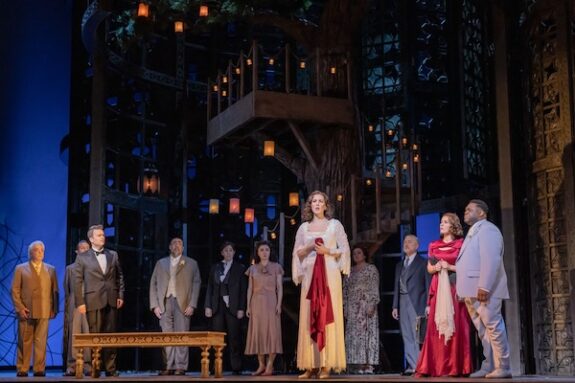
 United States Mozart, Le nozze di Figaro: Soloists, Chorus and Orchestra of Metropolitan Opera, New York / Joana Mallwitz (conductor), Metropolitan Opera, New York, performance of 26.4.2025, seen at Avenue Cinema, Belfast, 30.4.2025. (RB)
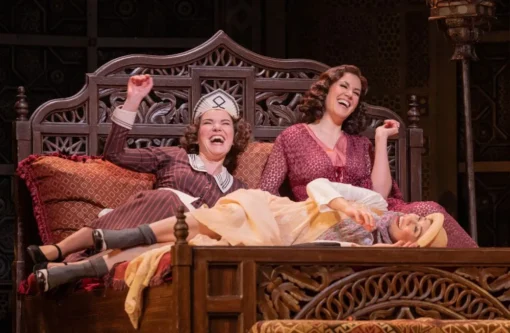
This was a revival of Sir Richard Eyre’s critically acclaimed production, which was first staged in 2014. The cast were a mixture of well-known, established performers as well as performers who were stepping up into principal roles for the first time. This production was also the Met debut for German conductor, Joana Mallwitz, who displayed her Mozart credentials at the Salzburg Festival in 2022.
Eyre’s production updates the action from the eighteenth century to Spain in the 1930s on the eve of the Civil War. During the Overture, the stage turned into a carousel. As the carousel revolved, we were able to see a maze of interlocking rooms in the Count’s palace while simultaneously being introduced to some of the key characters in the opera. The rooms were tastefully decorated with darkly coloured and intricate Iberian patterns on the walls. The movement of the stage allowed us to witness the daily activity of the characters in the warren of rooms and conveyed the sense that this was a place where intrigue and plots could be hatched. There was an early whiff of scandal as we witnessed a scantily clad young woman emerging from a bedroom pursued by Joshua Hopkins’s philandering Count, introducing us to the theme of fidelity in love which courses through the opera.
Rob Howell’s revolving set allowed for swift and fluid scene changes which ensured the action was able to progress at pace. The costumes were varied and imaginative and suitable for the period. The performers all seemed committed to mining the comic potential of this opera; Michael Sumuel and Sun-Ly Pierce brought an impressive physicality to their respective roles. I watched Richard Eyre’s production when it last appeared at the Met, but I was even more struck this time round by the clarity of the direction. It can sometimes be easy for the audience to become confused by the elaborate scheming and disguises, but this production helped to ensure the intricate plot remained clear. The pre-Spanish Civil War setting was an interesting idea, but it did not illuminate the drama in any new of meaningful way and there was no attempt to engage with the subversive ideas around class in the opera.
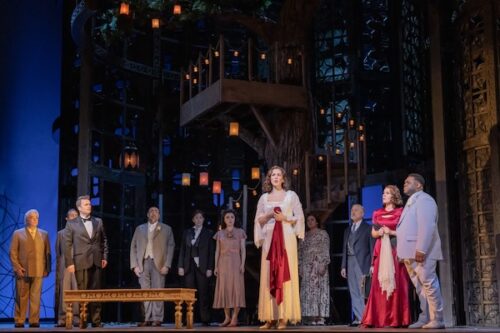
All the performers acquitted themselves well, but the standout performance was that of Federica Lombardi as the Countess. Her rendition of ‘Porgi amor’ was ravishing and certainly among the most beautiful and heartfelt I have heard. In ‘Dove sono’ she sustained the line beautifully and sang with a gorgeous tonal lustre before ending the aria with a rekindled sense of purpose and conviction. Joshua Hopkins acquitted himself well in the role of the philandering Count. He portrayed Almaviva as a controlled and scheming character and perhaps less prone to fly off into the angry rages which one sees in other productions. He sang with immense clarity, and he brought beautifully shaped phrases and a cultivated refinement to Mozart’s vocal line. He brought power and depth of sound to ‘Hai già vinta la causa’ and an increasing sense of excitement in the final part of the aria as his schemes seemed to be coming together.
Olga Kulchynska embodied the cunning and resourceful Susanna to perfection She sang with great cultivation although the tone was a little thin on occasion and I would have welcomed more vocal heft. Having said that, she made the point in her interview during the interval that Susanna sings almost non-stop throughout the opera, and it is necessary to pace oneself. Kulchynska was able to shift into top gear for her Act IV aria where she displayed an elegant sense of line and immense beauty of tone. She was also impressive in the duet with Elizabeth Bishop’s Marcellina, where the two women successfully played up the catty exchanges. Michael Sumuel’s Figaro was cheerful, ebullient and quick thinking and he brought zest and excellent comic timing to the role. His virile voice projected well into the auditorium and in some of the big set piece numbers his singing sounded entirely effortless. He displayed elegantly tapered phrasing in Act I’s ‘Se vuol ballare’. ‘Non più andrai’ was fresh and invigorating, driving the first act to a resoundingly triumphant conclusion.
Sun-Ly Pierce was the standout performance among the rest of the cast. She brought physicality to the role of Cherubino, which came to the fore in the Act II finale. She proved herself adept in the various gender-swapping scenes, seamlessly moving from one to another. Her performances of Cherubino’s two arias were exceptional, displaying a high degree of vocal finish and attention to detail. Elizabeth Bishop was impressive in the role of Marcellina, bringing humour and zest to the part. I was less impressed with Maurizio Muraro’s Bartolo; his singing sometimes sounded a little ragged and rough round the edges. The rest of the cast all acquitted themselves well.
The ensemble numbers were handled well, and I was impressed with the integrated blend of sound which was achieved, and the way in which everyone played off each other. The manner in which the cast and orchestra handled the gradual build up in the Act II finale was superb with the performers clearly enjoying the comic exchanges. The various duets and trios were well executed brilliantly and were well integrated into the dramatic and musical narrative.
Joana Mallwitz and the Met Orchestra did an excellent job in illuminating Mozart’s wonderful score. The Overture was bright and witty and Mallwitz illuminated the inner woodwind textures in fresh and interesting ways while highlighting the accents and pointed phrases. The pacing of the material was generally good, particularly in the finale to the second act, although some of the numbers were a little fast – for example, the Act III duet between the Countess and Susanna. The Met’s woodwind section was in particularly fine form and provided a wonderful palette of colours in the Countess’s two arias and in the Act III duet between the Countess and Susanna.
Overall, this was yet another first-class production of Le nozze di Figaro from the Met, with the plaudits on this occasion going to Federica Lombardi.
Robert Beattie
Production:
Production – Sir Richard Eyre
Revival Stage director – Jonathan Loy
Set and Costume designer – Rob Howell
Lighting designer – Paule Constable
Choreographer – Sara Erde
Chorus director – Tilman Michael
Cast:
Countess Almaviva – Federica Lombardi
Susanna – Olga Kulchynska
Figaro – Michael Sumuel
Count Almaviva – Joshua Hopkins
Cherubino – Sun-Ly Pierce
Marcellina – Elizabeth Bishop
Dr Bartolo – Maurizio Muraro
Live in HD Director – Habib Azar
Live in HD Host – Julia Bullock