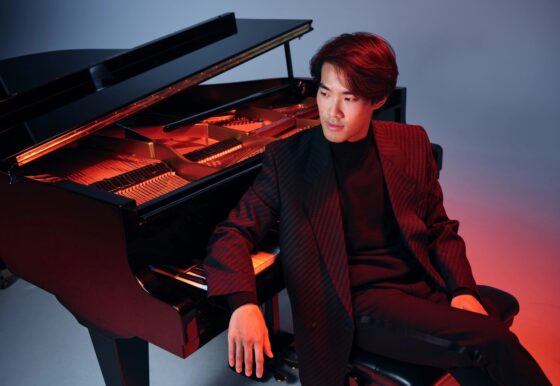
 Canada Prokofiev, R. Strauss: Bruce Liu (piano), Vancouver Symphony Orchestra / Otto Tausk (conductor). Orpheum Theatre, Vancouver, 30.5.2025. (GN)

Prokofiev – Piano Concerto No.3 in C major, Op.26
R. Strauss – Eine Alpensinfonie, Op.64
This concert was an important event: the Vancouver Symphony Orchestra debut of pianist Bruce (Xiaoyu) Liu, the first-ever Canadian winner at the Chopin International Piano Competition, and an artist who has received almost instantaneous international acclaim since his victory in 2021. He appeared for the Vancouver Chopin Society in a solo recital last year. The pianist’s admirers could not have been disappointed: few young pianists display such disarming keyboard command, tonal beauty and refined elegance, and we saw plenty of that here. However, Liu did not play one of the Chopin concertos but something quite far afield, Prokofiev’s Piano Concerto No.3. The result was distinctive: less brightly lit and dramatic than usual, but full of splendidly articulated detail and virtuoso flourish. Richard Strauss’s Alpine Symphony provided the ‘spectacle’ in the second half of the concert.
After the lovely clarinet opening of the Prokofiev, Lui entered with remarkable alertness and a light, feathered brilliance that possibly reminded me of the esteemed performances by Korean Kun-Woo Paik. The pianism that followed revealed a drive and quicksilver quality, underpinned by an unrivalled level of finger dexterity and deftness of touch. The concentration of line was remarkable: the notes just kept coming in a continuous sweep, and not even the most complex passages appeared to pose any technical difficulties. In fact, the pianist did a terrific job of opening out technically dense passages so that each note could be heard. The only item that I thought was unnecessary was the occasional use of staccato.
Perhaps a characteristic that one has to adapt to is that Liu offers relatively few cue points for the listener to register substantive emotional changes in the music, nor does he employ many changes in phrase shapes to suggest small alterations in contour and colour. The danger of this ‘neutrality’ in the current context is that an almost metrical motion can set in, which diminishes the concerto’s range of expression and rhapsodic impulse. While a fine gradation of tone colour and a cornucopia of telling detail were always present, I did not think the ebb, flow and wit in the opening movement were revealed strongly enough or given enough meaning. For example, the emphatic bottom notes in the various march sequences were delivered with admirable strength, but they were also sufficiently square that they did not have the rhapsodic push and snap that the composer almost certainly intended: the treatment became temporarily laboured. On the other hand, Liu seemed to relish the softer fantasy moments and invested these with a quiet, distilled beauty introduced by lovely filigree entrances. The orchestra, in fact, amplified this design: at one point, allusions were made to the ethereal textures of the composer’s Violin Concerto No.1.
There was also a quest for beauty in the Theme and Variations movement which alternates pensive and rhythmically-turbulent sections in an innovative way, but sometimes I felt the treatment was slightly too analytical and removed and not scented enough. The hard-hitting parts were superlatively articulated but remained slightly matter-of-fact: they needed more push and fire. And, for all its delicate tonal beauty, the piano entrance in the Gavotte sounded much like Ravel, while other passages that aimed at a rapt stillness did not seem to convey the full intensity of Prokofiev’s emotional aura.
The finale had fine rhythmic grounding and a good sense of motion, though the piquant duet between the winds and piano was somewhat imbalanced: the winds were almost too loud while the piano was too modest and lacked flippancy. While Liu might have been slightly cautious at other points, his technical command never faltered, and the romantic sweep and momentum needed at the work’s end was successfully achieved. Otto Tausk was very much an able collaborator in this type of interpretation. As we heard in his concert of Prokofiev’s Symphony No.7 just months ago, the conductor seems to love the bittersweet lyrical lines and the balletic allusions in the music at least as much as its raw Russian spikiness and pugnaciousness, and we witnessed that focus in all three movements.
Overall, the performance was an enjoyable one of its kind but, ultimately, too lightweight to fully penetrate the composer’s world. The concerto simply has a more visceral projection and more uncompromising ‘steel’ than witnessed here. It also has a stronger rhapsodic petulance. Liu has remarkable individual talents to display, and he will doubtlessly work towards a more complete reading over time. At this point, I find his playing perceptive, tonally beautiful and stunning technically, but it still remains somehow too neutral and held on too tight a rein for an expansive large-scale concerto. The pianist needs to convey more firmly the emotional building of a piece while finding a greater sense of considered relaxation. It was noteworthy that within seconds after he started to play a Chopin Nocturne as an encore, I said to myself, ‘Now this is his real home’.
Richard Strauss’s Alpine Symphony (1915) is indeed an extravaganza, with its vastly augmented brass section (including Wagner tubas), an organ, a wind machine, two harps and so on. I have seldom seen the Orpheum stage so full, though it actually managed to enlist only 98 players out of the 125 players prescribed by the composer. It is not necessary to wade into the critical history of the work very much, except to note that it has often been regarded as problematic: both anachronistic and bombastic and, possibly, the last dying breath of Wagnerian Romanticism. It has long occupied the bottom rung of Strauss’s ‘great’ tone poems (along with Symphonia Domestica), and it is noted that two of the greatest post-war Straussian conductors, Clemens Krauss and Fritz Reiner, wouldn’t touch it. However, recordings by Rudolf Kempe and Herbert von Karajan did put the piece on the map by 1980 and, as they have shown, it needs a rather special touch to have the work’s 22 separate parts add up to an unfolding musical experience rather than just a cinematic travelogue.
Otto Tausk’s treatment perhaps lay somewhere in the middle. It was a fairly tight-knit reading that aimed at some degree of thematic integration and managed to get most of the big climaxes in place. However, an integrative approach is not necessarily without complication, since the dominant motives in the horns and in the long four-note descending theme in the violins are prosaic by most standards and can appear overly repetitious if treated as pillars of structural unity. Moreover, the conductor did not shy from injecting excess sentiment into the string theme every time it came along, which is likely not the best choice. A compensating virtue was the quicker tempo chosen which removed some degree of bombast, but it also limited the ‘atmosphere’ and underlying tension of the piece. The quiet, pastoral interludes play a central role in setting up the climaxes, but here they seemed to merely skip by.
So, perhaps it is a matter of swings and roundabouts that really works for this composition. I do think that the orchestra had a great time playing the piece, and it is rare that we hear as big an orchestral sound. Moreover, no one can deny that Richard Strauss is a great orchestrator. The ensemble displayed a strong corporate unity, the brass and strings were excellent, and everyone put forward their best in the massive ‘storm’. During the performance, I actually thought about John Luther Adams’s modernist soundscapes, and had the idea that maybe this work could be seen as competitive with those from some historical standpoint. Only a thought – but that may be one secret to the work’s continuing longevity.
Geoffrey Newman
Featured Image: Bruce Liu © Christoph Köstlin