 United States Aspen Music Festival 2025 [6] – Mozart, Così fan tutte: Soloists, Chorus and Orchestra of Aspen Opera Theatre and VocalARTS / Patrick Summers (conductor). Wheeler Opera House, Aspen, 21.7.2025. (HS)

Some of Mozart’s finest music for both voice and orchestra makes people flock to Cosi fan tutte, even if the storyline can rattle today’s social priorities. The plot revolves around a bet between two young men and their older, more experienced friend who maintains that women cannot remain faithful. Of course, the boys’ girlfriends have their own, more mature woman friend, who insists that it is the men who are unfaithful. Neither is totally correct, but star soprano Renée Fleming’s new staging makes it clear that the women get the short end of the cruel trick the boys play on them. Without changing a word of the libretto or a note of the music, she engineered an ending in which they get what they want and the men don’t.
There is a lot more to Fleming’s first foray into stage directing. Cosi opened Monday with the first of three performances at the Aspen Music Festival, where she and conductor Patrick Summers run Aspen Opera Theatre and VocalARTs. A cast of sprightly young singers looked and acted their parts impressively, and the audience response was enthusiastic
Although the title translates roughly to ‘all women are like that’, in several pre-opening interviews Fleming pointed out the subtitle: ‘The School for Lovers’. The staging emphasizes that aspect: we all have a lot to learn about love and lust which makes for a sort of coming-of-age story.
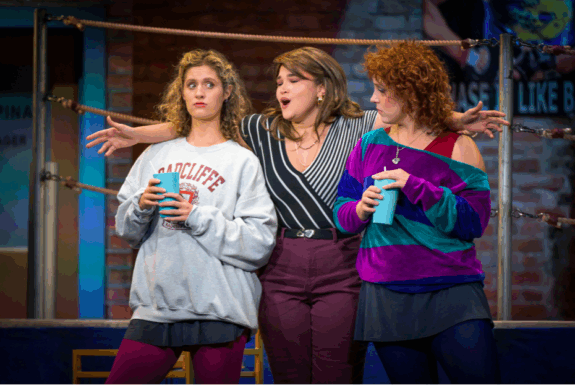
Setting the action in 1980 coastal Massachusetts instead of the original’s late-eighteenth-century Naples actually made the emotional details – and there are plenty of them in the second act – resonate better with a modern audience. The timing precedes the internet and social media, so the high-school-age boys and girls are still trying to figure it all out.

1980 also coincides with a fitness craze (think Jane Fonda, the movie Rocky and the dawn of modern pro wrestling), and the action here centers on a gym which gives the girls some agency by making them as physically active as the boys. Glittery costumes associated with pro wrestling go a long way to improve the disguises for the boys as each woos the other’s girlfriend. It gets closer to believable than anything I have seen in dozens of other productions. The get-ups for the ‘doctor’ and the ‘notary’ were also well crafted.
In this setting, Alfonso (a world-weary philosopher in the original) is an ex-boxer who owns the gym and drinks excessively, and Despina (the girls’ maid) is the gym manager selling fitness drinks to make extra money. Ferrando is portrayed as nerdy and Guglielmo as athletic, lusting after the girls but clueless. The sisters, Fiordiligi and Dorabella, are different in their own ways, but everyone in the cast reflects the intentions of the original characters nicely.
Fleming’s direction finds details in the action to respond to the music, often with a tellingly timed gesture or a change of expression. And there is some fun to be had whenever Mozart’s music gets bouncy and the girls (and non-singing friends in fitness wear) break into rhythmic exercises.
The genius of all this shows in the critical Act II scenes where the wooing of the other boy’s girlfriend (and watching her be tempted) brings up disturbing feelings, and the cast reflects it. In the end, the young women carve out their own way rather than settle for the usual choice of who ends up with whom (a point that the original libretto sidesteps). The young women take over the gym, Dorabella connects with Alfonso, Fiordiligi dons an ‘ERA Now’ sweatshirt, Despina departs for a better life in Boston, and the boys are deservedly cut adrift.
As for the music, Summers drew lively, sensitively balanced and insightful performances from the orchestra and vocalists. All the singers delivered the familiar arias well, and they sounded great together in the many duets and ensembles. The standouts were soprano Laura Miah as Despina, whose participation anchored so many of the duets and ensembles, and mezzo-soprano Ashlyn Brown as Dorabella, especially in her Act II aria, ‘È amore un ladroncello’. Also notable were baritone Finn Sagal as Guglielmo, particularly in his duet scenes with mezzo-soprano Brown. Tenor Jonghyun Park found the beauty in ‘Un’aura amorosa’ when he fails (at first) to win over Fiordiligi and thinks he is winning the bet.
For her part, soprano Lauren Carroll had the heavy lifting with her Act I aria, ‘Come scoglio’, and an even better aria in Act II, ‘Per pietà, ben mio, perdona’. As Alfonso, Peter Barber’s solid bass-baritone never flagged, and he looked the part of a hunky ex-boxer.
Harvey Steiman
Production:
Director – Renée Fleming
Choreographer – Sara Erde
Scenic designer – Michelle Harvey
Costume designer – Amanda Seymour
Lighting designer – Josh Hemmo
Wrestling consultant – Jacob O’Shea
Cast:
Fiordiligi – Lauren Carroll
Dorabella – Ashlyn Brown
Ferrando – Jonghyun Park
Guglielmo – Finn Sagal
Despina – Laura Miah
Don Alfonso – Peter Barber
Ms Fleming is talented!!