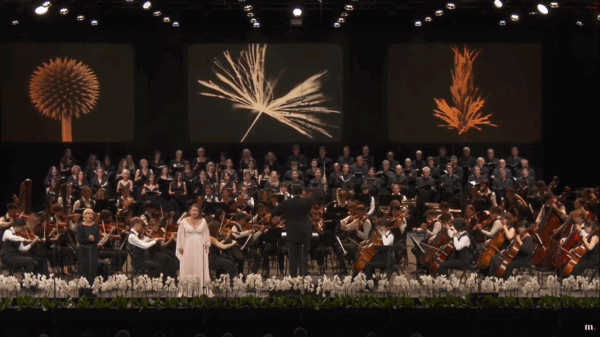
 Switzerland Verbier Festival 2025 – Puccini, Gianni Schicchi, Mascagni, Cavalleria rusticana (concert performances): Soloists, Oberwalliser Vokalensemble choir, Verbier Festival Orchestra / Andrea Battistoni (conductor), Johanna Vaude (video art). Broadcast live from Salle des Combins, Verbier, Switzerland, 24.7.2025 and available on medici.tv. (JPr) Updated review.
As the nineteenth century was drawing to a close audiences turned from Wagner’s gods and heroes to embrace post-Verdian verismo with stories which more reflected real-life. The birth of this movement could be said to be the premiere of Pietro Mascagni’s Cavalleria rusticana in Rome on 17 May 1890. Soon it was twinned with Ruggero Leoncavallo’s 1892 Pagliacci; together they enabled verismo to sweep Europe and as a consequence influence many diverse art forms.
The Verbier Festival 2025 offered another intriguing pairing which can be found on the world’s opera stages: Cavalleria rusticana with Giacomo Puccini’s Gianni Schicchi, a one-act comic opera; verismo in the literal sense (depicting real people) but not the darker side of life we see in in Pagliacci and Cav of course. Initially, whilst Gianni Schicchi was seen live it was not available on replay for some time because one of the artists withheld permission to show it but now it is possible at last to see Sir Bryn Terfel reprise the role of Gianni Schicchi.
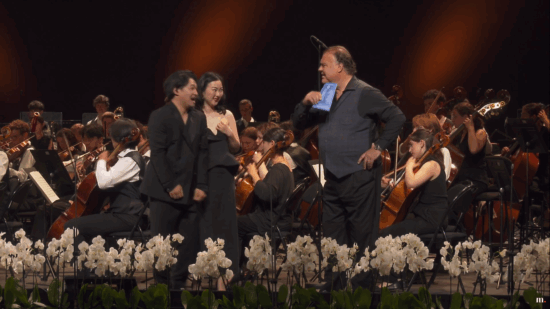
If you are to see a concert performance of an opera, then the way Gianni Schicchi and Cav were put on is – almost – what you would wish to see every time. Unlike the recent London Symphony Orchestra’s Salome (review here) also a one-act opera, no one was hiding behind a music stand and everyone knew their music. Although the men were in dark suits and women in elegant gowns, they involved us in the ongoing drama of both operas. Terfel – despite his career apparently winding down – seemed to enjoy himself immensely and gave a masterclass as Schicchi in his red Verbier pure energy cap, face masked by a small Swiss flag and brandishing the ‘will’ (possibly a leaflet about the village or the festival). Turiddu in Cav even got tipsy drinking ‘wine’ poured from a small plastic water bottle into a paper cap.
Gianni Schicchi presents a veritable kaleidoscope of different musical styles – certainly compared to Cavalleria rusticana in the second half – some more modern, some deliberately old-fashioned and with a lightness of touch recalling La bohème Act II. Greedy relatives at the bedside of wealthy Buoso Donati want his money for themselves and not for it to go to the monastery that he named in his will. Gianni Schicchi double crosses them and engineers the richest pickings for himself and his daughter Lauretta so she can marry Buoso’s nephew, Rinuccio. Puccini’s score has so much marvellous and inventive detail that even in a concert performance it all worked. It was wonderfully entertaining seeing the soloists, a mix of youth and greater experience, bringing to interludes such as a search for the will and the subsequent reactions when they read what was in it. The tension is palpable until they get to the very last page, when all realise only the monastery benefits and they are totally distraught.
As hinted at above Bryn Terfel was a colossal Gianni Schicchi and his experience in the role was clear for all to see. He sang very well with his very recognisable voice, nominally bass-baritone but rising into baritenor territory. In a performance which was very well sung by all concerned Ying Fang (Lauretta) and Sungho Kim (Rinuccio) delivered near perfect accounts of their show-stopping arias. Look out for the veteran Elena Zilio having great fun as Zita, Buoso’s mercenary cousin, even if the top of her voice can be a little shrill now in her eighties. Italian Andrea Battistoni’s account with his youthful Verbier Festival Orchestra was endearingly light-hearted.
Modern audiences seem to get an overdose of naturalism whenever the houselights dim these days in a theatre or opera house and so operas like Cav, with its tale of love-triangles, sexual jealousy and bloody revenge, can easily be dismissed as a lurid melodramatic potboiler. A concert performance throws the focus on Mascagni’s arias, duets, choruses, as well as prelude and famous Intermezzo: lush melodious music which is by turns atmospheric, prayerful or intensely emotional. In Cavalleria rusticana (‘Rustic Chivalry’) we have the soldier Turiddu who is sleeping with Lola, the wife of the local cart-driver Alfio, while he is away and so cheats on his girlfriend Santuzza who begs him to give Lola up. When he refuses, she tells Alfio what was going on behind his back and he kills Turiddu in a knife fight.
Rightly regarded ‘a conductor’s piece’ Mascagni rarely wastes a second of the 75-minute Cav which has an almost symphonic beauty, strong sense of colour and musical characterisation. With the highly demonstrative Battistoni (music director of the Teatro Regio di Torino) on the podium the young players of the Verbier Festival Orchestra were encouraged and supported through a highly passionate – and at times very moving – performance. The chorus was positively radiant in the ‘Easter Hymn’ and otherwise suitably enthusiastic as the Sicilian villagers. One of the women let out a truly bloodcurdling scream at the end of the opera to announce the bad news of Turridu’s fate.
Organisers of the Verbier Festival clearly did not entirely trust in the music and the performers because video artist Johanna Vaude provided some ever-changing and eclectic imagery at the back behind the chorus. It must have been even more distracting in the theatre than it was watching it on a screen. If they had ever stayed still as a backdrop to the singers that would have been better than them flickering constantly throughout. Some of what we saw was related to what we heard – sepia or black and white images of village life, bells, blue sky, clouds, fields and blooming flowers – but much wasn’t, such as crashing waves, lava flows, athletic men, smoke, lightning and an eclipse.
How exciting it was to see Freddie De Tommaso’s confident role debut as the unfaithful, heavy drinking Turridu. From his opening offstage aubade De Tommaso’s was a very ardent interpretation with some warm heroic tones and ringing, very secure top notes. He was at his best bidding farewell to his mother (Elena Zilio, compelling again). My only concern is that De Tomasso seemed to sing either loud or louder and I wonder if there was enough light and shade. Commanding, rich-sounding mezzo-soprano Yulia Matochkina was a rather stoic Santuzza at first but did appear increasingly neurotic and hungry for revenge as the opera went on and as her character came to terms with being abandoned by Turridu. Singing with a warm timbre Ava Dodd was a lady in red – or rather rose-pink – as the calculating and alluring Lola. Finally, what luxury casting it was to have Ludovic Tézier’s incisive velvety baritone singing the cuckolded Alfio who eventually gets consumed by envious rage. Look out for his first appearance illustrated by the silhouette of a trotting horse pulling a two-wheeled cart!
Jim Pritchard
Featured Image: Elena Zilio (Lucia), Yulia Matochkina (Santuzza), conductor Andrea Battistoni and the Verbier Festival Orchestra
Casts:
Gianni Schicchi
Sir Bryn Terfel – Gianni Schicchi
Sungho Kim (Rinuccio)
Ying Fang — Lauretta
Elena Zilio — Zita
Giorgi Guliashvili — Gherardo|
Katrīna Paula Felsberga — Nella
Maryam Wocial — Gherardino
Maksim Andreenkov — Betto di Signa
Ossian Huskinson — Simone
Theodore Platt — Marco
Ellen Pearson — La Ciesca
Felix Gygli — Spinelloccio / Ser Amantio di Nicolao
Edward Birchinall — Guccio
Anton Beliaev — Pinello
Cavalleria rusticana
Yulia Matochkina – Santuzza
Freddie De Tommaso – Turiddu
Ludovic Tézier – Alfio
Elena Zilio – Lucia
Ava Dodd – Lola