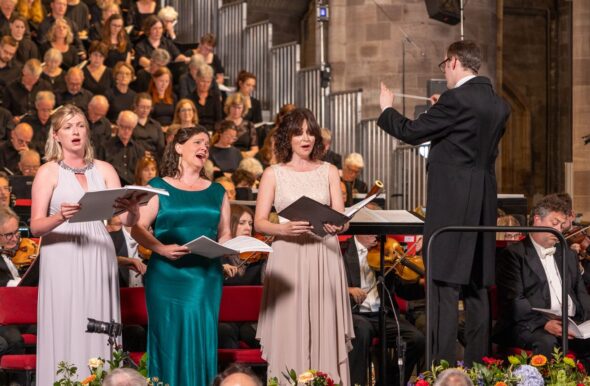
 United Kingdom Three Choirs Festival [4] – Coleridge-Taylor: Rebecca Hardwick (soprano), Aoife Miskelly (soprano), Amy Holyland (mezzo-soprano), Martha McLorinan (mezzo-soprano). Mark LeBrocq (tenor), David Stout (baritone), Three Choirs Festival Chorus, Philharmonia Orchestra / Samuel Hudson (conductor). Hereford Cathedral, 31.7.2025. (JQ)

Samuel Coleridge-Taylor – The Atonement, Op.53 (1903, rev.1905)
In recent years, Geraint Bowen has made something of a habit – a welcome one – of including in his Hereford Three Choirs programmes large-scale British choral/orchestral works which are infrequently heard in our concert halls. It was thanks to him that I experienced for the first – and so far only – time in live performance major works by Dyson, Bliss and Dame Ethel Smyth. Now Bowen gave us another revival but, so far as I was concerned, there was an important difference: I had already heard all those other works several times, either on CD or though broadcasts, but Samuel Coleridge-Taylor’s The Atonement is a work which I have not previously known of or heard. By programming it, Bowen was able to mark the 150th anniversary of the composer’s birth.
The Atonement was premiered at the 1903 Hereford Three Choirs Festival, so my first step was to search in The Three Choirs Festival. A History by Anthony Boden and Paul Hedley, a book which is as comprehensive as it is indispensable (review here). There was a brief reference to the fact that Coleridge-Taylor conducted the premiere, but the only comment on the score itself was that The Atonement was ‘a work that suffered badly from the libretto of Mrs Alice Parsons’. That meagre description scarcely filled me with confidence, but I reasoned that in all probability the neglect of the work meant that the authors of the book had never had the opportunity to hear a performance. So, I determined to approach its performance with an open mind.
After a long period of neglect, the music of Coleridge-Taylor (1875-1912) has enjoyed something of a minor renaissance in recent years, especially on CD. I have heard a number of his chamber and orchestral works, not least his attractive Violin Concerto. The music that I have heard has, without exception, been appealing and very well crafted but apart from the Violin Concerto and one other work, all the compositions by this composer which have come my way have been fairly short in duration. The other substantial work, besides the concerto, is the one on which the composer’s reputation rested for so many years: the tripartite choral/orchestral work The Song of Hiawatha (1898-1900) which was presented in full at the 2013 Gloucester Three Choirs Festival. In my review I said that Coleridge-Taylor’s score ‘is consistently accessible, enjoyable and tuneful, even if his use of leitmotifs means that his tunes tend sometimes to get stretched rather a long way’. I added that ‘I found it an entertaining work’ but I suggested that it ‘is a work that has probably had its day and it can hope for no more than the occasional revival’.
Coleridge-Taylor was for some years an admired figure in Three Choirs circles. On the recommendation of Elgar, he was invited to write an orchestral work for the 1898 Gloucester Three Choirs. The success of that piece, the Ballade in A Minor, led to an invitation to compose for the 1899 Worcester Festival: Solemn Melody was the result. Sadly for the composer, it seems that this work was never performed again until tonight’s conductor, Samuel Hudson included it in his programme for the 2021 Worcester Festival, where it proved worthy of revival (review here). A song cycle, The Soul’s Expression was premiered at the 1900 Hereford Festival and the following year another orchestral composition, Idyll was premiered at the Gloucester Festival, conducted by the composer; the work, it seems, was not too well received by the critics. Then came the invitation to write what became The Atonement for the 1903 Hereford Festival. The premiere of that work, which the composer conducted, proved to be his last Three Choirs appearance
I was able to do some homework; in particular, given the comment about her libretto in the Boden/Hedley history, I was keen to learn a little more about Alice Parsons (1871-1934). I am grateful to Simon Carpenter, the Festival Archivist and author of a recent, valuable history of the Three Choirs Festival (review here) who kindly provided me with some material he had assembled from his own researches. Alice was born in Cheltenham into a Unitarian family. Her origins were fairly humble but in 1894 she married Francis Parsons, a journalist who was the joint proprietor of two local newspapers, the Gloucestershire Echo and the Cheltenham Chronicle. After her marriage, Alice actively supported her husband in his work at the papers and it seems that this is when her writing began. She was locally active both in the movement for women’s suffrage and in the Liberal party. Most relevantly in the context of The Atonement, we should remember that her religious affiliation was to the Unitarians. Apparently, she was approached by Coleridge-Taylor in 1902 to write the libretto for The Atonement, but quite how this came about is unclear. The oratorio sets to music the story of Christ’s Passion and Crucifixion, though there is little or no direct quotation from Scripture. As Paul Ellison observed in his programme note for this concert, Parsons ‘made the decision to construct her own text, paraphrasing the all-too-familiar words. In doing so, she was reflecting the wish of the composer for something different’. I think it is also worth referencing an extract, supplied to me by Simon Carpenter, from a letter which Coleridge-Taylor wrote to one Reginald Buckley, who was preparing a programme note for the first performance: ‘I have written the music on no accepted religious lines, and have merely tried to put musical life to my libretto. I am told my treatment of Christ’s part is different to the usually undramatic setting. This is of course intentional, for I, personally, cannot imagine Christ, when on earth, to have been minus dramatic life. Personally speaking I have used “motif’, though not rigidly; in fact, I have tried to portray the scenes as naturally as I possibly could, without regard for any preconceived notion as to how such a work should be set. If I have failed, it is not through want of good and reverent intention.’
Coleridge-Taylor produced a full-length oratorio: I timed this performance at 85 minutes. To be honest, I think The Atonement is much too long: had Coleridge-Taylor produced a more compact score, lasting say an hour, it might have been beneficially tauter. In fact, the work was originally even longer. During the performance I noticed what appeared to be two quite substantial cuts in Parts IV and V of the work. After the performance I was able to clarify with Bryan Anthony Ijames, who had edited the score for the performance, that in 1905 Coleridge-Taylor made a revision of the work, omitting the two passages in question; confusingly the Three Choirs Festival had printed the 1903 libretto in the programme. The work is divided into five parts, as follows: I Prelude (for orchestra); II Gethsemane; III Prayer of the Holy Women and Apostles (a short choral movement); IV Pontius Pilate; V Calvary. This performance had an interval after Part III. The scoring is for SATB chorus, orchestra and no fewer than six soloists. Frankly, Coleridge-Taylor’s use of soloists is extravagant – and may partially explain why the work is so neglected nowadays. The baritone (Christ) is the only soloist required before Part IV; his is a substantial role. Part IV uses a soprano as Pilate’s wife and a tenor as Pilate – the tenor makes a brief reappearance in the work’s closing ensemble. In Part V the other three female soloists take part. To be honest, I don’t see why the same soprano could not sing in Parts IV and V; that would be a bit more economical, but, rightly, for this revival the Three Choirs respected the composer’s wishes.
What of the work itself? Based on this hearing and on reading the text beforehand, I can only concur with the verdict on the words which Boden and Hedley reached. Alice Parsons’s libretto seems ‘of its time’ with the words a prime example of Victorian piety. One regrettable trend I noticed during the performance is the number of times that Coleridge-Taylor repeats words; it is a device taken to excess. In some ways, Coleridge-Taylor’s music is, like the libretto, of its time in that it struck me as being pretty conservative in tone and very much late-nineteenth century. Yet, more than once during the performance I reflected that just two years before Coleridge-Taylor began work on The Atonement Elgar had composed The Dream of Gerontius (and in 1903 he gave us The Apostles). There is nothing in Coleridge-Taylor’s score which comes anywhere close to the blazing originality of Elgar’s music in those works. I thought the Prelude to The Atonement was quite promising; the composer laid out several themes which were to recur in the oratorio and the orchestral scoring was rich and noble. However, that promise was not really sustained.

The portrayal of Christ was interesting. Bearing in mind the composer’s comment to Reginald Buckley, I presume that David Stout was following the instructions in the score. As a result, Christ emerged as rather a forceful character. That is fine up to a point; after all, the Passion of Christ is a story of physical and emotional anguish. However, I might have expected more tenderness on occasions such as (in Part I) Christ’s words to his disciples, ‘Oh, little flock, whom I have loved so well’. Again, near the end of the work when Christ sings ‘Father, into Thy hands’, there was some musical softening but not quite enough, I felt. The picture of Christ that emerged seemed to me to be rather too one-dimensional and lacking in compassion, though that is in no way a criticism of Stout, who sang very well and with no little conviction. In the Passions of Bach, Pilate is portrayed by a baritone or bass but Coleridge-Taylor allotted the role to a tenor. This is another strongly projected portrayal of a character and in Mark LeBrocq we had just the right singer with all the necessary heft for the part of Pilate. This was an instance where I felt Coleridge-Taylor and Parsons had the characterisation right; Pilate displays not just steely authority but also contempt for the Jews and what their leaders are up to. This was a ringing performance which commanded attention. As Pilate’s wife, Rebecca Hardwick had just one solo to sing, though it was a big, dramatic aria. There was plenty of power and dramatic intensity to her singing. However, I had heard her the previous evening in Howells’s Hymnus Paradisi and I commented then that I regretted a lack of warmth to her tone (review here). Tonight, that lack of warmth was even more pronounced; indeed, there was too much edge to her tone. Whilst that aided her dramatic projection, I didn’t greatly enjoy the singing. In Part V there are parts for three more female soloists, each allotted a separate role: Aoife Miskelly as Mary, the mother of Jesus; Amy Holyland as Mary Magdalene; and Martha McLorinan as Mary, the wife of Cleophas. Each had a small solo before they combined as a trio. All three of them sang admirably and they blended well as a trio.
The Festival Chorus sang with commitment. I imagine the music is not as challenging as some of the other pieces which they will have performed by the end of the week. That said, they entered into the spirit of the piece with enthusiasm. They are required to fulfil a number of functions: as narrators; as commentators on the story as it unfolds; and, inevitably, as the Crowd. They were particularly successful in that latter guise; their singing in the scene with Pilate was positively vituperative. I am just thoughtful about one point: there seemed to be an awful lot of loud singing with not as much dynamic contrast as I might have expected. However, given that in other performances this week the Festival Chorus has proved attentive in this matter I will pay them the compliment of assuming that they were following the dynamic markings in the score.
Samuel Hudson led the performance with palpable enthusiasm for the task in hand. It is crucial, I think, to galvanise the performers when an unfamiliar piece is being performed, particularly if it is an uneven score. I thought Hudson achieved that.
The closing pages of The Atonement consist of a big ensemble for chorus and soloists (‘Christ hath triumphed’) The words and music express a truth for any Christian believer but, even so, I thought it was all too full-on and, frankly, a bit obvious; I was unmoved. That said, this ‘big finish’ enabled Hudson and his forces to conclude this revival of a long-neglected work on a high and it resulted in a very enthusiastic response from the substantial audience.
As will be obvious, I have significant reservations about The Atonement. I have heard that it has not been performed for some 90 years, though I cannot verify that. To be honest, I thought this revival showed why such neglect has occurred, though I must stress that the misgivings I have are in no way a reflection on the admirable performance it got. I have already referenced Elgar. I fear that The Atonement doesn’t begin to match the quality and originality of the music that Elgar was writing at around the same time. We were reminded in the programme book that when Elgar recommended Coleridge-Taylor as a prospective composer for the 1898 Three Choirs Festival he described him as ‘by far and away the cleverest fellow going amongst the younger men’. Perhaps, then, the shortcomings that I detect in The Atonement are simply the result of inexperience. Had he lived longer, Coleridge-Taylor might have revised the work or, more likely, have produced much better choral/orchestral compositions. In that connection, it is relevant, I think, to make another comparison with Elgar. Had Elgar died early, as did Coleridge-Taylor, after composing his early oratorio The Light of Life (1896) and before The Dream of Gerontius I doubt his reputation as a composer of choral/orchestral works would be as high as is the case.
The Three Choirs Festival honoured Coleridge-Taylor’s memory with this revival but I find it hard to envisage The Atonement becoming established in the repertoire.
John Quinn