
Bass-baritone Ryan Speedo Green on the Ring road to Wotan
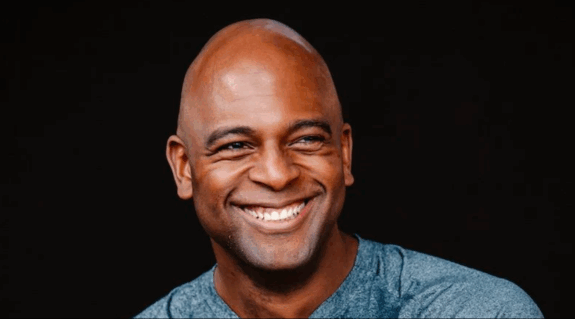
In the nine years since a book about Ryan Speedo Green told his story of a troubled African-American youth redeemed by opera, the bass-baritone has risen from short opera roles to a career that has made him a star at the Metropolitan Opera. His latest triumph is an astonishingly mature portrayal of Wotan in Wagner’s Die Walküre at Santa Fe Opera [click here]. Coming later this year at the Met: the title role in Mozart’s Don Giovanni and, beginning in 2028, a full Ring Cycle. At the age of 39, his current performance as Wotan in Santa Fe is turning heads in all the right ways. Coming next May: Wotan in the Los Angeles Philharmonic’s Die Walküre over six concerts under superstar conductor Gustavo Dudamel.
A school trip as a pre-teen to see Carmen at the Met and a backstage visit with star mezzo-soprano Denyce Graves convinced the young Green to make singing opera his career. His rich, dark voice, commanding stage presence and a desire to learn every detail of what it takes to achieve opera stardom has made him into a singer to be reckoned with. Cementing his presence in just the past two years are starring roles at the Met, including in Champion and Fire Shut Up in My Bones, both by Terence Blanchard, and marquee casting in such standards as Boris Godunov and La bohème.
In 2014 he joined the Wiener Staatsoper, where he spent much of the past decade singing smaller roles. He married Irene Fast in 2016, with whom he has two sons. A side benefit is a fluency in German, not to mention a solid foundation for his life.
The day after the second performance of Walküre in Santa Fe, Green sat down with me for an extended interview about his career arc and what went into his stellar Wotan.
Harvey Steiman – You and I last talked in 2016, when Sing for Your Life: A Story of Race, Music, and Family was published and you made your Metropolitan Opera debut in a very minor role. Now look at you.
Ryan Speedo Green – Since COVID, a lot of doors have been opened. I always believed that any role, no matter how big or small, was the proper approach. I was doing many small roles in succession and then, all of a sudden, I was asked to do one large role, and it’s, like, if you could do five medium roles in one month, you could probably do one large role in a month.
That was Champion in April 2023?
My first lead of my career, yeah. And that was paired with one of my idols. I got to do an opera with Eric Owens, whom I personally looked up to, whose career I actually wanted to emulate. Eric did not sing Wotan at the time. He was Alberich, but he always made such a huge impression. For me, his musicianship, his artistry, that’s something that I dreamed of emulating and to be in that position now is, it’s a blessing.
I’ve been so excited for all the repertoire that’s been open to me. My first professional German role was the Second Knight in Parsifal, in the Met’s production in 2014. And from there I fell in love with (singing) Wagner.
My only experience with Wagner was, as a teenager, seeing Parsifal. I remember the first 45 minutes, and then the rest of it I was asleep. You have to experience so many other musical genres to be able to understand the complexities of Wagner and Richard Strauss and some of these big-time German composers.
After I was in Parsifal, I started getting into the art songs of Schubert and Wolf and Liszt and Mahler. I thought that would connect me to the language. I had no idea it would lead me to Wotan someday. Walküre is the hardest of the three [Ring operas in which Wotan appears] because each act needs almost its own completely different kind of singing. There’s no time to change gears between acts.
Did you ever think about Wotan when you first started singing?
It wasn’t a role that I saw myself singing. My voice type has been transitioning for a long time. I started as a tenor when I was in high school, then transitioned to bass, then went to baritone, then high baritone, then back to bass, then bass-baritone. It was around the time I won the 2011 Metropolitan Opera National Council Auditions that I finally transitioned to bass-baritone and found my sweet spot. It took about ten years of being in that sweet spot to be able to experience, hone and practice every part of my voice in different genres – the German rep, the French rep, Russian rep, Italian rep, you name it.
About five years ago, right before COVID, I did my first Ring cycle. I sang Fasolt at Vienna State Opera, and I met the amazing baritone Tomasz Konieczny. He sings Wotan all over the world and was singing Wotan there. He came up to me after our first rehearsal and asked me, in his broken English, if I sang Wotan. And I was, like, God, no. I’m 34. And he’s, like, you should look into it because Fasolt is a prerequisite to Wotan – the range, the qualities, how you have to sing in legato line, the power. We also have to have beauty and this sadness.
And then he asked me if I sang Dutchman. I said no, and he said I should look at it too. COVID happened right after that, so I thought a lot about what he said. I started looking at the big Dutchman aria, and I put it in my audition rep to showcase another part of my voice. At eleven minutes, it is about the same length as Wotan’s ‘Leb’ wohl’ but without the breaks. The difference is Dutchman’s ‘Die Frist ist um’ is the first thing you sing. To have to sing ‘Leb’ wohl’ at the end of a 4½-hour opera requires everything of you. When I started singing the Dutchman aria [he included it in his first Carnegie Hall recital] a lot of people said I should look at Wotan.
How did you get cast as Wotan in a concert Das Rheingold with the Los Angeles Philharmonic?
During COVID, Daniel Mallanpalli, who was casting vocal roles at LA Phil, heard me as Rocco in Fidelio. The role has a ton of dialogue, it’s a father, it has a lot of the qualities of protecting your child, and he is pretty much in every scene. He had heard that my top was so easy and asked me if I would be interested in singing something a little higher – Kurwenal in Tristan und Isolde – which is one of the hardest baritone Wagner roles there is. And so I said sure, why not?
I did Kurwenal with him, and then at the Bastille for my debut at the Paris National Opera. And that’s when Gustavo Dudamel heard me and said ‘you have to sing with me’. That led to my first Wotan at the Los Angeles Philharmonic in January 2024.
It was like a chain reaction. Daniel James [Santa Fe Opera director of artistic administration] and Davide Lomelì [chief artistic officer] knew my history singing with them, including Don Giovanni last year. They had heard me sing the Rheingold Wotan in Los Angeles and asked, ‘Speedo, would you be interested in singing the Walküre Wotan here?’
First of all, this is a great place to do it. The long rehearsal process helps. Sure, everybody comes here to watch it, but there’s a history of singers premiering big roles. It’s a safe place for people like me who are delving into a repertoire that can be career-defining. People who sing it leave a legacy. When the world first offered me Wotan, I immediately knew what it meant, not only to my career, but how many people who look like me have sung the role of Wotan?
So where does Wotan stand with your future?
I never thought it would be a part of my career, but I’m fully embracing the majesty, the importance, the legacy behind it. I want to give it my all. And I hope last night in the performance people saw that I am pouring so much of myself into this role.
I don’t know if I can identify what was yourself and what is the role, but I could say there are very few bass-baritones in my lifetime who made me feel like that’s the way I want to hear it. You’re the most recent one. It’s because you love the bel canto part as much as the big, big scenes.
This role has been the hardest I’ve ever done. So much, it is the connections with the other singers. Obviously, you need technique and security to just survive in this role, to make it to the end. When I am walking off the stage, I feel like I’ve actually made it to Valhalla. And that kind of feeling I don’t think I have ever had in an opera before.
What singers today or in the past have influenced you the most for this role?
I will say two. I was 28 years old when I won the George London competition. The late Nora London told me ‘you’re the first voice in a long time that reminds me of my husband, George London’. Coming from her, that made a mark on me. She kept in contact with me throughout the years. She is German and very happy that I married a German woman. In the last four years, I’m embracing all of his German repertoire, studying how he approached it.
For a living singer, someone who I’ve had the luck and honor of working with, James Morris was a gold standard for most of my life. When I need to get in the mood for singing Wotan, I just watch the video of the final act of Walküre. The pure emotion, the connection that he has with James Levine, you don’t need a microphone or a magnifying glass to see the emotion on his face.
And then I could see how he could transition to Don Giovanni, King Philip II. All of these roles that I either am singing now or will be singing in the future, it’s James Morris and George London. I don’t try to emulate them because my voice is different, but they showed me how they approach it – the breaths they take, phrases they shape, the technical stuff. Now that I am fully invested in the roles that they have sung, I know that these are two pillars of voices that I can lean upon in the sense of understanding the limits.
One thing that distinguished both London and Morris was how much they emphasized the bel canto aspects of Wagner’s writing in the more intimate scenes.
Exactly! And I am so lucky to have James Gaffigan conducting. I didn’t have to say I want to make sure I can sing piano here, but with his control of the score, the understanding, the way that he handles every singer individually and accommodates every singer vocally, I never had to speak up for anything because he was already doing what I needed.
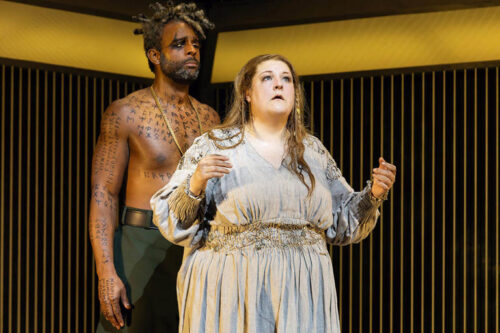
How do you tune into portraying Wotan’s emotions, which are all over the board?
Well, saying goodbye to Brünnhilde was like saying goodbye to my father when he passed away. Admonishing the Valkyries for disobeying me made me think about how I need to be better as a father with my kids.
Tammy [soprano Tamara Wilson singing Brünnhilde] never falters. I love those last 30 minutes of the opera, with her and me on stage together. It’s almost like I am in an opera playroom, being able to just create. If I do something different than I did the last time, it never fazes her. If she does, I have to think about how to react.
Colorblind casting is nothing new, the idea that a singer who is not white can be cast in any role. Opera was ahead of the game in that aspect. What do you see around you now?
I’ve seen such a dramatic increase of faces that look like me and roles that are not just supposed to be filled by people who look like me. Doesn’t matter anymore, if you look at the cast of this season at the Met. I mean, the Giovanni that I’m in, it’s a very colorful cast. People from all over the world. It’s exciting to be in an era where my Leporello can be white and I can be black. And it is about how we sing it and how we act it, not about the fact that my Leporello is white and I’m black.
And it all happens in the dark anyway.
Yeah, exactly. You know, like everybody looks the same in the dark.
Do you want to sing Leporello, by the way?
No. I’m gonna milk Giovanni as long as I can because I love being a bad guy, especially if I can make him even slightly lovable. Leporello is lovable because he’s just so funny. I pride myself on the Giovannis that I’ve done, and that when I leave the stage a lot of people come up to me to say, ‘I didn’t really want you to die at the end’. I left an impression on the audience members that they didn’t expect. That’s when you know you’ve done a good job.
What about Falstaff?
I’ve been Pistola in Falstaff for several productions. Falstaff is arguably the most dramatic comedic role you can sing vocally in my voice type, but that’s for later on in my career.
I dream of singing Boris someday, in part to honor my wife, who is half-Russian, half-German, to be able to be the lead role in an opera like that and pay homage to the history and the legacy of that role. [It was also a role in which London excelled.]
And Claggart in Billy Budd. To be that bad guy, to try and destroy innocence like that, that is so against my character. But it’s a role that I would love to sink my teeth into.
Thank you for taking the time to have this conversation.
Harvey Steiman