 Germany Bayreuth Festival 2025 [3] – Wagner, Tristan und Isolde: Soloists, Bayreuth Festival Chorus and Orchestra / Semyon Bychkov (conductor). Bayreuther Festspielhaus, 10.8.2025. (DM-D)
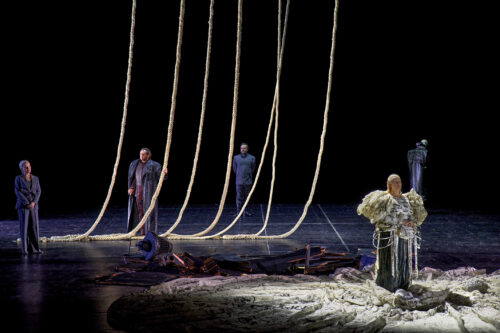
For the first act of this revival of the 2024 production of Tristan und Isolde, the stage, designed by Vytautas Narbutas, was vast and bare, with some shipping ropes hanging from the fly tower. When the curtain opened after the Prelude, Camilla Nylund was almost centre stage, sitting, head near the floor, on what initially looked like a round, off-white platform. Soon, however, she sat upright, and the platform turned out to be a huge gown. The lighting, designed by Sascha Zauner, was so dim that it only became apparent very gradually that text from the libretto was written on this vast garment, and at times Nylund’s Isolde continued writing on it with an appropriate pen. When further movement was required from Isolde, she would open the gown around the waist, sometimes assisted in this by Brangäne, so that she could move about at will. In moments of formality, i.e. when she encountered Tristan, and when the ship arrived in Cornwall, Isolde quickly returned to the gown to be enclosed in it again. Entering and exiting the stationary gown was an activity familiar to both Isolde and Brangäne: given the complexity of the action involved, they would not have been so at ease with the process if it had not been a frequent and thus established and well-practiced habit.
Kurwenal and Tristan were moving about for much of the time of the first act in the background, unseen by Isolde and Brangäne, sometimes together, sometimes on their own – their motivation for being there or not was not elucidated. When Tristan and Isolde came together on the stage for the first time, there was a noticeable tension and chemistry between them, an attraction they were both aware of and worried about. When they decided to drink what they thought was the death potion, lighting was such that it was not clear whether they had drunk from the small vials containing the potion before throwing the vials into the distance – whether they had drunk or not was in fact the topic of several conversations among spectators whom I overheard during the interval.
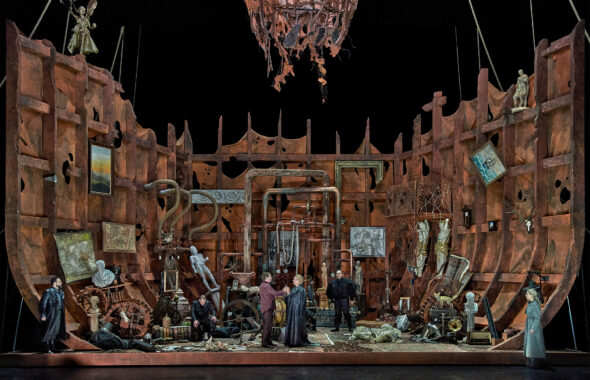
Act II was set in a space deep inside the ship, with dark brown wooden walls, and a huge number of objects, lit in such a way that some could be identified, for others it was impossible to tell what they were. They may have been Isolde’s possessions which she took with her to Cornwall. For their love duet, Tristan and Isolde moved about in this mess, stumbled, climbed, fell, sometimes picking up objects, sometimes just looking at them, ignoring most. Perhaps the mess of their environment was meant to reflect the mess of their relationship? For the third act, the ship’s walls from Act II had been stripped to a skeleton structure, the amount of stuff in the space had shrunk, and Tristan was in amongst one of the few more well-defined heaps of remaining objects. Again, the lighting was such that only some of those objects could be identified. Both in Acts II and III, Isolde’s huge gown was part of the amassment of objects and would receive the most attention of any one of them.
The costumes designed by Sibylle Wallum were predominantly dark in colour, and neutral without specific period references. Brangäne wore a dark grey trouser suit – this, together with some of Ekaterina Gubanova’s movements and gestures, may have suggested a person of Asian origin, a reference perhaps to the servant Suzuki from Puccini’s Madama Butterfly? Overall, there were many suggestive elements in Thorleifur Örn Arnarsson’s production, hints, possibilities, ‘did they or did they not’ – moments, stimulating the spectator’s imagination by its openness, possibly stretching a willingness to engage a little far.
Semyon Bychkov returned to Bayreuth to conduct, as for the 2024 premiere of this production. In his interpretation of the score, primordial forces were interacting – not merely the already majestic flow of waves near the surface of an area that you can think you can control, even if you cannot. Rather, the immensely, unimaginably powerful currents and energies released at the very depths of the deep sea, which inevitably and irresistibly influence everything in the layers above, including the visible waves. No matter how primordial those forces are, comparable perhaps to those of volcanos, they still follow laws of nature. Bychkov released the power of those depths in the music, while still adhering to its principles of composition – thus the utter turmoil at the basis never turned chaotic, and subtler aspects given rise to were well expressed as emerging from that primordial churning.
Such a reading of the score implies that the singers’ voices take on a different role in relation to the orchestra. They are uniquely part and parcel of the soundscape, reflecting and representing the emergence of meaning. The interaction of voice and orchestra was thus never one and the same. It varied with the music, just as much as the music varied. Sometimes, they intentionally fought each other, seeking to overpower. Bychkov demonstrated in such instances that he was fully aware of the respective singer’s individual capacity in general and at any particular moment in a specific performance. Yes, voices and orchestra were engaging in a musical fight, but not one resulting from a conductor’s insensitivity to the singer’s particularities, but one intended and played out with relish by both sides. At other times, orchestral playing and singing were in agreement, developing material in and from togetherness rather than opposition and struggle. At further times, the singers set the impulses for the orchestra to follow.
In this overall context, Andreas Schager sang Tristan, a role in which he gave his debut in 2012 in Minden. His rendering was then and still is indefatigable. His seems still most comfortable and happiest when he sings with full power, relishing every moment of it, and his voice is still steely and ringing. Over the years, his middle and lower range have strengthened, and he uses that development to the best effect. He can now afford to engage in the softer, gentler, perhaps subtler modes of singing, where appropriate for the role, and he proves to be as successful and increasingly impressive here as he has been with the full blast singing for many years.
Camilla Nylund clearly enjoys singing Isolde, following her 2022 debut in the role in Zürich. She relished the different levels of her encounter with the orchestra, and her secure technique allowed her to define every moment of the role at will, with many nuances of volume, always with clear intonation and a truly mesmerising ‘Mild und leise’. Ekaterina Gubanova played Brangäne as a passionate woman torn by her desire to help her friend Isolde, and the clash between duty as a servant and a different relationship as a friend. Her voice was sultry, without any sharp edges and with a particularly supple lower register. Jordan Shanahan was a lively Kurwenal, with a strong, robust but elegant voice. In relation to this character, there was a striking directorial idea: Kurwenal mistreated Brangäne early on in Act I, forcing her to her knees. Later, Isolde put Kurwenal into the same position in an apparent act of revenge.
Günther Groissböck sang King Marke with a heavy, gravelly voice, suited well to the interpretation of this character in this production as so overcome with his grief that he could not but exert physical violence on Tristan, repeatedly grabbing hold of him and pushing him to the ground, which in turn made him suffer even more. Alexander Grassauer was a sturdy Melot, and Daniel Jenz, Lawson Anderson and Matthew Newlin were appealing as Shepherd, Steersman and Young Sailor.
Daniel Meyer-Dinkgräfe
Featured Image: Tritan und Isolde Act II: [l-r] Jordan Shanahan (Kurwenal), Günther Groissböck (King Marke), Andreas Schager (Tristan), Camilla Nylund (Isolde), Alexander Grassauer (Melot) and Ekaterina Gubanova (Brangäne) © Bayreuther Festspiele/Enrico Nawrath
Production:
Director – Thorleifur Örn Arnarsson
Stage design – Vytautas Narbutas
Costumes – Sibylle Wallum
Lighting – Sascha Zauner
Chorus director – Thomas Eitler-de Lint
Dramaturgy – Andri Hardmeier
Cast:
Tristan – Andreas Schager
Isolde – Camilla Nylund
King Marke – Günther Groissböck
Kurwenal – Jordan Shanahan
Brangäne – Ekaterina Gubanova
Melot – Alexander Grassauer
Shepherd – Daniel Jenz
Steersman – Lawson Anderson
Young Sailor – Matthew Newlin