
 Germany Bayreuth Festival 2025 [4] – Wagner, Die Meistersinger von Nϋrnberg: Soloists, Bayreuth Festival Chorus and Orchestra / Daniele Gatti (conductor). 11.8.2025. (DM-D)
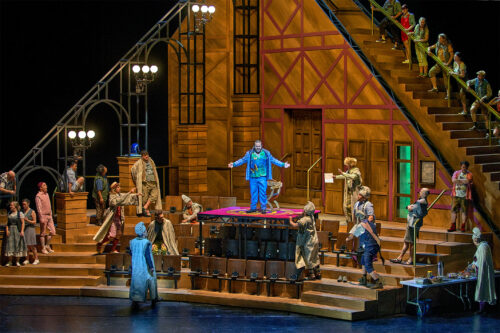
The new production for 2025 at the Bayreuth Festival was from Matthias Davids. Expectations had been raised by the knowledge that Davids has a well-established name as a director of musicals, in his capacity as artistic manager of the musical section of Landestheater Linz, Austria. The majority of the canon of musicals is indeed on the long list of his production credits. In addition to Linz, he has directed in Dresden, Leipzig, Berlin, Hannover, Graz, and Munich, among others. His forays into opera include productions of La bohème, The Cunning Little Vixen and The Magic Flute. In statements ahead of the opening night of Die Meistersinger, he underlined his intention of seeking to bring out and emphasise the comedy in Wagner’s opera.
As the curtain rose in Bayreuth, we saw a narrow and very high staircase to the left, leading up to a miniature church building. Walther von Stolzing, on the floor in front of that staircase, had been folding a considerable number of paper aeroplanes and thrown them up the staircase and presumably had them returned down from it. Eva appeared near the top of the staircase and they engaged in some communication, mainly through gestures because they did not wish to attract too much attention from the others going about their respective businesses, including Magdalene, Eva’s companion. Every time Eva came into Walther’s sight, he got all physically excited, huffed and puffed, rolled his eyes, and then sought to calm himself down intentionally, indicated by the gesture of soothingly lowering his arms, palms parallel to the floor, as if to control hyperventilation. This was incredibly funny, well and meticulously choreographed/directed and expertly executed by Michael Spyres. I found myself giggling in response. Sadly, several people in the row in front turned round and glared at me angrily.
This set of responses, my own laughter at ever so many ingenious ideas and moments in the production, and the sour and stoic display of a certain lack of humour persisted, and only occasionally was the onslaught of funny things to see so intense that the wall of unwillingness to engage with the humour on offer was broken and an audible sound of some- often polite and retrained – laughter could be heard in the auditorium. Those moments were chiefly related to the character of Beckmesser: in the brawl scene at the end of Act II, the apprentices at some point quickly created a makeshift boxing ring from a number of random ropes. In Beckmesser’s moments alone in Hans Sachs’s workshop, he clumsily (because of the injuries he sustained in the brawl the night before) stumbled about, sat on a just-mended stool which broke apart underneath him, and he lost the arm sling and sought to get his arm back into it (wonderful slapstick!). In the fairground scene of Act III, fun was made hilariously of the traditions of those country events, with all kinds of queens (such as wine queen), and two chorus members dressed up very strikingly (one of them clearly a man in drag) as Angela Merkel (the former German chancellor and regular spectator in Bayreuth), and another two as famous German TV presenter Thomas Gottschalk. Those four interacted with other characters on the fairground, they interacted amongst and with each other. For them, as for every single one of the numerous characters in that scene, every moment was thoroughly directed and choreographed, nothing was left to improvisation, chance or coincidence.
Thus, the production was a prime example of directorial craftsmanship at its highest level. This verdict is true in the context of all modes of performing arts, no matter whether theatre, musical, operetta, or opera, each with its many possible sub-categories. Daniele Gatti responded to the enormous level of energy of what happened on the stage not only in the fairground scene, but across all of the opera, he responded to the fun that all onstage clearly had, both in crowd scenes and in more intimate momnents between fewer characters, with his approach to the score. His interpretation was rough and ready in the best creative sense, earthy, pithy, robust, direct, down-to-earth, unambiguously signalling the moods of the characters central to a specific scene, or the broader atmospheres and nuances within them.
Georg Zeppenfeld has been a Bayreuth Festival stalwart since his debut there in 2010. In Barrie Kosky’s production of Die Meistersinger he sang the Nightwatchman in 2017 and Pogner in 2021. He now added the role of Hans Sachs to his repertory. His voice was, and continues to be, particularly at ease with the lower registers of his canon of bass roles (such as King Marke, Gurnemanz, Hunding), which have been central to his career so far. In comparison, the role of Hans Sachs is composed for the bass-baritone voice, as is the role of Wotan, for example. Thus, it was particularly impressive how well Zeppenfeld mastered this transition. His voice was agile and flexible, and he was particularly good at bringing across vocally his character’s frequent and very sudden mood swings. Michael Nagy sang Beckmesser with considerable vocal elegance, Jongmin Park characterised Pogner as a dignified and unknowingly narrow-minded father; he sang with a very sonorous, broad voice, which he kept under keen control throughout.
When Michael Spyres as Walther at one point imitated Sachs in conversation with Eva, he gave a brief display of his vocal range, which led to him to be referred to as baritenor, because for that short moment he revealed his baritone register, suggesting he could have sung a baritone role in that or any other opera just as well. His acting was precise and displayed a great sense of comical gestures and timing. His singing was ardent, his intonation accurate, his pronunciation clear. The lower register was of course strong, and the higher range did not sound too baritonal with a ringing top range. There were passages, however, when his voice, despite all those aspects of a beautiful sound, did not sound as free and open as at other times. Christina Nilsson was delightful as Eva. She was a contemporary young woman, with her own ideas and her own mind. She found that way of her own in the midst of the adherence to tradition she was surrounded by. She decided to go along with some of it (or indeed a lot of it, including being bartered off like a prize cow to the winner of the competition), but she knew when that limit had been reached.
At the end of the opera, Walther seemed to have been convinced by Sachs to accept the honour of becoming a mastersinger and thus entering and further perpetuating that aspect of tradition. As a sign of this acceptance, he received again the chain of office from Sachs which he had earlier returned to him. At that moment – and in contravention of the plot as set down by Wagner – Eva now stepped up, took that chain from Walther, calmly walked over to her father, Pogner, and placed it into his hands with a sense of unshakeable determination, rather than resentment or anger. Together with Walther she then left the fairground area. Nilsson’s voice was bright, clear, with exquisite top notes and an impressive art of crescendo.
The production highlighted an often-overlooked problem inherent in the constellation of the characters and their assumed ages: Magdalene is supposed to be Eva’s nurse, suggesting she is older than Eva. David is Sachs’s apprentice, suggesting he is of a similar age as Walther and Eva. Magdalene and David are engaged to be married, so there must be some age gap between them. Matthias Stier contributed a fresh-voiced and young-looking David, again with a good sense of comic acting. Christa Mayer was Magdalene, appropriately cast as the more mature woman, and the difference in their ages between her Magdalene and Stier’s David gave rise to further questions about their relationship with Magdalene displaying some hints of motherly behaviour. Mayer sang with a well-rounded, beautiful mezzo-soprano voice.
The mastersingers were all cast with singers who have excelled in major Wagner roles elsewhere, such as Hans Foltz sung by Patrick Zielke (who was Gurnemanz in Bremen in 2017).
Daniel Meyer-Dinkgräfe
Featured Image: Die Meistersinger Act III © Bayreuther Festspiele/Enrico Nawrath
Production:
Director – Matthias Davids
Staging – Andrew D Edwards
Costumes – Susanne Hubrich
Lighting – Fabrice Kebour
Choreography – Simon Eichenberger
Chorus director – Thomas Eitler-de Lint
Dramaturgy – Christoph Wagner-Trenkwitz
Cast:
Hans Sachs – Georg Zeppenfeld
Veit Pogner – Jongmin Park
Walther von Stolzing – Michael Spyres
David – Matthias Stier
Eva – Christina Nilsson
Magdalene – Christa Mayer
Kunz Vogelgesang – Martin Koch
Konrad Nachtigal – Werner Van Mechelen
Sixtus Beckmesser – Michael Nagy
Fritz Kothner – Jordan Shanahan
Balthasar Zorn – Daniel Jenz
Ulrich Eisslinger – Matthew Newlin
Augustin Moser – Gideon Poppe
Hermann Ortel – Alexander Grassauer
Hans Schwarz – Tijl Faveyts
Hans Foltz – Patrick Zielke
A Nightwatchman – Tobias Kehrer