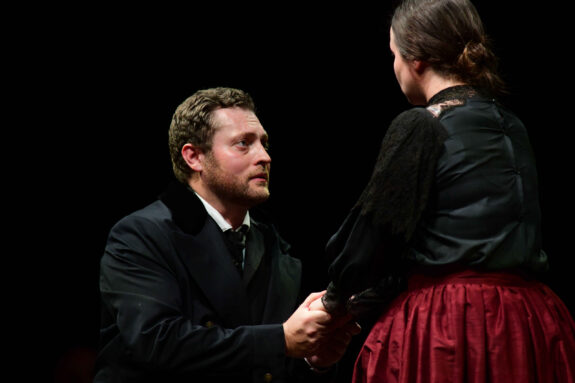
 United Kingdom Tchaikovsky, Eugene Onegin: Soloists, The Wild Arts Ensemble / Orlando Jopling (conductor/orchestrator). Opera Holland Park, London. 14.8.2025. (CSa)

The idea of an operatic setting of Alexander Pushkin’s masterpiece – the verse novel Eugene Onegin – came suddenly to Tchaikovsky in 1877. Writing to his young friend, the amateur poet and musician Konstantin Shilovsky, Tchaikovsky enthused: ‘You won’t believe how fired up I am with this subject. How delighted I am to be rid of Ethiopian princesses, Pharaohs, poisonings, all that stilted stuff. What an infinity of poetry there is in Onegin. I am not deluding myself. I know there will be little in the way of stage effects or movement in this opera. But the amount of poetry, humanity, simplicity in this subject, and a text of genius, will more than compensate for these deficiencies’.
Simplicity, or at any rate the illusion of simplicity, lies at the heart of Dominic Dromgoole’s paired down yet inspired production for Wild Arts and sung in Siofra Dromgoole’s English translation. A group of modestly, period-dressed soloists who double as chorus members and a reduced orchestra of 16 onstage instrumentalists, played out Tchaikovsky’s lyric opera or, as he called it ‘scenes from rural life’. The action takes place against a minimal set of billowing white curtains, in which a window-frame on a movable stand and a few rustic benches serve as props. Economy of scale and absence of spectacle did nothing to detract from the deep humanity of this intimate drama. On the contrary, compelled the audience to focus on the emotional truth which underpins Pushkin’s tragic story about missed opportunities and emotional blindness, and to concentrate without distraction on the inner lives of the characters.
Wild Arts, founded in 2022 by the cellist and conductor Orlando Jopling, is a not-for-profit charity committed to making music ‘fresh, enjoyable and available for everyone’ and to ‘staging [environmentally sustainable] world-class performances to beautiful places across the UK and Europe in a way that our planet can support’. On the London leg of its summer tour, Eugene Onegin took place beneath a canopied auditorium, situated next to Holland Park’s formal gardens. It proved a suitably accessible and bucolic location for the opera’s first act. Set in Madame Larina’s country estate, peasants reap and celebrate the harvest and the turning seasons while their privileged and purposeless masters struggle with Chekhovian ennui, arid social convention, and private passions.
It is here, in Larina’s house, where the young noblewoman Tatyana (lyric soprano Galina Averina in lustrous, luscious voice) first meets and falls head-over-heels with the aloof, buttoned-up aristocrat Eugene Onegin (played a little too stiffly but sung expressively by rich-toned British baritone Timothy Nelson). In the famous ‘Letter Scene’ Tatyana, using a wooden bench as a makeshift desk, writes feverishly to Onegin of her undying but tragically unreciprocated love. Her aria, central to the opera dramatically and musically, was delivered with heart-rending sincerity and outstanding technical control.
The part of the poet Lensky, Onegin’s sensitive and idealistic best friend and likely the true object of Onegin’s repressed desires, was sung convincingly by the young English tenor Xavier Hetherington. His pure, resonant timbre, particularly in the upper register, culminated in a deeply reflective Act II soliloquy ‘Kuda, Kuda’ (‘How far away my golden days’), an achingly beautiful lament for the transience of love and life, which he delivers just before his death in pre-dawn duel with Onegin.
Smaller roles were sung and acted with care and skill, not least Robert Burt’s deliciously gallic take on the dancing master Monsieur Triquet, who, presiding hilariously at Tatyana’s name day ball, duck head walking stick in hand, conjured memories of Maurice Chevalier. High praise too for bass Siôn Goronwy in the pivotal role of Prince Gremin, the war wounded general who marries Tatyana after she has been rejected by Onegin. His sonorously expressed third act aria ‘Lyubvi vse vozrasty Pokorny’ (‘The gift of love cannot be measured’), introduced a profound sense of nobility, and was one of the evening’s highlights.
A final word of recognition for the bantamweight ensemble of musicians who played under the expressive baton of Orlando Jopling. Undaunted by the work’s orchestral demands, the agility, accuracy and musical acuity of this chamber-sized group preserved and occasionally enhanced the subtle beauty of Tchaikovsky’s lush score.
Chris Sallon
Featured Image: Timothy Nelson (Onegin) and Galina Averina (Tatyana) © Allan Titmuss
Production:
Libretto – Tchaikovsky and Shilovsky after Pushkin (trans. Siofra Dromgoole)
Director – Dominic Dromgoole
Designer – Tatyana Dolmatovskaya
Movement – Siân Williams
Producer – Max Parfitt
Cast:
Eugene Onegin – Timothy Nelson
Tatyana – Galina Averina
Lensky – Xavier Harrington
Olga – Emily Hodkinson
Prince Gremin – Siôn Goronwy
Madame Larina -Hannah Sandison
Filipyevna – Rozanna Madylus
Monsieur Triquet – Robert Burt
Zaretsky – Alex Pratley
Katerina – Laura Mekhail