BBC Proms 2025 [19] – Bach (orch. Respighi)/de Hartmaan/Górecki: Joshua Bell (violin), Francesca Chiejina (soprano), BBC Symphony Orchestra / Dalia Stasevska (conductor). Royal Albert Hall, London, 22.8.2025. (MBr)

J. S. Bach (orch. Ottorino Respighi) – Three Chorales – No.1: ‘Nun komm, der Heiden Heiland’
Thomas de Hartmaan – Violin Concerto
Henryk Górecki – Symphony No.3, ‘Symphony of Sorrowful Songs’
Rarely has the BBC Symphony Orchestra been on such opulent form as it was for this Prom – a concert of wide contrast, if tenuous musical coherence. It was surely a stretch to think this concert covered a thousand years of musical history – a literalist may well have put everything into the twentieth century (yes, even the Bach was orchestrated by Respighi) – but threads are what they are. Never mind, it was an evening of first performances (the Bach and Thomas de Hartmaan’s Violin Concerto) and revisiting one of the – once – most popular (or, populist) of symphonies, Górecki’s Third, his ‘Symphony of Sorrowful Songs’.
No de Hartmaan has ever been played at the Proms and this was the UK premiere of his Violin Concerto. Ukrainian by birth (b.1884), de Hartmaan was a prolific composer who wrote four symphonies – and 53 film scores. Notably absent from concert halls because of his ‘turbulent life, resistance to self-promotion and the post-war dominance of the avant garde’ the booklet note puts him in the company of Korngold, Weinberg and Rózsa as in line for rehabilitation. On the basis of his Violin Concerto – which Joshua Bell, the soloist for this performance, has now revived – I have some reservations about both the composer and the work.
The concerto was composed in 1943 and is often seen as de Hartmaan’s response to the occupation of his homeland by the Nazis. Reviving the work does, therefore, seem apposite today. Bell has described the concerto as ‘cinematic’ – and herein, I think, lies part of the work’s problem: there is little that is conventional in its four movements to tie it thematically together – a macabre, two-minute Menuet simply adding to the imbalance of the concerto. Where there is tension and storminess it is almost invariably from the orchestra (the BBC SO on superb form): there is some terrific scoring for the timpani – and its outbursts of drama are often thrilling in scope, fully cinematic as de Hartmaan surely intended. The violin writing is itself highly virtuosic, especially in the first movement – but lyricism seems on a short leash, the ‘Klezmer’ dances much more to the forefront.
Joshua Bell (playing from a handwritten score) made every compelling argument he could for the concerto: his tone could not have been more beautiful to the ear (and what a large, full tone he makes), and the virtuosity was simply astounding: tempestuous, pounding dance rhythms, brilliant syncopations on the instrument, and there was a wonderful glaze to his sound when playing the slow movement, the music almost hypnotically done. The final movement brought an electrifying freneticism to Bell’s playing – all with astonishing purity of sound attached to it. If it all sounded glorious, it also felt like multiple scenes spliced together – the sense of oppression not just quite there. The concerto may well travel from sadness and despair through to a triumphant sense of survival, but it sounded rather like a film score in doing this. Perhaps subsequent hearings of de Hartmaan’s concerto will leave a different impression on me – and I had perhaps rather wished Bell had turned to the Rózsa concerto (itself used as a soundtrack in a film by its composer) – but for now I think it is a flawed work that perhaps works better in a distinct context.
As does, arguably, Henryk Górecki’s Symphony No.3, ‘Symphony of Sorrowful Songs’, perhaps better suited to the CD player than the concert hall where it has largely struggled to sell seats (although this was a pretty packed night at the Royal Albert Hall). Like the de Hartmaan concerto, the Górecki symphony needs very much more than a serviceable orchestra and Dalia Stasevska got quite exquisite playing from the orchestra. Górecki’s relentless tempi – almost exclusively at Lento, or thereof – and its elegiac and sombre tone does risk an element of mushiness in this acoustic but that wasn’t the case from my seat: Stasevska provided nuances and variations in speed where marked, a subtle change of pace and some contrast in the music’s mood (notably in the second movement).
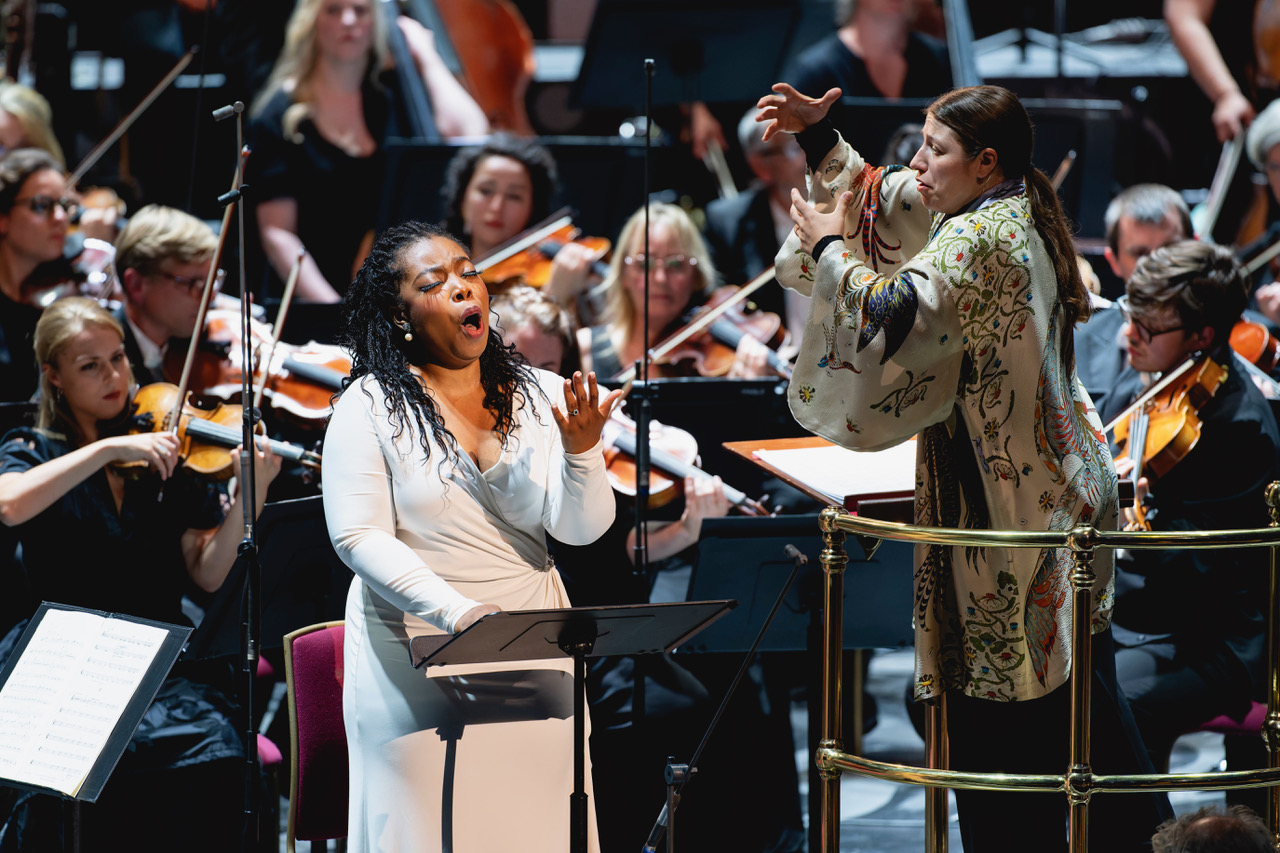
The sonorities of the symphony might work in clusters – or repeated ostinatos – but that didn’t mean there was a lack of lyricism going on here either. Much of that had to do with the superb soloist, Francesca Chiejina, who brought tremendous depth to the dark songs which Górecki uses in this symphony. The Polish lamentation was just gorgeous, but it was the tragic words of the prayer inscribed on the wall of the prison cell at Zakopane in the second movement which left such a lasting impression: crystalline in its humility, touching in its poignancy.
The concert had opened with Respighi’s orchestration of J. S. Bach’s Three Chorales – No.1: ‘Nun komm, der Heiden Heiland’. Scored for a full string orchestra (plus a bassoon), the textures are rich, as one would expect from Respighi – and here the string divisions caught the BBC SO strings in glowing, sumptuous form.
Marc Bridle
Featured Image: Dalia Stasevska conducts ‘Symphony of Sorrowful Songs’ with soprano Francesca Chiejina © BBC/Andy Paradise