 United Kingdom BBC Proms 2025 [23] – Bizet, Sarasate, Holmès, Saint-Saëns: Inmo Yang (violin), Rachel Mahon (organ), BBC Symphony Orchestra / Marie Jacqot (conductor). Royal Albert Hall, London, 28.8.2025. (MBr)

Bizet – L’Arlésienne – Suite No.1
Pablo de Sarasate – Carmen Fantasy
Augusta Holmès – Andromède
Saint-Saëns – Symphony No.3 in C minor, ‘Organ’
Ostensibly a French themed night, this BBC Prom was high on my list of preferred review choices this year. More, I think, to do with the violinist for the evening – the South Korean virtuoso, Inmo Yang – rather than Saint-Saëns’s roof-raising ‘Organ’ Symphony – the former making his Prom’s debut, the other its 23rd appearance – in the end it was all a bit of a mixed bag. A French orchestra may indeed have helped (especially in the opening work by Bizet) – but I largely found the conductor, Marie Jacquot, to be unappealing and uninteresting on the platform and any orchestra, whatever its nationality, would have struggled with the majority of the works on this programme.
Bizet’s L’Arlésienne – Suite No.1 is a bit of a Prom’s rarity these days and I can’t say it is the composer’s finest music. The suite is arranged as a mini symphony – but Jacquot appeared to treat it as a near full-scale one with tempi that were rarely strident nor rhythmical. The opening Prélude (albeit in three sections) was on the didactic side (an excellent saxophone solo aside) but the love theme was too expansive for my tastes. The peasant dance, on the other hand, was simply coarse – hardly lively as it should be. The Adagietto caught the orchestra’s strings in fine form (if hardly with the depth of tone from their Gòrecki Prom) but least persuasive of all was the Carillon lacking anything rustic about it at all. If Bizet wants to enchant us with a world of church bells and folk dances, then this was not one we were taken to I am afraid.
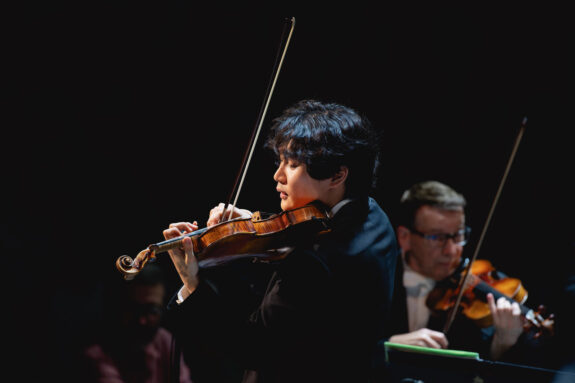
Pablo de Sarasate’s Carmen Fantasy (being given somewhat astonishingly, only its third Proms performance) was an entirely different affair. You can tell a Guarneri ‘del Gesu’ violin from a mile away – that dark, oaky, deep tone for one thing, the size of its majestic sound for the other – and Inmo Yang (winner of the Sibelius Competition in 2022) got the absolute best out of his violin in a jaw-dropping performance of this piece. Technically it was fabulously done; notable were some spellbinding harmonics in the ‘Aragonaise’, effortless pizzicato, and superb trills and glissando in the ‘Seguidilla’. Best of all perhaps was a quicksilver and virtuosic final movement, with superlative arpeggios that spanned the violin, and an explosive climax at accelerando. As an encore, he played a dazzling Recitativo and Caprice Op.6 by Fritz Kreisler. A notable (and popular) Prom’s debut, I hope he returns again soon.
Augusta Holmès (the accent was added later), was born to Irish Scottish parents in Paris, and a pupil of César Franck. She has an aesthetic outlook that is principally Romantic, her music ‘Wagnerian’ in style – typically French for the period, but untypical for her gender. Often symphonic in scale, her works are large orchestral pieces of often imposing dimensions – and her tone poem, Andromède (1883) is no exception to that.
Based on the myth of Andromeda and Perseus who rescues her from a sea monster by holding the head of Medusa to it to turn it to stone, Holmès’s Andromède is programmatic music, held together by a strong compositional narrative. Its Wagnerian credentials are undeniable: the vast opening fanfare on unison trombones (the oracle), for example, and especially the Pegasus episode (redolent of ‘The Ride of the Valkyries’ from Die Walküre) are impressive, and were so here with the BBC SO on thrilling form: strings surged and swelled as if suggesting crashing waves. Jacquot could have made more of Andromeda’s lament, however, the Largo piangendo section not nearly expressive enough to convey the beauty in the score. Neither was the love music impassioned enough but harps, in ascending arpeggios, made a wonderful sound at the close of the work as Andromeda achieves immortality: a magical pianissimo from the orchestra ending the best orchestral performance of the evening.
And so to Saint-Saëns’s ‘Organ’ Symphony, a work which is difficult to achieve a great performance of in my view. Here there was just not a lot of excitement, just not enough dramatic contrast to make this sound like anything other than a run-of-the-mill workout. Ideally, one wanted more terror in the orchestra (especially during the Dies Irae section). The brooding introduction to the symphony hardly conjured up much Liszt to my ears. The Scherzo hadn’t been wild enough either – one wanted more from the pianos, for example, not less. Ideally this music should sound like rattling bones. The final movement was hardly the exhilarating dash for hell leather (although Rachel Mahon’s organ entry was as impressive as any I have heard – how could it not be on this extraordinary instrument). If conductor and orchestra didn’t quite sink their teeth into the coda in quite the propulsive, surefire ways I have heard it done in the best performances then that didn’t stop the audience raising the roof anyway. The ‘Voice of Jupiter’ made that inevitable.
Marc Bridle
Featured Image: Violinist Inmo Yang plays Pablo de Sarasate’s Carmen Fantasy © BBC/Andy Paradise