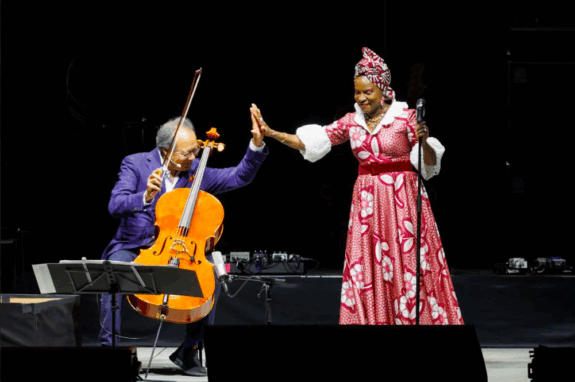
 United States ‘Sarabande Africaine’: Yo-Yo Ma (cellist), Angélique Kidjo (singer), Thierry Vaton (piano), David Donatien (percussion). Cal Performances, Greek Theatre, University of California, Berkeley, 30.8.2025. (HS)

Yo-Yo Ma may well be the consummate musical polymath. Aside from his classical virtuosity as a cello soloist and chamber music collaborator, he was a founder of the world music Silk Road Ensemble and has performed in a diverse range of genres, working seamlessly with the likes of Carlos Santana, Chris Botti, Diana Krall, James Taylor, Miley Cyrus, Zakir Hussain and Sting.
A friendship with the formidable Beninese-French singer Angélique Kidjo, kindled when both were in Paris to perform at a World War I memorial in 2018, led the two musicians to fuse his classical roots with her African heritage. The mix emerged as particularly stunning on Saturday evening at UC Berkeley’s outdoor Greek Theatre in a show dubbed ‘Sarabande Africaine’.
The title derives from a conversation in which Kidjo explained to Ma the history of the sarabande. The dance form originated in North Africa, as Ma explained after a tour de force unaccompanied cello medley in the middle of the program, which ended with the Sarabande from J. S. Bach’s Suite No.2 for Unaccompanied Cello. The slow dance, performed in Africa by women, became popular in Spain, only to be banned by the Inquisition. Brought to the New World, it became popular in Western Europe by the eighteenth century and found a champion in Bach, who include a sarabande in each of his cello suites.
The Bach was the capstone of a tour through Western music that overlapped African with classical. It began with a softly bowed version of Harry T. Burleigh’s setting of ’Nobody Knows the Trouble I’ve Seen’, a tune brought to America by African slaves. That segued into ‘Lamentations’, an all pizzicato arrangement of the African American spiritual ‘Surely He Died on Calvary’, from Coleridge-Taylor Perkinson’s Black/Folk Song Suite. It then moved into ‘Goin’ Home’, a spiritual based on the slow movement of Dvořák’s New World Symphony. When Ma’s sensitive and evocative playing culminated with Bach’s Sarabande, it felt absolutely perfect. An eye-opening moment was not only a gorgeous piece of music-making by an elevated artist but a statement about Africa’s contributions to classical music.
Among the pieces that featured Kidjo’s preternaturally emphatic, mezzo-soprano-level voice was ‘Yemandja’, a setting by the modern classical composer Philip Glass of poetry by Kidjo in the African language of Yorùbá. The gently rolling music characterized the water spirit in the religion, with her singing reaching a level of unexpected intensity.
Another lovely moment started with Ma laying down slow arpeggios on which Kidjo started humming ‘Summertime’, the Gershwin song from the opera Porgy and Bess. Gershwin was inspired by the music of the displaced Gullah people in South Carolina. Kidjo’s translation into Swahili of DuBose Heyward’s lyrics for ‘Summertime’, arranged by Kidjo’s composer husband, Jean Hebrail, was mesmerizing.
Perhaps the most fascinating example of Kidjo’s ability to build a new frame around familiar classical music was a version of Ravel’s Bolero. More of a jazz-style arrangement, it began with Ma playing the familiar rhythm (snare drum in Ravel’s original), bowing in octaves. Kidjo picked up the melody, note for note (mostly) but shading it in her own style. Pianist Thierry Vaton and percussionist David Donatien (on a mix of African and Western drums) completed the circle in a brief (about three-minutes) version, with Ma taking the second half of the melody to create a welcome difference. Also touching was ‘Aisha’, a song written by Kidjo to a melody from J. S. Bach’s Keyboard Concerto No.5. In it she sings to her daughter about the safety of girls in conflict zones.
Kidjo’s fans, who seemed to represent about half the audience in the 8,500-seat arena, relished her performances on well-known hits from her own pen, including ‘Kelele’ and ‘Zelie’, and her arrangements of Ángel Cabral’s ‘La Foule’, Jimi Hendrix’s ‘Voodoo Chile’ and Miriam Makeba’s ‘Pata Pata’. Ma’s music, often deftly crafted by arranger Mike Block as countermelodies, seemed designed to add another voice – an appropriate use for an instrument that I think comes closest to singing like the human voice.
At the end, more musicians piled onto the stage. At times a group of five African drummers served as a sort of interlude or change of pace with their driving rhythms. For the last few numbers, a rock sextet of guitars, horns and drum set brought the concert to a rousing finish.
Of necessity in such a big outdoor venue, the musicians were miked and amplified and, for the most part, the audio crew achieved an admirable clarity in both music and speech. At times, the cello could have used a bit more of a boost to balance Kidjo’s intensity, but other than that the evening was a smash.
Harvey Steiman
Featured Image: Cellist Yo-Yo Ma and singer/composer Angélique Kidjo in ‘Sarabande Africaine’ © Drew Altizer
Bella Bellow – ‘Blewu’
Handel – Sarabande from Keyboard Suite in D minor
Angélique Kidjo – ‘Kelele’, ‘Agolo’, ‘Zelie’, ‘Aisha’ (arranged from J. S. Bach’s Keyboard Concerto No.5), ‘Afrika’
Philip Glass (arr. Michael Riesman) – ‘Yemandja’ from Ifé: Three Yorùbá Songs
Gershwin (arr. Angélique Kidjo & Jean Hebrail) – ‘Summertime’ from Porgy and Bess
Traditional (arr. Harry T. Burleigh) – ‘Nobody Knows the Trouble I’ve Seen’
Perkinson – ‘Lamentations’ from Black/Folk Song Suite
Dvořák – ‘Goin’ Home’ from New World Symphony
J. S. Bach – Sarabande from Suite No.2 for Unaccompanied Cello
Citron Malavoi – ‘Ti’
Ángel Cabral (arr. Angélique Kidjo & Jean Hebrail) – ‘La Foule’
Ravel/Kidjo – ‘Lonlon’, arranged from Bolero
Hendrix/Kidjo – ‘Voodoo Chile’
Talking Heads/Kidjo – ‘Once in a Lifetime’
Miriam Makeba – ‘Pata Pata”
(Arrangements for cello by Mike Block unless otherwise noted)