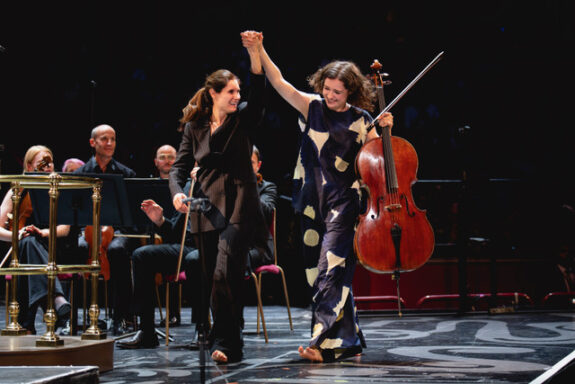
 United Kingdom BBC Proms 2025 [30] – Boulanger, Shostakovich, and Rachmaninov: Anastasia Kobekina (cello), BBC Scottish Symphony Orchestra / Delyana Lazarova (conductor). Royal Albert Hall, London, 10.9.2025. (LJ)

Lili Boulanger – D’un matin de printemps (1917-18)
Shostakovich – Cello Concerto No.1 in E-flat major (1959)
Rachmaninov – Symphony No.2 in E minor (1906-8)
Russian cellist Anastasia Kobekina, daughter of composer Vladimir Kobekin, attended the Moscow Conservatory and later studied with French cellist Jérôme Pernoo and Norwegian cellist Kristin von der Goltz. Kobekina plays the ‘De Kermadec-Bläss’ cello made by Stradivari in 1698. The nickname ‘De Kermadec-Bläss’ reflects the French De Kermadec family’s century-long ownership of the instrument. Its last owner, Rudolf Habisreutinger, affectionately added ‘Bläss’, the Swiss-German word for a loyal mountain dog, to symbolise his deep bond with the instrument. Kobekina’s bond with this cello is by no means less loyal or meaningful. And, yes, listening to her play is like hearing two best friends in conversation, even confrontation.
But, in this performance at the Royal Albert Hall and in her recordings, Kobekina shares with her cello more than conversation. There is a dynamism between this musician and her instrument, expressed through her unrestrained playing. Just listen to her recording of Vivaldi’s Cello Concerto in A minor (especially the Allegro) from her Venice album (released by Sony in 2024) and you will hear how she extracts a wide range of sounds and textures from the cello. When talking about Kobekina’s recording of this very piece, Simon Sinek describes it as a ‘gateway drug’. Despite Sinek proceeding to denigrate contemporary classical music as ‘modern sh*t’ and express his desire to ‘take the major key outside and shoot it’ – views that do not align with my own – Sinek’s appreciation of Kobekina is much more sympathetic. So, to extend Sinek’s metaphor, after Kobekina’s performance of Shostakovich’s Cello Concerto No.1 in E–flat major, the audience at the Royal Albert Hall became confirmed addicts, imploring Kobekina to play once more in her spirited way. She obliged, following Shostakovich’s defiant and solemn piece with the instantly recognisable Prélude from Bach’s First Cello Suite in G major as an encore. Fans take note: Kobekina will be releasing her recording of Bach’s six Suites on Sony Classical later this month.
I must pause here, because this spiritedness had somewhat less desirable side effects. Kobekina’s performance, though exciting, was somewhat hindered by her endpin which kept slipping. This inconvenience, coupled with her lightning speed meant that there was some slight pitchiness. In addition, Kobekina’s prioritisation of lyricism came at the price of deep resonance. Whilst this may have suited the Cadenza, it did not work so well during the more introspective and searching Moderato (Rostropovich’s recording with the Moscow Philharmonic from 1961 is an interesting comparison; indeed, Shostakovich wrote the concerto when the cellist was studying at the Leningrad Conservatory).
Yet, Kobekina used her innate sense of lyricism to give a distinctive shape to the piece. It was immediately clear that improvisation is central to her method of finding the character of a work. You could hear this in the percussive way in which she played her instrument. This keen sense of originality could present difficulties for an orchestra and conductor with whom there is usually only a day or two of rehearsals. Even in this short time, Kobekina, conductor Delyana Lazarova, and the BBC Scottish Symphony Orchestra managed to find a common language that underlined Shostakovich’s intention for the piece itself to be an act of defiance in the face of censorship experienced across the USSR during the late 1950s. In her interview with Pauline Harding published in the concert programme, Kobekina says that the cello is ‘like one individual fighting against the cogs of the system’. This individuality could be heard in her performance which seemed to sit on top of the orchestra. This may have been intentional as Lazarova kept the BBC SSO tight and unintrusive with the exception of moments such as the horn solo (played crisply by Chris Gough) during the end of the first movement (Allegretto). During the final movement (Allegro con moto), however, Kobekina and the orchestra became slightly disjoined.
Lazarova appeared at one with the BBC SSO, though she only became its Principal Guest Conductor this month! (Previously, she was Assistant Conductor to Sir Mark Elder at the Hallé.) It was clear that Lazarova relished conducting the BBC SSO and they also seemed to warm to her generosity of spirit. Speaking with the BBC earlier this year, Lazarova remarked: ‘Conducting felt like a natural extension of my life as a violinist, a way to step deeper into the music and bring those markings to life.’ In the same interview, she gave her top five artists. The range – from Stevie Wonder to Fazil Say – speaks to a sense of freshness that defined the better parts of the performance.
Lazarova was attentive to the string section, no doubt due to her experience as a violinist. During Rachmaninov’s Symphony No.2 in E minor, she would steadily draw her left arm across her body, from left to right, bringing the strings with her as if sculpting the piece. She was especially good during the moments between phrases, allowing the strings to take ‘breath’ in the second movement (Allegro molto). It follows that the BBC SSO string section sounded excellent, performing with the depth and heart-on-sleeve earnestness required of this symphony. So, too, did the woodwind section, with special mention for Yann Ghiro who played the clarinet solo at the opening of the third movement (Adagio) beautifully, evoking feelings of solemnity and hope.
Rachmaninov completed this symphony in 1907 when living in Dresden. His excitement upon completing the work is clear from the postscript to his letter dated 11 February 1907 to his friend, baritone singer Mikhail Slonov: ‘I have composed a symphony. It’s true! It’s only ready in rough. I finished it a month ago, and immediately put it aside. It was a severe worry to me and I am not going to think about it anymore.’ When back in Russia, Rachmaninov conducted its premiere in St Petersburg on 26 January 1908. As musicologist Geoffrey Norris says of the piece in the Master Musician Series published by J. M. Dent (1976): ‘The Second Symphony is a prime example not only of Rachmaninoff’s mature melodic style (evident above all in the Adagio, one of his most lyrical, long-breathed ideas) and his architectural skill, but also of his orchestration. The overall effect is one of opulence, but this does not imply that there are not varied colours and textures.’
Lazarova brought the contrast between the Dies irae and the more life-affirming parts of the symphony – what Norris describes as the piece’s ‘varied colours and textures’ – to the surface in a coherent yet impassioned manner, resisting the temptation to rush the final movement (Allegro vivace). The BBC SSO also sounded strong in the climax of the piece, with full strings in unison and the rest of the orchestra playing block chords to dramatic effect. With more performances together, Lazarova will be even better able to unify the BBC SSO’s sections to evoke more textures and give voice to more countermelodies. Left wanting more from Lazarova and the BBC SSO, audience members who purchased a programme for the concert could enjoy reading some excellent accompanying notes on the way home, written by none other than Geoffrey Norris.
This review would be incomplete without mention of the opening piece: Lili Boulanger’s D’un matin de printemps (1917-18). Boulanger is also of Russian descent on her mother’s side, but that altogether more melodramatic and deeply felt philosophical strain associated with the Russian greats is a far cry from D’un matin de printemps, which, even though it was composed when Boulanger was suffering a terminal illness, has more in common with Debussy’s impressionist compositions than the two other pieces on the programme. Lazarova conducted the piece with a lightness and clarity that resulted in an unfussy and exciting amuse-bouche. Indeed, ‘unfussy and exciting’ are words I would use to describe Lazarova’s entrée with the BBC SSO. I look forward to hearing how this partnership develops.
Lucy Jeffery
Featured Image: Conductor Delyana Lazarova and cellist Anastasia Kobekina (cello) © BBC/Andy Paradise