 United Kingdom Ballet Nights – Bound in Motion: Jamiel Devernay-Laurence (compère). Cadogan Hall, London, 11.9.2025. (JO’D)
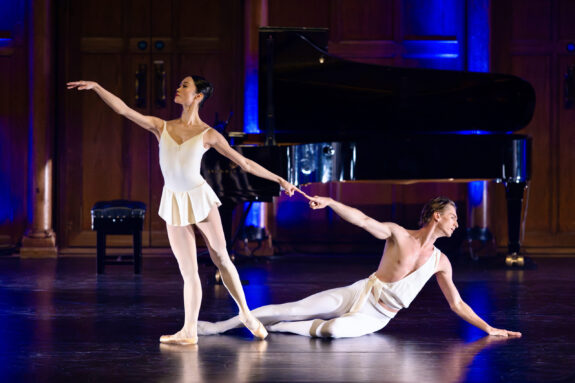
Jamiel Devernay-Laurence’s ever-developing Ballet Nights marked its ‘second birthday’ with a further selection of dance works, this time under the title Bound in Motion. Neo-classical, contemporary, flamenco, ‘club moves’: nine, varied, atmospherically-lit pieces culminating in Apollo Pas de Deux, performed by The Royal Ballet’s Fumi Kaneko and Vadim Muntagirov.
After a musical introduction (house pianist Viktor Erik Emanuel and violinist Michael Bochmann playing Wieniawski’s Polonaise in D major), the muscular figure of Denilson Almeida, First Artist at The Royal Ballet, appeared in shadow to begin The Dying Swan. Choreographed by Calvin Richardson, of the same company, this is an angular, athletic, even jerky take on the solo first performed in 1907 by Anna Pavlova. Viktor Erik Emanuel played the piano part, Rebecca Hepplewhite the cello.
It was followed by Footsteps, choreographed by Garrett Smith to music by Imogen Heap (recorded). A contrastingly softer, more lyrical pas de deux, y compris the shoulder-length hair and semi-transparent harem pants of the male dancer, performed by Ombline Noyer and Donovan Délis-McCarthy from Ballet d’Jèrri in its London debut.
The choreographic duo Ekleido (Hannah Ekholm and Faye Stoeser) were in the line-up of the previous Ballet Nights, Spring into Summer (review here). They returned with Femina, a work for six dancers to an electronic score on the theme (according to compère Jamiel Devernay-Laurence) of women and LGBTQIA+ figures erased from medieval history. After an effective opening in which the six, androgynous dancers stand with their backs to the audience, the piece, though performed with verve, becomes somewhat repetitive.
Also returning to the Cadogan Hall stage were English National Ballet Lead Principals Sangeun Lee and Gareth Haw in a reprise of William Forsythe’s Slingerland Duet, to a string quartet (recorded) by Gavin Bryars; choreography and dancers no less enigmatic and mesmerizing than they were four months ago. Before the interval, flamenco by El Yiyo with live accompaniment by pianist, composer and singer, Andrés Barrios. Another successful Ballet Nights debut, the two men listening to each other, watching each other; alert, in the moment, making the audience alert and in the moment, too.
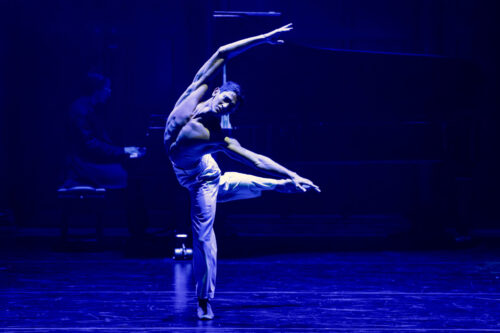
Part Two began with Viktor Erik Emanuel playing Ravel, an excerpt from Gaspard de la Nuit. It was then the turn of a second First Artist of The Royal Ballet, Caspar Lench, to perform Flux (choreography by Jordan James Bridge; music by Rival Consoles). As in the evening’s opening solo, the male body is lit to appear lean and hard. But mixed in with the highly contemporary movement is a fleeting jeté, some entrechats. And at the end the lighting suddenly switches to show the dancer’s body, in perpetuum mobile, as something not hard at all.
Sirens, choreographed by third-year Rambert School of Ballet and Contemporary Dance student, Omar Toussaint, is a work for three (barefoot) female dancers to music by Ernst Reijseger. It begins and ends with the same arresting tableau vivant and sustains interest in between. Marco Goecke’s Infant Spirit, a homage to Pina Bausch, was the evening’s fourth and final solo for male dancer. To music by Anthony and The Johnsons, Andrew Cummings’s movements are troubled, twitching, uneasy. He wears a suit, but his torso under the jacket is naked. It leaves him somehow exposed and vulnerable. Perhaps it was this vulnerability that earned the dancer a standing ovation from several members of the audience.
And then Apollo Pas de Deux, an extract from George Balachine’s ballet of 1928, choreographed to music (recorded) by Igor Stravinsky. Vadim Muntagirov’s port de bras and command of the stage; the technical expertise of Fumi Kaneko, softened as if with time; tender, humorous choreography that synthesizes with the music: in short, the jewel in the crown of this particular ‘Ballet Night’.
John O’Dwyer
Featured Image: Fumi Kaneko and Vadim Muntagirov in Apollo © Deborah Jaffe
Wieniawski – Polonaise in D major
Performed by Michael Bochmann MBE and Viktor Erik Emanuel
The Dying Swan
Music – Saint-Saëns
Choreographed by Calvin Richardson
Cello Soloist – Rebecca Hepplewhite
Piano – Viktor Erik Emanuel
Performed by Denilson Almeida
Footsteps
Music – Imogen Heap
Choreographed by Garrett Smith
Performed by Ombline Noyer and Donovan Délis-McCarthy
Femina
Original Score – Stella Mozgawa, Floating Points
Choreography and Direction – Ekleido
Performed by and material devised by Hannah Ekholm, Faye Stoeser, Roshaan Asare, Rory Clarke, Tia Hockey, Jasper Nervaez
Slingerland Duet
Choreography, Lighting and Costume Design – William Forsythe
Music – Gavin Bryars, String Quartet No.1
Performed by Sangeun Lee and Gareth Haw
Andrés Barrios and El Yiyo
Music< Design and Performed by Andrés Barrios and El Yiyo
Gaspard de la Nuit, M.55: III Scarbo
Music – Ravel
Performed by Viktor Erik Emanuel
Flux
Music – Rival Consoles
Choreographed by Jordan James Bridge
Performed by Caspar Lench
Sirens
Music – Ernst Reijseger
Choreographed by Omar Toussaint
Performed by Keavie Holliday, Morgan Phillips and Chloe Hurn
Infant Spirit
Music – Anthony and The Johnsons
Choreographed by Marco Goecke
Performed by Andrew Cummings
Apollo Pas de Deux
Music – Igor Stravinsky
Choreographed by George Balanchine © The George Balanchine Trust
Performed by Fumi Kaneko and Vadim Muntagirov