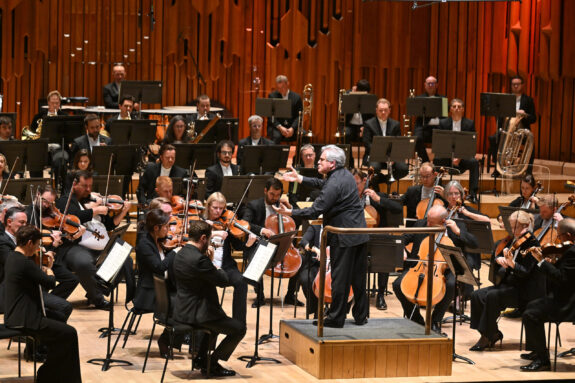
 United Kingdom Shostakovich, Prokofiev, Beethoven: Seong-Jin Cho (piano), London Symphony Orchestra / Sir Antonio Pappano (conductor). Barbican Hall, London, 18.9.2025. (AV-E)

Shostakovich – Symphony No.9 in E-flat major
Prokofiev – Piano Concerto No.2 in G minor
Beethoven – Symphony No.5 in C minor
The London Symphony Orchestra has a long-standing ‘Shostakovich Tradition’ from André Previn and Evgeny Svetlanov right through to Maxim Shostakovich and Mstislav Rostropovich, to Gianandrea Noseda today; and the LSO’s Chief Conductor Antonio Pappano can now be added to that pantheon as he his is a first-rate conductor of the composer: it may sound like the cliché to state that Shostakovich is in the LSO’s blood, but it is true because they play the composer as he should sound: coarse, brittle, rough in texture, and not polished and pristine and refined, as we hear with the streamlined Boston Symphony Orchestra under the, in my opinion, overrated Andris Nelsons whose Shostakovich Symphony cycle was an apt example of how the composer should NOT sound.
Pappano is an instinctive Shostakovich conductor for his interpretation of the Ninth Symphony was one of the upmost perfection in its exquisite execution.
For the sarcastic and acerbic Allegro, the playing of the LSO was acutely attuned to the composer’s acidic and pungent soundworld and characterised by the pixie piccolo, truculent trombones, strident strings and snarly snare drum with the LSO letting their hair down having a field day.
Under the sensitive and insightful direction of Pappano, the morose Moderato emanated the sensation of a delicate dilapidated desolation and a melting mercurial melancholia echoed by a coy clarinet solo and ending with a solitary piccolo – the sound of the soul of the composer, no doubt. The LSO strings played with such serenity here. The cynically sarcastic Presto was conducted and played with the appropriate acrobatic aplomb. The Largo opened with majestically menacing trombones: never have I heard this torturous passage played with such ferocity; only to be followed by a sobbing solo bassoon (Rachel Gough) – surely, Shostakovich himself?
The concluding Allegretto, overflowing with pastiche, irony and sarcasm, subverts and perverts the customary celebratory climax of the classical symphony, and conductor and orchestra played it as such with great verve. The Shostakovich Ninth Symphony is by far the most misunderstood of his 15 Symphonies since it is always dubbed ‘light’ and ‘humorous’ when in fact it is ‘dark’ and ‘serious’.
The Prokofiev Piano Concerto No.2 is arguably the most difficult to play of his five piano concertos, but Seong-Jin Cho had a commanding and compelling mastery over it morphing all movements into one organic hole. Listening to his plangent plash playing was perplexing because it had such a non-intellectual, intense immediacy that somehow unified categorical and conceptual opposites: it had a rehearsed-spontaneity, a light-heaviness, an ugly-beauty, uncouth-refinement, a blatant-subtleness, a simplistic-sophistication, a civilised-barbarity – all of which are not moronic oxymorons.
Seong-Jin Cho’s playing was so mesmerising and hypnotising that is became virtually impossible to consciously comprehend it clearly for critical reviewing for one was bathed in a haze of sensations that clouded any rational-logical analysis. Cho produced subterranean sounds of an angelic-fiendishness which were delightfully-disturbing in throwing one out of any singularly coherent emotion, so conflicting and contrary emotions become one.
I had never really heard Prokofiev’s Second Piano Concerto until now for the versions I have heard (live or recordings) with Ashkenazy, Béroff, Bronfman, Browning, Kissin, Lugansky, Toradze, Wang, and yes Argerich, simply lacked such a wide-ranging panorama of tone, colour, dynamism and emotion.
For an encore, we were served with Ravel’s short waltz A la manière de Borodine, which was played with an elegant evanescence.
After such an overwhelming first-half, the concluding Beethoven Fifth Symphony was rather underwhelming and somewhat of an anti-climax despite being competently conducted and with repeats observed in the outer movements. In the present company of Shostakovich and Prokofiev, Beethoven seemed to be the odd-man-out and didn’t quite ‘fit’ in. It would have been far better to have performed the Rachmaninov Symphonic Dances.
For, the four-note opening ‘Fate’ motif of the infamous ‘Fifth’ somehow did not come off – it hardly ever does – and it seemed to have sealed the fate of this performance! For what followed was rather routine. For sure, Pappano paced the first movement well enough and yet paradoxically, it was somehow lacking in any sense of urgent, thrusting, forward momentum; and further let down by the timorous timpanist who lacked attack (despite using hard sticks and being placed next to the double basses nearer to the front of the stage).
The Andante, lacking any sense of drive and drama, was rather routine even boring but still very well played. The concluding Scherzo would have carried more weight with two more basses as there were only six; and the Allegro, again, was very well played, but was rather tame and too well-mannered and lacked Beethovenian bulldog attack; it ended without any sense of triumph, and yet, after all that, I still had not quite recovered from the first half!
Alexander Verney-Elliott
Featured Image: Sir Antonio Pappano conducts the London Symphony Orchestra © Mark Allan