 United Kingdom George Enescu International Festival 2025 [7] – Enescu, Oedipe: Soloists, Chorus, Children’s Chorus and Orchestra of Bucharest National Opera / Tiberiu Soare (conductor), Daniel Jinga, Adrian Ionescu (choir conductors), Smaranda Morgovan (coordinator of the children’s choir). National Opera Theatre, Bucharest, 15.9.2025. (GT)
George Enescu poured a remarkable quarter of a century into crafting his only opera, which premiered to widespread acclaim in Paris in 1936, and was celebrated as a masterpiece. It was not heard in Bucharest until 1958 when Constantin Silvestri conducted the Romanian premiere in his native language. Based on the mythological story of Oedipus as narrated by Sophocles in the Greek myths, Enescu used a libretto by Edmond Fleg. Despite this, the opera remains infrequently performed, even in its home country of Romania. The 2023 staging, masterfully directed by Stefano Poda received glowing praise for its artistry and execution.
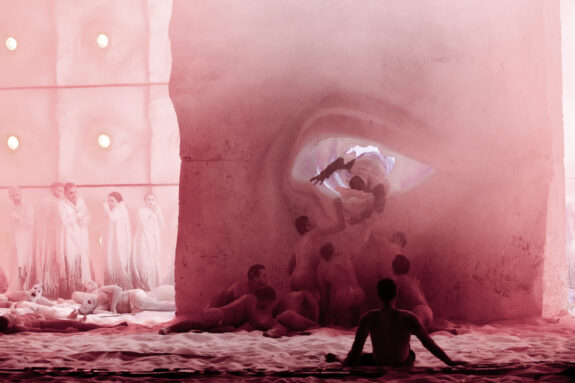
The staging throughout all four acts presented three great white walls of the Palace with sculpted eyes staring out at the audience, from which, at climatic points, the eyes transformed into beaming lights of overwhelming brightness, or of dark red and green colours. The characters entered or exited through big passages, through which, at different moments great beams of light illuminate the stage. Poda who was responsible for the sets, costumes, lighting, and choreography said: ‘The composer has the extraordinary power to translate the ancient world into modern ears, to make us step into a kind of time machine. It is simply formidable.’
The opening sombre Prelude was distinguished by a motif on the contrabassoon and a magical flute solo. Act I is noticeable for citing Romanian folklore, this was heard especially in the dancing and in the warmth of the Theban women singing: ‘King Laius, in your house, the child who awakes, suckles milk made from rays’. This contrasted the vibrant vigour of the male voices, ‘Sing, Thebes, from your seven gates.’ The choral singing by the Theban women was very moving with the misty entrance from the palace. The High Priest uttered, ‘Pour the Waters of Dirce Upon the newborn.’ A focal point were the festivities celebrating the birth of Oedipe. The emerging tragedy of the narrative became evident in the prophesy by Tiresias that the newborn child will commit parricide and marry his mother Jocasta leading to the Shepherd taking Oedipe away.
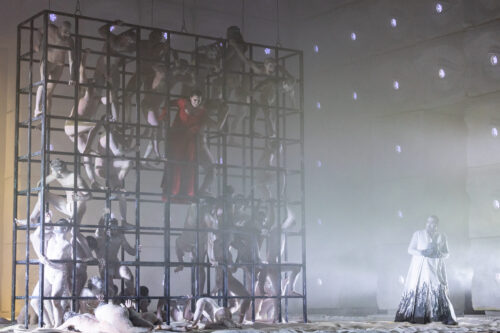
Act II is set twenty years later, and the opening interlude led to the Shepherd’s solo on the flute by the Shepherd which prepared one for Oedipe’s monologue, ‘Where am I? The raven is cawing. Dismal crossroads of my life….’ yet was interrupted by the storm. Lightning strikes and bright lights burst out when Oedipe murders his father unknowingly. The third scene is in Thebes where a great cage-like structure descends, and the Theban men climb onto it, encircling the Sphinx, giving the impression of abuse by the men attired in no more than loincloths. The figure of the red-robed Sphinx was striking in this terribly dramatic sequence. The Sphinx of Ramona Zaharia possesses a powerful mezzo-soprano, in strikingly voiced tones addressing Oedipe: ‘I have been awaiting thee.’ and announces, ‘I am the Daughter of Destiny. I am thy Destiny’ yet Oedipe denies her saying, ‘Man is stronger than Destiny!’ The words cause the death of the Sphinx and is followed by a bizarre festive event celebrating her demise and leading to Oedipe being welcomed, ‘Glory to the King of the Thebans!’ by the Theban virgins. The Shepherd’s plaintive flute symbolises destiny and the continuation of humanity, and Oedipe assumes the crown and weds Jocasta.
Superb choreography saw the Thebans massed around Oedipe in powerful scenes of greatly inflicted pain with their agonised faces looking upwards, heard against strikingly powerful music. These scenes were hugely dramatic and occurred several times throughout the opera manifesting the power of the Theban people.
The opening of Act III takes place during the plague after a reign of peaceful prosperity, and Theban men lie in agony and pain. Creon, after consulting the oracle, prophesies that the city’s woes will only be relieved after the death of Laios’s killer. ‘The stain of a murder has sullied our houses.’ Creon prophesises that Oedipe will not see out the day. The Shepherd tells of Oedipe’s guilt in killing his father and wedding his mother. The scene of Oedipe losing his sight was realised by him bursting through the structure of a single eye with his fist and then crawling through the wall structure while being helped by the Theban men. Oedipe’s daughter Antigone takes care of him and her childlike singing introduces a tone of peaceful serenity. Jocasta’s suicide after learning of her marriage to her own son is dramatic, and Oedipe emerges covered in his wife’s blood.
Act IV sees Oedipe at the end of his powers and Creon offers a way out of his dilemma. ‘Oedipe, you must depart to purge the town.’ The final scene is in a sacred wood in Attica and Oedipe asks, ‘Light of my eyes, dear and gentle Antigone, where are we?’ On meeting Creon, he asks, ‘You know that Apollo repents in my favour…’ Antigone is now taken from Oedipe who tells Creon, ‘I conquered Destiny!’ The Eumenides call him and turning to Antigone, Oedipe sings, ‘I shall walk serene towards my final hour, and I shall die in the light.’ Finally, the chorus of the Eumenides sing, ‘Happy is pure in soul: peace be unto him!’
A coup de théâtre was that in regaining his sight, Oedipe runs on followed by the Thebans, yet suddenly, against a great crash of sound from the orchestra, he dies in a great flash of lightning which switches to a deep green background and then to a blinding white. In Oedipe’s final penitent moments he is loyally followed by the people, creating the effect of almost eternal movement by marching ever onwards in the director’s skilful use of the revolving stage. This skilfully arranged scene produced powerful effects, enhancing Enescu’s score, which was recreated with great eloquence and virtuosity by the orchestra under the direction of Tiberiu Soare. There are no great arias or duets in the opera, and the momentum of the narrative was ensured through the choral singing and the drama on the stage. This production needs to be seen again to understand the immensely complex score by this great composer. The orchestral interludes were marvellous highlights set against the profoundly moving scenes.
Of the singers, Ionut Pascu’s Oedipe had few opportunities to fully reveal his tenor voice, and his characterisation was mostly in his impressive acting, and Sprechstimme. Of the other roles, Vazgen Gazaryan’s High Priest dominated every scene, both in his movements and voice, from the opening when the people emerge from the palace. Ruxandra Donose’s Jocasta was outstanding for her emotive singing and portrayal of every nuance of her tragic part. An even greater success was the Sphinx of Ramona Zaharia; she has a superlative stage presence, and her striking beauty contrasted the debasement by the Thebans. Paul Curievici’s Laios was outstanding despite the limited opportunities to sing, but his acting was fantastic and a central part of the show. Of the excellent secondary roles, the Creon of Adrian Sampetrean was well characterised, though with little opportunity again to display his vocal gifts. The Shepherd of Andrei Lazar was another success in both his portrayal and masterful vocal performance. Another great triumph vocally was the singing of the choirs, especially the delightfully sensitive children’s choir.
Throughout the orchestra was exemplary, and another indication of how excellent the standard of performance is here in Bucharest, the level of playing is world-class, with marvellous virtuosity from the flute, contrabassoon, the brass group and the splendid strings. The direction of Tiberiu Soare was masterly in bringing every nuance of colour from Enescu’s complex score, with Romanian folklore emerging and hinting at the influence of French composers.
The monotonic and severe sets hinted at the symbolism of Enescu’s score. There was a great cross, the prison-like structure which lowered down to imprison the Thebans was a coup de théâtre with the entangled Sphinx, and the great sword which fell to the floor at the close of Act III symbolised the loss of Oedipe’s sight.
This was an immensely powerful performance though it was performed in French and not in Romanian and was difficult to follow without English surtitles. Nevertheless, it was an outstanding triumph for Bucharest Opera and received a standing ovation from the capacity audience and was surely one of the great successes of this year’s Enescu Festival. George Enescu was a great composer in diverse genre, and more stagings of this core work from his life need to be performed on world stages.
Gregor Tassie
Featured Image: Bucharest National Opera’s Oedipe © Andrei Gîndac
Production:
Direction, Set design, Costumes, Lighting and Choreography – Stefano Poda
Associated director – Paolo Giani
Assistant directors – Paula Stoica, Claudia Machedon
Choreography assistant – Silvia Sisto
Ballet coordinator – Monica Petrica, Antonel Oprescu
Assistant conductor –Mircea Paduraraiu
Cast:
Oedipe – Ionut Pascu
Jocasta – Ruxandra Donose
The Sphinx – Ramona Zaharia
High Priest – Vazgen Gazaryan
Laios – Paul Curievici
Creon – Adrian Sampetrean
Antigone – Kaarin Cecilia Phelps
Tirésias – Alexei Botnarciuc
The Shepherd – Andrei Lazar
Thésée – Daniel Filipescu
Mérope – Andrea Iftimescu
The Watchman – Damian Vlad
A Theban woman -Zoica Sohterus
Phorbas – Leonard Bernad