 Spain Gounod, Faust: Soloists, Generalitat Valenciana Chorus, Comunitat Valenciana Orchestra / Lorenzo Viotti (conductor). Palau de Les Arts, Valencia, 5.10.2025. (JMI)
Valencia’s Palau de Les Arts opened its new season with this grand opera by Charles Gounod of a familiar story which is very demanding both vocally and musically. It was last seen here in February 2009. Charles Gounod didn’t write many operas, but two of them, Faust and Romeo et Juliette, are undoubtedly among the great operas of the repertoire and always on the programs of major opera houses. The same cannot be said of the third of his best-known operas, Mirielle, which is not often performed.
On this occasion, Palau de Les Arts in a co-production with La Scala, the Berlin Staatsoper and Teatro Real commissioned a new Faust from director Johannes Erath. It is Erath’s second version of Faust (a previous one was put on at the Cologne Opera).
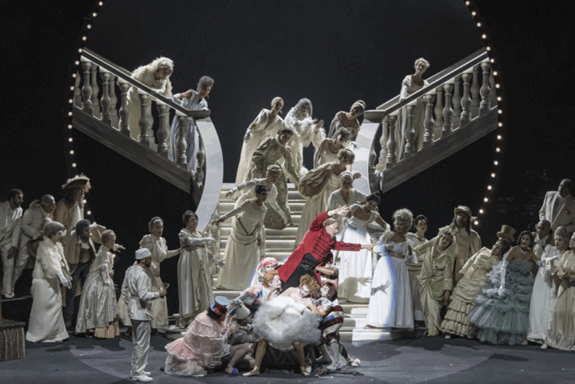
This new production may be visually appealing, depending on one’s personal taste, but the staging is often incomprehensible, at least for this writer. Act I takes place on a large, dark stage, and the appearance of Méphistophélès works in an interesting way. In Act II, we find ourselves in the scene where the devil takes Faust. Where would it please Faust to be? Nothing more appropriate, apparently, than a circus, where Valentin is a clown and sings his well-known aria about going to war.
On to Act III, where the first scene seems to take place in a church. There is a confessional with Méphistophélès as the confessor, of course, and then he plays the organ, dressed … as the Pope. It is here that we discover Marguerite who is a ballerina, accompanied by other ballerinas as well as a mute character who is always on the stage near Marguerite and whose role no one explains. In the second part of Act III, it seems as if we are on a large rock, and we see the protagonists plus dancers and the mute character, about whom we know nothing.
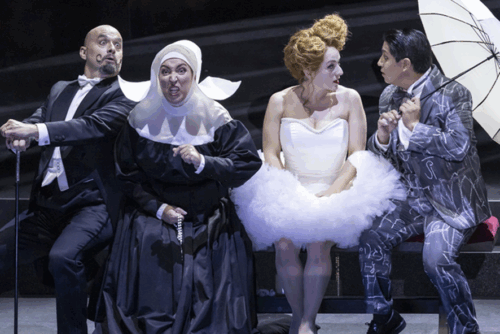
I cannot overlook another original feature of the production. When Faust and Méphistophélès arrive at Marguerite’s house, their greeting is followed by Méphistophélès’s news to Marthe that her husband is dead. Marthe in this production is a nun and dressed as such.
Valentin appears again in Act IV, now back from the war, albeit still a clown. The duel with Faust isn’t a sword fight, as the libretto says. Instead, Valentin stands in the center of a large target, with Faust throwing knives as if it were a game. Valentin pulls a knife out and seems to think that the opportunity can’t be missed. He plunges the knife into his clown body, and so he dies, or so it seems, but there are moments later when he appears to revive.
Finally, the last act arrives, with Marguerite in the supposed prison hallways as a ballerina and, at the back of the stage, one sees a hospital stretcher with her corresponding corpse (reminiscent of a clown). All in all, it is a very personal vision by Johannes Erath which I don’t understand, and I am truly sorry.
However, I have nothing but praise for the musical interpretation of Maestro Lorenzo Viotti and the excellent orchestra and chorus. Viotti also decided to offer us the music for Act V which is usually cut short.
Faust was played by tenor Iván Ayón-Rivas, whom we saw at this theater in April playing Gonzalve in L’heure Espagnole and Rinuccio in Gianni Schicchi (review here). His Faust is a bit unconvincing – he is a light tenor and this opera requires a lyric tenor. He hit some brilliant high notes, but his voice did not always carry well into the audience.
Soprano Ruth Iniesta in the part of Marguerite combined a beautiful light soprano with a good singing technique, and she moves well on the stage. It is hard to understand what she is doing – making Marguerite a ballerina is simply a whim. She did well, and one will have the opportunity to see her more in the future as her career is developing rapidly.
Bass Alex Esposito as Méphistophélès did nicely – his voice is well-suited to the part and his performance was praiseworthy. He is a well-established talent who always brilliantly fulfills his commitments. The clown Valentin was baritone Florian Sempey. In his first aria, sung from the back of the stage, his voice didn’t cut through the orchestra very well, but he did better in the second one which he sang up at the front.
Siebel was played by Ekaterina Buachidze, who did fine but without much brilliance. Gemma Coma-Alabert was correct as the ‘nun’ Marthe, as was Bryan Sala as Wagner.
José M. Irurzun
Featured Image: Faust at Valencia’s Palau de Les Arts © Arts Fotografía
Production:
Director – Johannes Erath
Sets – Heike Scheele
Costumes – Gesine Völm
Lighting – Fabio Antoci
Video – Bibi Abel
Chorus director – Miquel Rodrigo Tamari
Cast:
Faust – Iván Ayón-Rivas
Marguerite – Ruth Iniesta
Méphistophélès – Alex Esposito
Valentin – Florian Sempey
Siebel – Ekaterina Buachidze
Marthe – Gemma Coma-Alabert
Wagner – Bryan Sala