
 United Kingdom Schubert, Zemlinsky: Claudia Boyle (soprano), Roderick Williams (baritone), Bournemouth Symphony Orchestra / Mark Wigglesworth (conductor). Lighthouse, Poole, 8.10.2025. (CK)
Schubert – Symphony in B minor, ‘Unfinished’
Zemlinsky – Lyric Symphony
No commentator on Zemlinsky’s Lyric Symphony fails to mention that it was modelled on Mahler’s Das Lied von der Erde: disastrous for Zemlinsky, since in any comparison with Mahler’s transcendent masterpiece the Lyric Symphony is bound to come off worse. It was only a harmless remark in a letter to his publisher that he was working on ‘…something along the lines of Das Lied von der Erde’. Although Zemlinsky selected his texts from a similarly exotic source – the poetry of Rabindranath Tagore – the work resembles Das Lied only at the most superficial level: a better comparison would be with Waldemar and Tove’s passionate duologue in Part 1 of Schoenberg’s Gurrelieder. The great thing about a performance such as the one we were treated to in Poole is that comparisons fall away: Zemlinsky’s music inhabits its own universe.
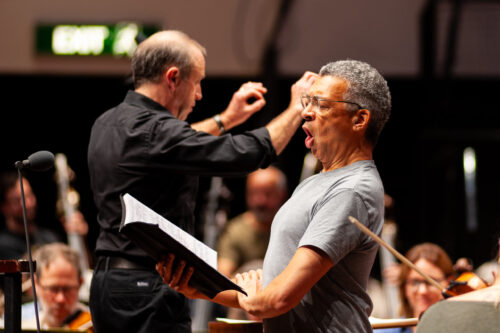
The music calls for superb soloists, and it got them. What can I say about Roderick Williams that hasn’t already been said a thousand times? He is this season’s Bournemouth Symphony Orchestra’s Artist-in-Residence (lucky us), and it was apparently he who suggested performing the Lyric Symphony. He has always been eager to go off-piste: at this summer’s BBC Proms he was the lynchpin of a performance of Delius’s A Mass of Life (review here), and longer ago I have heard him sing Havergal Brian’s Wine of Summer and Maxwell Davies’s Eight Songs for a Mad King. In the first song, as the orchestra seethed and boiled around him with most un-Mahlerian voluptuousness, he was almost engulfed (not much you can do about that, admitted Mark Wigglesworth in a candid pre-concert interview). He sang, as always, with beauty and authority, expressing the post-coital tenderness of the third song – a lovely horn solo curling around his final Du bist mein Eigen, mein Eigen – and the abrupt, characteristically male reaction of the brief, torrential fifth (she’s suffocating him, he wants out).
One of this performance’s revelations – for me, at least – was the mercurial, protean performance of the soprano Claudia Boyle, by turns erotic, touching and sad; bright-edged and coquettish in the second song, intimate in the pillow talk of the fourth – introduced by a fragile, exquisite violin solo – with celeste and tuba suggesting a vast space in which her voice seemed to hang suspended. She made each song a monodrama: at one moment she was Gurrelieder’s Tove, at another, Wozzeck’s Marie. In the sixth song, drooping violin phrases and a muted trombone suggest a discarded woman’s resignation and pain, but she does not go gently into that good night: the opening orchestral gesture returns in dark magnificence, topped by shrieking trumpets, and she ends superbly, dramatically, at the top of her range. It was quite a performance.
The BSO players’ response to Wigglesworth’s inspired direction was beyond praise: intense, urgent, sumptuous as the music demanded. And it is a wonderful score: the strings opening the last song as lush as anything in Verklärte Nacht, celeste and muted trumpet imparting a chill, a solo horn, an oceanic final tutti subsiding to an exhausted calm. Wigglesworth was hardly exaggerating in ending his programme note: ‘The sensory overload is so gorgeously thrilling it is like listening to a Mahler symphony and a [Richard] Strauss opera at the same time’. Wigglesworth’s own commitment was never in doubt – in the performance, in the pre-concert interview and the post-concert discussion with the soloists. He even made the English translation of the text that was used in the surtitles.
Although I have known the Lyric Symphony for a while, this was my first opportunity to hear a live performance: I am grateful to Wigglesworth and the BSO just for that. And for more than that. A great performance can convince you that a little-known work is a masterpiece: this happened at the Lighthouse. I have heard nothing finer this year.
The choice of Schubert’s Unfinished Symphony to open the concert worked well. In his pre-concert interview Wigglesworth made a case for it as the first Romantic symphony, and the Lyric Symphony the last: they were composed exactly a century apart. (Worth noting that he and the orchestra play the work more often cited as the first Romantic symphony – Berlioz’s Symphonie Fantastique – in a month’s time.)
The Unfinished was given a lovely performance, with lissom playing from the strings and fine work from the woodwind and horns: the addition of a third horn gave extra bloom to those magical transitions to the first movement’s famous second theme. The darker elements were not underplayed; thunderclouds gathered after the Mendelssohnian grace of the opening of the second movement, and the music ended in a kind of provisional calm.
If I had a reservation about the BSO’s concerts I attended last season, it would have been that the choice of repertoire was, in the main, rather ‘safe’. Not much straying from the canon, Kirill Karabits’s marvellous Voices from the East concerts excepted (and yes, they went out in an expensive blaze of Belshazzar and brass bands in May). I know that there are relentless financial imperatives for a regional orchestra; and I assume that last season’s programmes were inherited rather than devised by Wigglesworth. There is more to cheer about this season (I am so looking forward, for example, to hearing Dvořák’s irresistible Sixth Symphony instead of the usual Eighth or Ninth).
It is a memorable occasion when a piece like Zemlinsky’s Lyric Symphony is given the chance to blow us all away. Which it most certainly did.
Chris Kettle