 United Kingdom Garsington Opera 2025 [4] – Beethoven, Fidelio: Soloists, & Garsington Opera Chorus, The English Concert / Douglas Boyd (conductor). Garsington Opera at Wormsley, 27.6.2025. (CR)
Production:
Director – John Cox
Revival director – Jamie Manton
Designer – Gary McCann
Lighting – Ben Pickersgill
Chorus director – Jonathon Cole-Swinard
Cast:
Florestan – Robert Murray
Leonore – Sally Matthews
Don Pizarro – Musa Ngqungwana
Rocco – Jonathan Lemalu
Marzelline – Isabelle Peters
Jaquino – Oliver Johnston
Don Fernando – Richard Burkhard
First Prisoner – Alfred Mitchell
Second Prisoner – Wonsick Oh
In certain respects, John Cox’s production of Fidelio (revived from 2009, and due also to be shown in 2020, but only given in concert performance then on account of Covid) is a period piece, that largely attends in its staging with all due care to the era and style of Beethoven’s time (during the height of the Napoleonic wars). The authentic instrument ensemble The English Concert even also accompany, invoking the edgier orchestral timbres of the period.
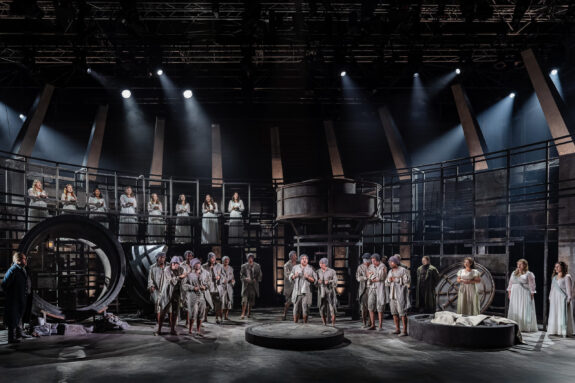
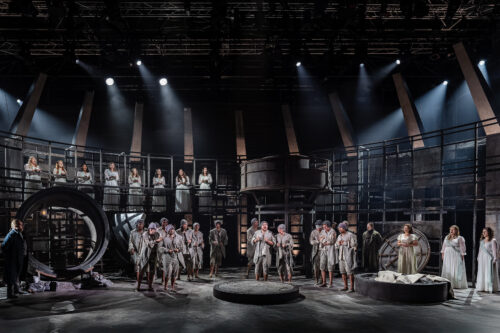
The production is not simply an exercise in exact historical recreation, however, as the action takes place within a much more modern barricade or prison rampart, albeit grey and somewhat rusty, with a watchtower in the middle, embodying a modern, dystopic tyranny – and goodness knows there are enough of those in the world today. But the generalised atmosphere of oppression is free of comment upon any particular context within the world at large. As such it doesn’t limit our focus; rather, the sharp contrast between the characters from Beethoven’s original drama and the contemporary setting into which they are displaced – or as though those original characters are stuck in a recurring round of oppression – leaves us free to ponder what seems to be the perennial question of the arbitrary and ruthless exercise of power by some of those who hold it. That said, just as with Cox’s The Marriage of Figaro also seen in recent seasons at Garsington (in 2024 and a few times before) – and an opera also dealing with revolutionary themes, even if in a civilian context – it is not the lofty notion of freedom which is foregrounded as such, but the emotional and personal relationships of the figures caught up within the situation of the drama. They are generally brought out with fine, sympathetic detail in Jamie Manton’s assiduous direction of this revival, at least in Act I and particularly in the wonderfully veiled sound of the quartet; the second act tends to be more static.
If there is any overarching, abstract idea, though, it is that of hope, in a liberated world more at one with a natural and just order. That picks out a theme which Beethoven and his librettist seem to have regarded as of virtually equal importance with liberty in this opera since not only does Leonore famously sing about it (‘Komm, Hoffnung’) as the principal part of her memorable scena towards the end of Act I, Marzelline also apostrophises it (in her more skittish manner) in the major key section of her aria ‘O wär, ich schon mit dir vereint’.
At the opening of the drama, Marzelline tends to the plants which sit on one of the covered openings to the cistern below, where the prisoners are incarcerated, symbolising renewal and recovery. Tellingly, after Rocco’s humorously petit bourgeois-minded aria ‘Hat man nicht auch Gold beineben’, giving advice to her about money being an important source of happiness for married life, a bag of coins is placed within the soil under the plants, making the (nevertheless) point that freedom and fulfilment don’t come from good intentions and elevated sentiments alone, but require the security and distribution of material resources to make those work for all. Hope for liberation is poetically and strikingly enacted in the prisoners’ emerging from the dark cistern (here beneath the stage) and groping towards the real light (blazing summer sun during this performance) and gardens of the Wormsley Estate seen beyond the transparent sides of the auditorium once the blinds are dramatically lifted to afford the prisoners that vision in a way that typical opera houses are not able to stage.
Musically, Douglas Boyd oversees an urgent account with The English Concert. After a somewhat lacklustre and broad way with the Overture, they bring a raw, insistent edge to the score. It brings a dramatic, Mozartian liveliness to the numbers of Act I dealing with Marzelline’s comically unfortunate love triangle between her, Jaquino and Fidelio. But contrastingly, evil is well depicted with the strings’ digging into their instruments to illustrate Leonore’s horror at ‘Abscheulicher! wo eilst du hin?’, and with the rasping textures of the dungeon scene which opens Act II. The tenacious pace of the performance is also helped by keeping the spoken dialogue succinct and leading on directly from the end of each number without letting applause cause tension to sag.
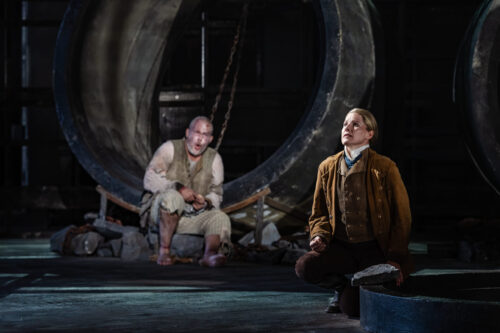
Robert Murray is first revealed as Florestan in that dungeon, hung up in chains within a cross-section of the cistern, bruised and emaciated, perhaps like a crucified Christ. After his resoundingly sustained ‘Gott!’, he falls a little underneath the note in his subsequent aria (with a somewhat weedy oboe solo too) but becomes more secure for ‘O namenlose Freude’. Sally Matthews brings out the human vulnerability of Leonore’s courageous, risky action with a nervous veneer in her interpretation, rather than an exactly forthright heroic account. If her wide vibrato somewhat obscures the clarity of her vocal lines (such as in ‘Komm, Hoffnung’, with milky sounding horns) she is certainly also bold and expressive.
Isabelle Peter is a charmingly coquettish Marzelline, matched with human interest by Jonathan Lemalu’s personable performance as her father, Rocco. Although Musa Ngqungwana’s Don Pizarro is not especially dark in tone or menacing in character, merely stentorian, his Act I duet with Rocco rises to more delirious fury. Oliver Johnston and Richard Burkhard give decent, more measured portrayals of Jaquino and Don Fernando respectively. Apart from a slightly garbled opening to ‘O welche Lust’, the Garsington Opera Chorus respond with more emphasis and enthusiasm elsewhere in this undogmatic rendition of Beethoven’s ode to freedom.
Curtis Rogers