
 United Kingdom Longborough Festival Opera 2025 [3] – Debussy, Pélleas et Mélisande: Soloists, Longborough Festival Orchestra / Anthony Negus (conductor). Longborough, Gloucestershire, 28.6.2025. (CP)
Production:
Director – Jenny Ogilvie
Designer – Max Johns
Costume designer – Anisha Fisher
Lighting designer – Peter Small
Associate director – Alex Gotch
Associate designer – Alys Whitehead
Cast:
Arkel – Julian Close
Geneviève – Catherine Carby
Golaud – Brett Polegato
Pelléas – Karim Sulayman
Mélisande – Kateryna Kasper
Yniold – Nia Coleman
Doctor and Voice of a Shepherd – Pauls Putnins
Servants – Ariathney Coyne, Mak Korda, Rebecca Wield
Taking advantage of the shade of a fine oak tree on Longborough’s hottest day of the year, an East Coast American visitor was heard to remark, ‘nothing much happens on stage, just listen to the fine band and Debussy’s atmospheric music’. For the most part they were spot on! The fine band, as large as any this season at Longborough, led with remarkable assurance by Barbara O’Reilly, with Anthony Negus at the helm confirming the influence of Wagner on Debussy. In his work Debussy on Music, translated by Richard Langham Smith in 1977, the composer writes ‘my method of composing owes nothing to Wagner. His calling card – his leitmotiv must always precede him – this procedure I find gross’. With many a ‘Tristan chord’ and references to Parsifal in this, Debussy’s only opera, many will disagree. Debussy is indebted to both Impressionism and Symbolism and sought freedom of expression. He set particular store by tonal colour and was an advocate of the concept of silence as a dramatic device – one of his lasting innovations. The band responded well to these requests in their interpretation of this impressionistic work.
Critics heaped praise on Peter Small’s lighting of Longborough’s current production The Barber of Seville. With Small again in charge, the lighting plot is very, very difficult to understand; it is hard to imagine a less monochrome production, due to both the set design and the lighting used or not used. Perhaps Glyndebourne’s recent Parsifal runs this close!
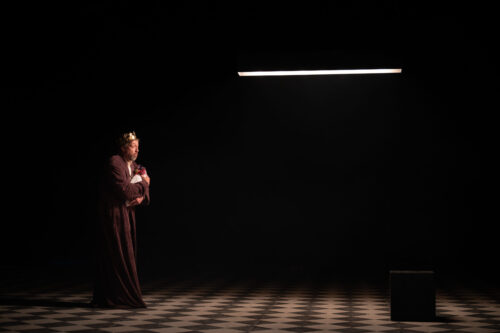
Both productions relied on the voices on the stage and a terrific orchestra. The ‘castle effect’, designed by Max Johns, is the reverse of the Barber set and will probably be used for Dido later in the season. Yes, sustainability matters, using resources responsibly is important; however, this set design prior to the interval found Brett Polegato as Golaud, older half-brother of Pélleas, so far ‘upstage’ in the dark that his baritone voice barely carried beyond the first dozen rows. Designing lighting requires a thorough understanding of the narrative and aesthetic before translating ideas into a visual representation. Perhaps the thinking was the single constantly moving orange lamp suspended from above and the strip light on the floor were designed to focus attention on the intensity of the relationships of the characters. The significance of the auditorium suddenly being flooded with light in the midst of the second half remains unexplained.

Kateryna Kasper, making her Longborough debut with her fine soprano voice, catches the eye immediately as Mélisande. Her experience of a decade with Opera Frankfurt equips her for both contemporary and traditional roles. She carries the show and manages to sing splendidly from her death bed – not an easy task for some! Her audience is expected to imagine she has long hair – she doesn’t. The costume designer Anisha Fields and director Jenny Ogilvie will be forgiven for this as her singing is exquisite. She commands the stage when necessary, showing a softer side when negotiating with Karim Sulayman singing Pélleas, her potential lover in the tragic and often unspoken love affair. What could be a simple tale of a love triangle isn’t. Golaud, believed to be a man of reason, gives a remarkable exhibition of a senior tantrum before eventually killing her. In contrast, the immature Pélleas fails to show his feelings for Mélisande until it is too late as her light is extinguished. Sulayman, also making his Longborough début, displaying all the Pélleas characteristics of an individual struggling to take decisions. His tenor voice is not strong; at times he was overwhelmed by the confident sound emanating from the pit. He does show the necessary sensitivity when Mélisande loses her ring in the well depicted as an assortment of silver foil sheets. Without her long hair he has a problem attempting to unravel Melisande’s tangled long locks – they weren’t! Three castle servants, the foil deliverers, have significant other jobs as scene-shifters and lighting device installation and removal; they were kept very busy!
As for the rest of the strong cast, bass Julian Close makes a particularly welcome return to Longborough. His stage presence as Arkel is immense and many in the audience will remember his performances as Hagen in recent years. His deep voice and Kasper’s soprano could be heard clearly throughout the performance. Soon after the interval the lighting of a series of enclaves in the castle walls presented a more inviting ambiance with little loss of the evocative characterisations. Nia Coleman sings the role of Yniold intelligently. In this opera he is Golaud’s son from a former liaison. Taking advantage of these recesses, Yniold acts as the child spy reporting on the fragile relationship between the lovers. His trapped golden ball is imagined, so too, the flock of sheep. Mélisande eventually faces up to a brutal, berserk Golaud who finally kills the indecisive Pélleas. Throughout the drama the orchestra with its fine horns, double harp and driving strings responds to the urgings of Anthony Negus, someone capable of translating Debussy’s keen interest in theatrical projects into an emotion-charged story.
The East Coast American proved to be accurate in their assessment; the music made all the difference!
Clive Peacock
Spot on . I found the lighting distracting and ineffective . Your summary of the voices unarguable and the set was badly used in the first half . Orchestra superb!