 United Kingdom NT Live – Molière’s The Misanthrope (by Martin Crimp, after Molière): Filmed (directed by Christine Lalla) during its run at the Lyttelton Theatre, Royal National Theatre, London, broadcast in cinemas from 22.9.2026, and viewed at Cineworld, Newport, Isle of Wight. (DH) ****
Tony Harrison prefaced the Bloodaxe edition of his Dramatic Verse with Lion Feuchtwanger’s poem ‘Adaptations’. Feuchtwanger wrote it directly after his experience of collaborating with Brecht on their version of Edward II ‘after’ Marlowe in 1924. ‘I use/ Old material to make a new play’, he boasts, ‘and before/ The name of the dead writer I put the little word “After”’. The result? One group of critics calls him ‘respectful’, another says he’s nothing of the kind. Every failure is charged to the adaptor and every success credited to the dead writer, of whom nobody can be sure wasn’t an adaptor himself. You turn the page in the Harrison book, and you’re plunged into his brilliant text of The Misanthrope (which, after that fantastic build-up, he disappointingly called a ‘version’), staged by the National Theatre in 1973. Harrison used iambic rhyming couplets in his updating of the action of the play to 1966 and the de Gaulle presidency. Arguably it was the most successful UK staging of the play in the 20th century. Critics didn’t seem to have received the Feuchtwanger memo though. Contemporary reviews praised both Harrison’s clever modernisation and witty verse and Alec McCowen and Diana Rigg’s deft handling of it.
For all its sparkle, the Harrison version didn’t seem to take flight when revived by the National in 1989 and it wasn’t until June of this year that the company staged an entirely new version. Martin Crimp was given the task of reimagining the play for contemporary audiences and, as Faber’s delightful tête-bêche double edition of the texts shows, it is his second rendering of the play. The first was successfully staged at the Young Vic and later in a West End production with Damian Lewis as Alceste, conceived of as a successful playwright. It worked well, and my assumption when I saw the announcement of this production was that it would be an updated version of that text. It is completely new, however.
Crimp was dissatisfied with his earlier version because he says he had wrongly thought of it then as a ‘personal’ play and ‘accepted the myth that the actor-writer was himself a kind of outsider’. Further, in adopting the convergence between Alceste and Molière, on which his first adaptation is predicated, he assumed that ‘the misanthrope’ had to be a man. Director Indhu Rubasingham, however, suggested a female lead to Crimp for her new production, an idea that he says led him to read the play in a new direction. This he does: inventively, wittily and, for the most part, topically. He keeps the original’s five-act structure, the ‘misanthropy’ and the satire, but things get interestingly loose after that. As before, he uses rhyme, more freely but just as ingeniously as Harrison, and it is propulsively dramatic. Here Alceste has become Alice, a famous novelist, reacting against the pretentious vacuity of the world around her. Unfortunately for her, it is not just the oh-so-grounded world of publishing she has to contend with. She is in a relationship with a younger actor, Stefan, a recovering addict emerging from a very messy divorce, and so the world of theatre, film and TV is also there for Crimp’s deflationary virtuosity to exploit.
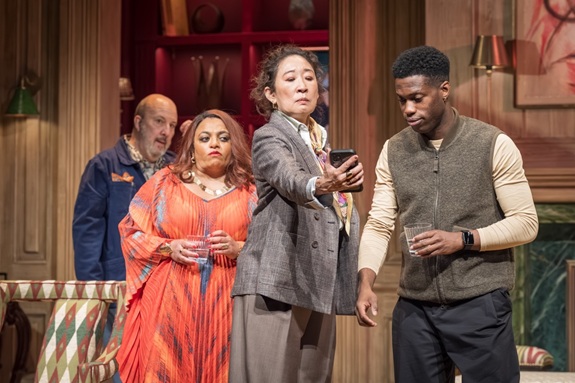
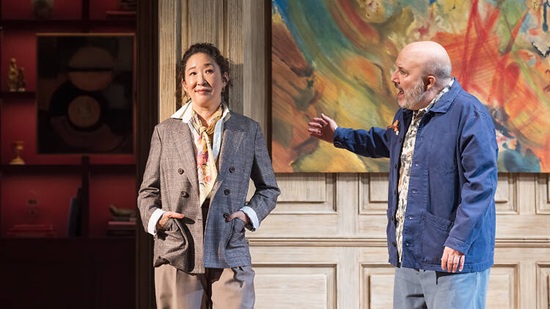
For all the very funny disregard shown for some contemporary theatrical methods in the play (a loosely disguised Simon Stone comes out of it very badly for daring to ‘devise’ classic texts in a spinning glass-box), Crimp has clearly worked very closely with Rubasingham and her cast. The fit is perfect. A lot depends on Sandra Oh’s Alice. She manages to be a completely credible ‘misanthrope’. Her withering criticism of Esmée’s (Imogen Elliott very good as a privileged, talentless BookToker) cliché-laden novel — for example, ‘Can I ask you a question? What is a “humble kitchen”?’ — is hilarious, painful to watch and well-argued. So is her put-down of Stefan’s ex-wife Elaine, who foolishly admits to Alice that she reads Alice’s novels to escape from reality. But Oh also manages to convince us that her principles are meaningful — she is not just toying with people for the sake of it — and that she is one of the few characters in the play who has an emotional centre. The way she knowingly allows herself to be gaslit by Stefan when Elaine shares an incriminating voice message with her is both authentic and devastating. Tom Mison’s Stefan most definitely has no core at all. He is chilling, an unapologetic narcissist, compelling in every scene he is in, every inch the ‘dead star’ Alice labels him as towards the end of the play. Paul Chahidi as John is also excellent. Both a crutch and a foil to Alice, he exudes a warmth conspicuously lacking from almost everybody else, so that when he fails to follow Alice in rejecting the smug, superficial artistic milieu in the play’s final moments we feel both shock and regret.
Indhu Rubasingham’s direction is intuitive and authoritative. There is an irresistible momentum to every scene. She gets the comic architecture, of course, but there is a hint of something darker, too, almost omnipresent, especially in the scenes between Stefan, Alice and Elaine. When Elaine (Jemima Rooper) makes her appearance in the third act, for example, we meet her as a successful conductor of an orchestra in Paris. Enough groundwork has been laid here to make the audience think that Todd Field’s Tár might be in for some rough treatment, and goodness knows if ever a film opened itself to parodic exploration it is that one. But instead Rubasingham sets an almost Strindbergian dynamic with Rooper scathingly effective in setting out Elaine’s complaints against Stefan only to be met with Mison’s almost bloodcurdling selfishness.
The staging of the ending is also superbly realised. And here as elsewhere the NT Live Broadcast Team do a wonderful job of helping us experience it vividly in the cinema. The conceit is that Stefan is throwing a sort of costume party to celebrate the publication of Alice’s novel, set in the time of Louis XIV, and of course Molière. (The novel as described by John earlier incidentally sounds simultaneously terrible, ‘this one long unpunctuated THING’, and a sure-fire Booker winner, but no matter.) Rubasingham stages a magnificent parody of a baroque celebration. Robert Jones’s detailed set flies upwards, chandeliers descend, synthesisers play a grotesque, alienating parody of pastiche Lully (provided by the brilliant composer Anna Meredith no less) and the cast do an approximation of a courtly dance. It is rampant phoniness — a nightmare in fact — and everyone except Alice has bought into it.
You come out of the cinema wondering what, if anything, is ‘authentic’ and how complicit we are in what Crimp suggests is at best widespread insincerity, at worst downright fakery, and how much it matters. And you could ask similar questions vis-à-vis modern productions of Molière I suppose. Is there a real, a correct way of staging him? There is no question that it is perfectly possible to use pretty much every word of Molière’s text and come up with a viable modern realisation. For proof look no further than Lilo Baur’s hilarious production of L’Avare, which is just about to re-enter the repertory at the Comédie-Française, set in Switzerland where Harpagon is a Trumpian banker. Easier perhaps to do it in French, but actually Harrison was also pretty faithful to the original in 1973. Crimp’s approach flies too though. He describes it as ‘after Molière’ but again proves Feuchtwanger’s maxim to be fallible. The validity and brilliance of the execution belong to him, Rubasingham and the company. But it would not exist without Molière. As John, absurdly dressed as the playwright in Act V, says ‘I’m Molière. Do you not spot the likeness? / Charming? — witty? — super-smart? / cutting-edge — obviously — when it comes to art?’ If that’s not a neat tribute, I don’t know what is.
You can find your nearest screening at NTLive.com (click here).
Dominic Hartley
Featured Image: Paul Chahidi (John), Rina Fatania (Indira), Sandra Oh (Alice) and Freddie MacBruce (Allen) © Marc Brenner
Cast:
Alice – Sandra Oh
John – Paul Chahidi
Stefan – Tom Mison
Claire – Abigail Cruttenden
Esmée – Imogen Elliott
Indira – Rina Fatania
Allen – Freddie MacBruce
Elaine – Jemima Rooper
Benjamin – Teddy Holton-Frances
Madeleine – Poppy Townsend White
Creatives:
Director – Indhu Rubasingham
Set and Costume designer – Robert Jones
Lighting designer – Tim Lutkin
Composer – Anna Meredith
Sound designer – Alexander Caplen
Movement and Intimacy director – Lucy Hind
Fight director – Kate Waters
Associate Director – Gitika Buttoo
Associate Set and Costume designer – Ethan Cheek
Broadcast Team:
Camera director – Christine Lalla
Sound supervisor – Conrad Fletcher
Script supervisor – Stephanie Rose