
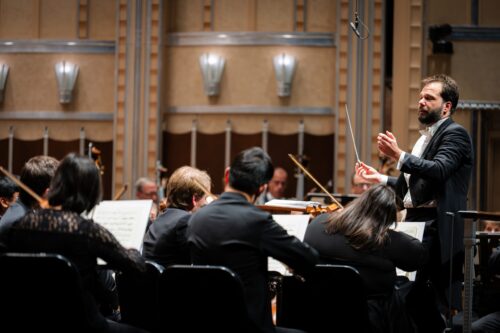
 United States Haydn, Mahler: Cleveland Orchestra / Petr Popelka (conductor). Mandel Concert Hall at Severance Music Center, Cleveland, 30.10.2026. (MSJ)
Haydn – Symphony No.80 in D minor
Mahler – Symphony No.5 in C-sharp minor
Speculation about who is to become Franz Welser-Möst’s successor in Cleveland has been heating up. Czech conductor Petr Popelka made it clear in interviews with local media before his two weekends of concerts with the Cleveland Orchestra that he regards these performances as a job interview. So, how did he do? No one-word answer will suffice.
Having heard Popelka as a guest three times, it is obvious that he thoroughly knows the scores he conducts. He has strong concepts and mostly delivers on them in performance. He is a master of the dramatic pause, and conducts quiet, intimate music with intensity. The problem that keeps returning in Popelka’s performances could be described as an excess of good taste. Simply put, he restrains everything marked above forte and seems unwilling to cut the music loose. Make no mistake, his Mahler Fifth was good except for that constant governing of the brass and percussion. But any performance of this work which makes Christoph von Dohnányi and Franz Welser-Möst’s Cleveland performances look freewheeling by comparison is too restrained.
Excessive politeness was also an issue in the first work of the concert, Haydn’s Symphony No.80. One could argue that Mahler No.5 is a big enough work and doesn’t need a program mate, but one can’t complain about a chance to hear one of the less-familiar Haydn symphonies. No.80 matches with the Mahler inasmuch as it starts in the minor and ends in the major, but its world is very different, not least in the much smaller orchestration. It may well be one of the works influenced by Haydn’s theatrical work in the 1770s and 1780s for the entire first movement is a well-sprung setup gag: the opening music is highly dramatic although Popelka arguably understated it. After a tense pause, the composer completely undercuts the apparent seriousness with a flippant close of the exposition section. Popelka never rushed the pauses, giving the work its full comic timing so that it still worked delightfully. The Adagio movement was elegantly unfolded, though the following Menuetto was arguably a little ponderous. The Finale: Presto also felt a touch restrained for a composer who loved to tease both audience and players. All-in-all, it was a solid performance of rare repertory that would have been better if the conductor weren’t always erring on the side of caution.
After intermission, the performance of the Mahler got off to an imperfect start with a wayward opening fanfare, but it is a notoriously naked start. These things happen. What is more important is that this blip didn’t prevent the orchestra from strongly establishing the symphony’s expressive world. Rhythms were subtly sprung so that the music’s tread was solemn but not heavy. Popelka showed insight when the second appearance of the lyrical subsidiary theme was more urgent than the first time. But the first disappointment came with the sudden acceleration marking the beginning of the development which wasn’t all that explosive in this performance. In his renditions (and in his Decca recording), Dohnányi demonstrated that the passage could be controlled in tempo but still burn. Popelka seemed more concerned with not hitting the passage too hard that early in the work. While long-term planning is good, the problem that emerged was one of Popelka restraining things over and over again at virtually every climax. Is this his absolute view of the work, or was he trying too hard to appeal to the vaunted Cleveland Orchestra poise? One hopes that the orchestra will never lose that inner coherency, but it is not a one-trick pony. They can blow the roof off when appropriate, and if it isn’t appropriate in Mahler, when is it? Mahler is the fellow who, when confronted with Niagara Falls, reportedly exclaimed, ‘At last, a true fortissimo!’ If he writes for a passage to be loud, take him at his word.
It became even more of an issue in the second movement, the part that made the great German conductor Wilhelm Furtwängler swear off ever conducting Mahler’s Fifth because he couldn’t face the music’s ‘nihilistic’ ending. While it may not be true nihilism, the movement definitely tears apart its own attempts to rise up to brightness … or, at least, it should. Popelka, unfortunately, restrained any attempt by the brass or percussion to show strength, inhibiting what should be a hair-raising experience. Right in the middle of it, however, was a glowing passage performed to perfection: the slow recitative passage for the cellos. The performance suddenly snapped to emotional attention as the conductor encouraged the low strings to dig into a rich, burnished sound after a breathtakingly quiet start. In that kind of music, Popelka strikes gold.
The third movement was better, as Popelka encouraged the players to spring rhythms, turning what can be a leaden ländler in some hands into a careening waltz for giants. Alternately playful, graceful and anxious, the movement unfolded with a fine balance of spaciousness and forward drive. Nathaniel Silberschlag played his solos standing at the head of the horn section, unlike in 2019 when Franz Welser-Möst had him come downstage to stand by the podium. The position made little difference for Silberschlag filled the hall radiantly. His solos and the pizzicato string interludes were redolent with emotion, although the closing of the movement was, again, kept on too tight a leash. Woodwind principals Joshua Smith (flute), Frank Rosenwein (oboe), Afendi Yusuf (clarinet) and John Clouser (bassoon) offered gleaming but characterful solos as well.
The highlight of the concert came in the famous Adagietto where Popelka thrived on the music’s intimacy and encouraged the Cleveland strings and harp to play like their lives depended on it. It was magnetic, gorgeous and emotionally compelling, proving that Popelka can make glorious things happen in the right music. The following Rondo finale (played without pause, unlike the break between the first two movements) started at a good pace and gained momentum from there, with Popelka finally letting the orchestra loose in the closing pages which were negotiated with nimble flair. The audience response was highly enthusiastic.
As job interviews go, it was fair, although not a clincher. Popelka will follow with Brahms’s German Requiem next week while fellow contender Santtu-Matias Rouvali comes to town soon with Richard Strauss’s Heldenleben. Local media thinks it is down to a battle between these two.
We’ll see.
Mark Sebastian Jordan
Thanks so much for this thorough and thoughtful report, which I’ve been anticipating all weekend. While I’ve been living in Philadelphia for 38 years, I grew up in Cleveland and it’s still what I think an orchestra should sound like. Pity about the over-restraint, though if you had to deal with Yannick N-S regularly, that might be more welcome! I look forward to your report about Rouvali, whose work last year in Philadelphia I enjoyed.
That’s a fair enough point about YNS, but after twenty years of Dohnányi and twenty-five of Welser-Möst, I’m tired of restraint. There’s more to music than just reserve. What I’d like to see is a conductor who can maintain the orchestra’s poise, while letting them play powerfully more often. Tricky task, to be sure.
I’m fascinated by Rouvali (who will be back soon). He can be amazing at times, then he’ll do something bizarre for no apparent reason. But he at least gets the idea of balancing the CO between poise and power.
If the orchestra sounds terrible, as Philadelphia does often under YNS, less restraint isn’t a virtue. I can imagine that 25 years of FWM might make one think otherwise! Lord knows I was done with YNS three years go, when he’d only completed 11 here. FWM was a regular here before he landed Cleveland, and he clearly wanted to be Sawallisch’s successor. But the PO was obsessed with Rattle, which of course never happened, and we wound up with Eschenbach, which was a disaster. Funny enough, the young FWM I heard in Philadelphia could be pretty intense at times. FWIW, late Sawallisch, when he became more emotional after his wife’s death, was the greatest sustained, ongoing musical experience of my life.
Popelka is still relatively inexperienced, and I’d be very surprised he’d be able to start both an important opera house and a major orchestra successfully at the same time. Maybe go with Rouvali and make PP principal guest?
Thanks for your review!
The Sunday afternoon concert felt the same as was described in this review. The Haydn was lifeless and the the Mahler was timid – very disappointing. I hope for better with the Brahms.
Thanks Mark for an excellent review as always! I attended Sunday’s ‘audition’ and came away less than impressed. The Mahler 5 was way too refined; the complete opposite of Klaus Mäkelä’s glorious Mahler 5 with TCO three years ago. The Haydn was the same; it just didn’t quite come to life.
Your take on Rouvali is spot on! I am super excited to see him with Ein Heldenleben in a few weeks, especially after that nearly flawless Schubert 9 he led TCO last spring.
Hoping a decision is made soon on the next Music Director. It is safe to say we are now in crunch time! I do not envy the decision makers, such an awesome task!
Who else is on the list being considered? Additionally, do you know who made the recommendations for the particular ones? Daniele Rustioni came twice to conduct here and he is fantastic. Is he on the list?
I wish I knew the answers to those questions. All I can do as a critic is to give my own perceptions and summarize what I hear elsewhere. The Cleveland media seems to think it’s down to Popelka versus Rouvali, but that too is just speculation. Rustioni received mixed reviews and isn’t considered a frontrunner by most commentators. If it were left up to me, I’d opt for Manacorda, though he’s not a high-profile choice. I think he’s a stronger interpreter than either Popelka or Rouvali, and he has been back a few times, but he’s not on this year’s schedule, which suggests he’s not being looked at any further. It could indeed be down to Popelka or Rouvali, but I wouldn’t rule out the possibility of a surprise candidate emerging late in the running. Only time will tell.
My sense from one state over (who can read cleveland.com on Apple News) is that the Cleveland media says what the orchestra administration tells it to. Moreover, this week it sent Adella subscribers (I am one) an email urging us to watch the next two streams, Popelka and Rouvali, in a way they haven’t done so before.
Rustioni, fwiw, seems to have crept into a position in Philadelphia where he’ll be a candidate to succeed Yannick.
If negative reviews were a factor for the Cleveland Trustees and Management, the last three MDs wouldn’t have been appointed. The obvious choice is Rouvali. Cleveland has bypassed several candidates and they landed elsewhere. I’m not suggesting these would have been better choices, but Rouvali (and perhaps Rustioni) can generate a bit of audience enthusiasm that’s been so lacking in Cleveland particularly pre-COVID.
Rouvali is not perfect, and as MS has noted, he tends to take long pauses. This is particularly evident in his Sibelius recordings, but perhaps as a Finn that’s his prerogative. However, he has had some success in Cleveland, is available and would probably be willing to take up residency in the Cleveland area. Despite his lack of opera experience, which has always been a major factor for Cleveland, he’s the leading contender. Not my personal top choice, but an improvement over the incumbent.
Thanks so much for your reply. I am stunned that Rustioni got a mediocre review. I find him to be a wonderful musician, and the orchestra sounded great under him. I live in Cleveland, and this year I only bought tickets for Stephen Hough in recital. Last year we went to concerts F W-M didn’t conduct. I find him a mediocre musician at best and I am at a loss understanding how or why he was retained here 24 seasons. My other gripe with the Cleveland Orchestra is that they keep inviting the same soloists like a revolving door (Ohlsson has been here 3 times in the last 2 years) or they bring NAMES rather than top artists. When a guest cancels, the audience is never given a reason why; you cannot return the tickets and get a refund either. You are forced to accept what they serve. Since Pittsburgh is close by, we have started going there instead. On the 29th we are going to hear my beloved Malofeev with Honeck!